


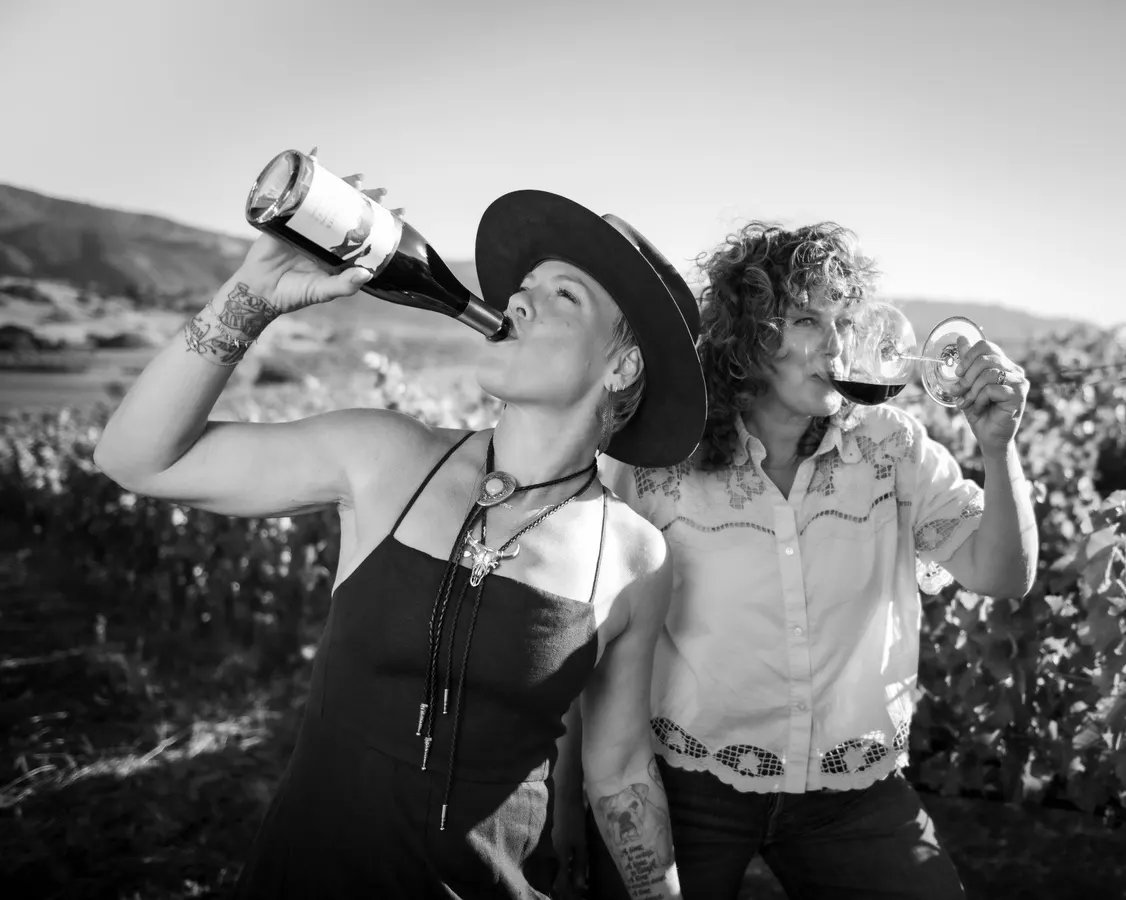
Two Wolves Winery is named after a Cherokee legend about balance. P!NK shares she is trying to get her winemaking partner, Alison Thomson, to the dark side.
Two Wolves Wine
Celebrity wine labels are not rare. The category has swelled over the past two decades into something the industry regards with a kind of weary eye-roll. The arrangement is simple: a famous name, a contracted winery, a label designed by committee, and a bottle that sells on recognition rather than merit. “It mostly sucks,” Alecia Moore—owner of Two Wolves Wine—tells me as we sit together tasting her wines. “It’s just a money grab.”
She says this without irony. She is, after all, talking about her own category—and she knows exactly what separates her from it. “I was worried that people would think I was a clown,” she says. “Just another celebrity that wanted to slap her name on a bottle and hire Michel Rolland and make a $200 bottle of wine and call it a day.” She pauses. “I really rolled up my sleeves.”
That is an understatement. Moore—better known as P!nk, three-time Grammy winner, one of the best-selling artists of her generation—bought an organic vineyard in California’s Santa Ynez Valley in 2013, sight unseen, while on tour in Australia. Her first vintage was 2014. For years, she told almost no one.
She Studied Wine Backstage on Tour—Then Bought a Vineyard She’d Never Seen
Moore did not grow up drinking wine. “I used to think wine was punishment at holiday dinners, because it was so bad.” The turn came in her twenties, when a new management team—men who loved good wine and had the budget for it—began taking her to serious restaurants on tour days off.
They’d escape venues and hotel gyms to visit wineries. “When you’re traveling like I travel,” she says, “how is Budapest? The steam room in the hotel gym was broken, and the venue looked just like the one in Bucharest.” Visiting wineries on the road became her way out of the loop.
Château Beaucastel stopped her in her tracks. “It stops a conversation,” she says. “You’re like, wait—what’s this?” She signed up for Wine and Spirit Educational Trust courses, then UCLA Extension.
“Good night, Sydney!” she’d call from the stage, then sprint backstage, open her laptop, set up her wine glasses and start studying.
“I’m a high school dropout,” she says, “but I think education is wasted on the young. We need to find pieces of ourselves before we can really dig in.” She found hers.
Her night job allowed for daytime global wine immersion. She visited Peter Gago at Penfolds Wine, went down into the cellars and heard about the secret Grange. She spent time with the late Charly Foucault at Clos Rougeard in Loire Valley, whose Cabernet Franc became one of her north star wines. She went to the cellar cold, with a translator. Foucault pretended to speak no English for two full hours while she asked every question she could think of. Then she asked the right one. “He just broke out in fluent English,” she laughs. “And I was—get out. This whole time he was testing me.” She asked if she could have his once-used Cheval Blanc barrels. He said no. “I was like, great. Let’s eat.”
She and her husband Carey Hart had been riding motorcycles up to Santa Ynez for twenty years—wine tasting their way down the street, shy at the beginning of the block, a party at the end.
Why Santa Barbara County? “I loved the farmer mentality and the humble nature of being in a wine region that not enough people know about.” She was in Australia on tour when she found the property online. She sent Carey home to look at it. She bought it sight unseen. “It turns out there are no accidents,” she tells me. “I’m now the custodian of one of the most magical pieces of land in the world.”
Alecia Moore—better known as P!nk, three-time Grammy winner, one of the best-selling artists of her generation—bought an organic vineyard in California’s Santa Ynez Valley in 2013, sight unseen, while on tour in Australia. Her first vintage was 2014. For years, she told almost no one.
Two Wolves Wine
P!nk Was Terrified the Wine World Would Never Take Her Seriously
Moore never intended to release wine. She made it in a refrigerated garage, starting with a single macro bin, because she loved it and wanted to learn. Winemaker Alison Thomson was brought in as a partner and co-winemaker after what Moore describes as a stealth dinner party interview.
“She didn’t know it was an interview,” Moore says. “She just thought I was the most curious person she’d ever met.” Thomson immediately felt the pull. “As soon as we started working together, it felt like home,” she says.
After years of secretly making wine together, Thomson forced the issue. “She made me,” Moore says. “I was never going to release the wine. We ran out of room. I was like, donate it to school functions.”
Moore was held back by fear. “I had a deep need to be accepted by the wine community, and I don’t know why that is. I’m not a person that needs to be accepted—ever. But with wine, I really wanted to be given a fair shake. I wanted to do the work so that I could be given a fair shake.” Something quieter surfaces. “I have such thick skin, but the thickest skin is just covering up the mushiest center. I’m so sensitive, really, truly.”
The wine community received her.
“Literally every single person threw their doors wide open for me, with no judgment—maybe preconceived notions, which were quickly thrown away.” A year in, she pulled over on a motorcycle ride in Santa Ynez and sobbed on the side of the road. Carey took 30 minutes to notice she wasn’t behind him. “I was like, I don’t know what I’m doing. No one’s ever going to take me seriously.” He told her to give it another year. She did.
The story, as she tells it: A grandmother explains to her granddaughter that two wolves live inside each person, at war. One is greed, envy, anger, jealousy, selfishness, fear. The other is curiosity, compassion, generosity, love. The granddaughter asks which wolf wins. The grandmother answers: The one you feed.
Certified Organic Since Day One—and She Has a Blunt Reason Why
She purchased a certified organic vineyard—a foundation she has deepened steadily since. Moore is frank about why it matters. “You hear horror stories of a vineyard worker that got cut with pesticides in his leg, and now he’s an amputee. Real stories.” She lives on the land with her children. The stakes are not abstract.
Thomson, who studied restorative ecology before wine, thinks about the farm as a system. “How do we make this the healthiest system in our vineyard, but also have a positive effect on the surrounding area?” Cover crops to support beneficial insects. Native plantings. Owl boxes and bluebird boxes. Soil health as a long-term project. “That’s where it all starts,” she says. “Making sure that our soil is healthy—good drainage, good nutrients.” They are in a relatively isolated natural area, she notes, one with some of the highest bird densities in the county. “It’s a really beautiful, natural area. You put love into a vineyard, and it gives it right back to you.”
Moore is clear-eyed about what “sustainable” has come to mean—and not mean. “I heard a winemaker once say, ‘We’re sustainable. I pay my mortgage.’” She pauses. “I was like, wow. You’re an asshole.”
P!nk never had a female mentor, the music industry is filled with men. Two Wolves wine is the first project she had ever worked with women in charge, like her winemaking partner, Alison Thomson.
Two Wolves Wine
Only 14% of Women Winemakers Make It. She Built an Entire Team of Them.
Moore built the Two Wolves team with five women, and the reasons are less ideological than personal. “At UC Davis, 50% of the winemaking class is women. 14% become winemakers. One of the first comments ever made to Alison in a cellar was, ‘But you can’t pick up a barrel.’ Then you get a woman with children—that’s unhireable. Untouchable. ‘She’s gonna have a baby. She won’t be here all the time. I won’t be able to use and abuse this person.’”
Before Two Wolves, Moore had never had a female mentor. “There were no women really around me. I had all men, who are wonderful—but this was the first project I’d ever worked with a woman in charge. And immediately it felt like home.”
Friday lunches are mandatory. “When we gather, it’s sisterhood. It’s absolutely beautiful. I want to be able to come into the winery and bitch about my partner, and then have everyone in the room do the same. We need that space.”
Thomson, for her part, reflects on what the project gave her that she couldn’t find elsewhere. “There was a while when I thought I was going to have to leave the wine industry because I didn’t see that compatibility—didn’t see anyone who had young children and was working harvest. Alecia showed me that was possible. She allows that space for family.”
The Cherokee Story Behind the Winery’s Name
The winery’s name comes from a teaching story Moore has carried most of her life. She tells it with the care of someone who has thought about it for a long time.
“It’s a story that belongs to different tribes,” she says. “I always knew it to be a Cherokee legend.” She notes that Two Wolves sits on Chumash land.
The story, as she tells it: A grandmother explains to her granddaughter that two wolves live inside each person, at war. One is greed, envy, anger, jealousy, selfishness, fear. The other is curiosity, compassion, generosity, love. The granddaughter asks which wolf wins. The grandmother answers: The one you feed.
“It’s about balance,” Moore says. “We’ve got all of it—but what are we feeding today? One day can be better than the next.” She looks at Thomson, grinning. “She’s my partner wolf,” Moore says. “I’m trying to get her over to the dark side.”
She didn’t set out to build a legacy brand. She set out to learn. The wines—grown on 25 certified-organic acres in Santa Barbara County, made by a team of five women in small quantities—are the byproduct of a decade of earnest, difficult, joyful work. The Santa Ynez Valley has the highest concentration of female winemakers of any wine region in the world, per capita. Moore didn’t know that when she arrived, on her knees in January with a pair of pruning shears. She knows it now. She earned the right to.
















Leave a comment