


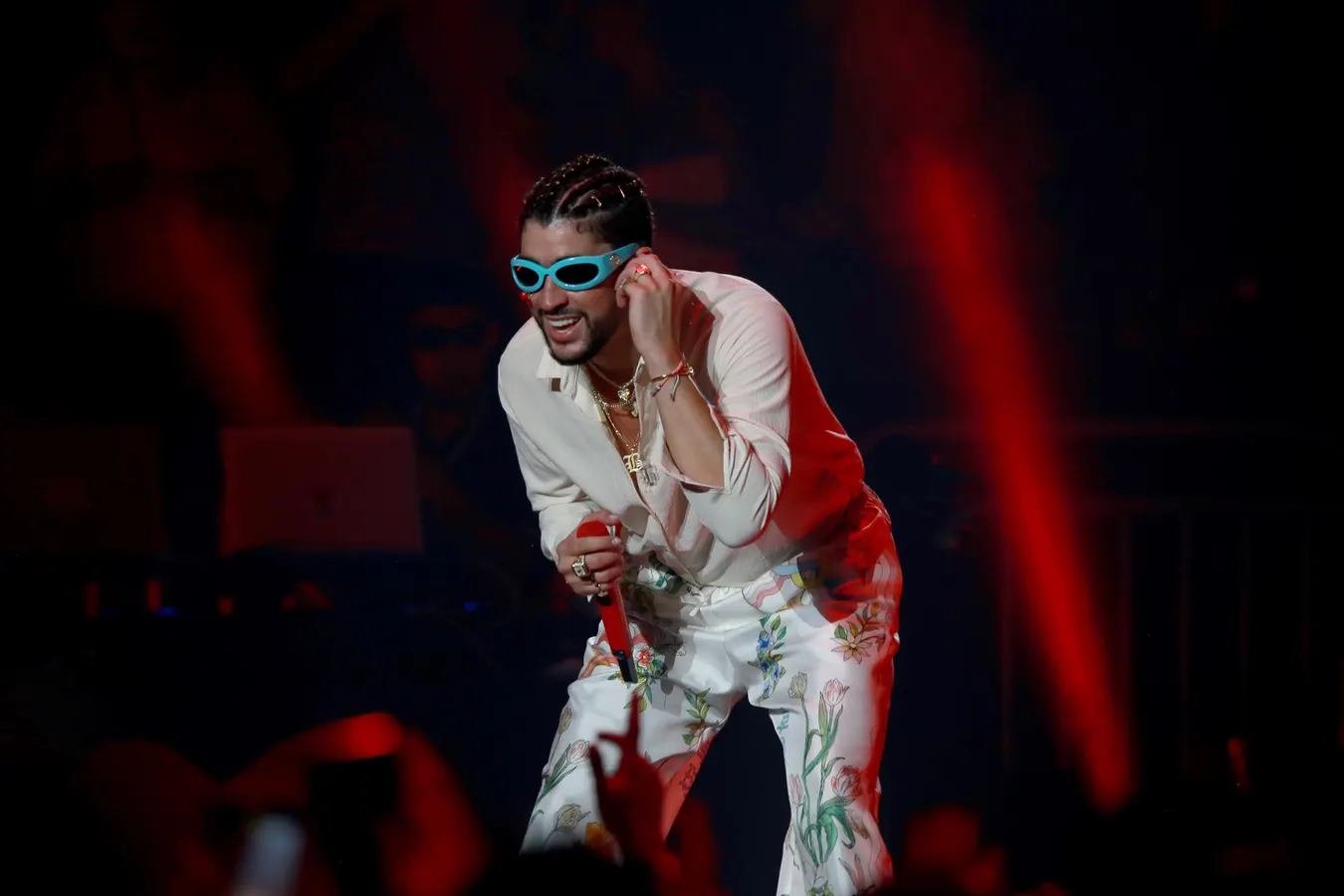

SAN JUAN,PUERTO RICO – JULY 28: Bad Bunny performs during his concert, “Un Verano Sin Ti” at Coliseo de Puerto Rico José Miguel Agrelot on July 28, 2022 in San Juan, Puerto Rico.(Photo by Gladys Vega/Getty Images)
Getty Images
Spotify turned 20 this week, and to mark the occasion, the platform did something it has never done before: release an all-time greatest hits list of its own data. Most streamed artists. Most streamed songs. Most streamed podcasts. And most streamed albums, which is where history was made.
Spotify’s newly unveiled list of the most streamed albums of all time has Bad Bunny’s Un Verano Sin Ti sitting at number one. Not Taylor Swift. Not Drake. Not The Weeknd, who managed to land three albums in the top 20. Bad Bunny. A kid from Vega Baja, Puerto Rico, who raps and sings entirely in Spanish, topped a global streaming chart on the platform that essentially defines the modern music economy.
Let that sink in.
The full top five most streamed albums of all time on Spotify are Un Verano Sin Ti by Bad Bunny, Starboy by The Weeknd, ÷ (Deluxe) by Ed Sheeran, SOUR by Olivia Rodrigo, and After Hours by The Weeknd.
Why This Rollout Was Always Going to Be Different
When Un Verano Sin Ti dropped in May 2022, the industry knew it was a moment. A 23-track, genre-bending meditation on Puerto Rican identity, Caribbean summer, and what it means to hold your culture and your commercial ambitions in the same hand — it wasn’t built to play by the rules of a traditional album rollout. There was no lead single designed to “set up” the album. There was no radio-friendly concession to crossover audiences. There was an ethos, a visual universe, and an unapologetic commitment to perreo and plena and everything in between. And it worked.
But longevity doesn’t happen by accident. The reason UVST sits atop Spotify’s all-time album chart — years after its release — is a masterclass in what happens when marketing strategy and cultural authenticity converge.
The Streaming-First Architecture
Un Verano Sin Ti was conceived as a streaming experience in a way few albums are. At 23 tracks, it rewarded repeat listens. Its sequencing mimicked the arc of a Caribbean summer — the heat, the heartbreak, the revelry — which made it an album people returned to seasonally, not just cyclically. Summer 2022 became summer 2023 became summer 2024. Every year, without a new rollout, without a press cycle, the album re-entered the cultural conversation organically because it was tied to a feeling, not a news hook.
That is not luck. That is architecture.
The team understood that in the streaming era, the most valuable real estate isn’t chart position in week one, it’s playlist permanence and algorithmic longevity. UVST became a fixture in summer playlists globally, in workout playlists, in study playlists, in “música latina” editorial slots that Spotify curates for hundreds of millions of users. Every one of those placements compounded over time into the number we’re looking at today.
Un Verano Sin Ti did not succeed because it crossed over into English-language markets by softening its edges. It succeeded because it made the world come to it. The album’s Grammy nomination for Album of the Year — a first for a predominantly Spanish-language record — wasn’t a reflection of the Recording Academy finally catching up. It was a reflection of the fact that UVST‘s cultural footprint was too enormous to ignore.
What Marketers Should Be Stealing From This Playbook
The temptation when looking at Bad Bunny’s numbers is to chalk it all up to cultural momentum , the kind of organic, unstoppable wave that you either ride or you don’t. But that framing lets the strategy off the hook.
Un Verano Sin Ti was a campaign built on a few principles that any music marketer should be studying.
First: commit to a world, not just a release. The album’s imagery — the beach, the retro Puerto Rican aesthetic, the sun-soaked nostalgia — created a visual identity that fans adopted and spread without being asked. User-generated content from fans who wanted to live inside the album’s world extended the rollout indefinitely.
Second: resist the reflex to explain. There were no long-form interviews breaking down the album’s themes for audiences who might not get it. The music trusted itself. That restraint is rare and increasingly valuable in an era where every release comes with an accompanying press tour designed to make sure everyone understands what they’re supposed to feel.
Third: build for replay, not reaction. The 23-track runtime, the tonal variety, the way the album moves from Tití Me Preguntó‘s comic bravado to Un Caro Río‘s aching tenderness — it is an album that reveals new layers on the fifth, tenth, fifteenth listen. In streaming economics, that is everything.
SAN JUAN, PUERTO RICO – JULY 11: Bad Bunny performs onstage during Night One of Bad Bunny: “No Me Quiero Ir De Aqui” Residencia En El Choli at Coliseo de Puerto Rico José Miguel Agrelot on July 11, 2025 in San Juan, Puerto Rico. (Photo by Kevin Mazur/Getty Images)
Kevin Mazur/Getty Images
The Bigger Picture
Spotify’s 20th anniversary list also confirmed that the most streamed song of all time on the platform is “Blinding Lights” by The Weeknd spotify, which tells you something about the staying power of pure sonic craftsmanship over trend-chasing. The most streamed album of all time being Un Verano Sin Ti tells you something different and arguably more significant: that the future of global music is not English-first, that streaming has genuinely flattened the old hierarchies of market access, and that a record rooted in specific, unapologetic cultural identity can outperform everything the Anglo pop machine produces.
For the music industry, this is not just a fun anniversary data drop. It is a directive. The artists and labels paying attention right now are the ones asking: what would it look like to build our version of a Un Verano Sin Ti? Not to copy the sound, but to understand the philosophy. Make something complete. Trust the audience. Build for return visits, not just first impressions.
Bad Bunny didn’t make the most streamed album in Spotify history by trying to win the most-streamed-album-in-Spotify-history conversation.
He made it by making the best possible version of what he actually wanted to make.
The numbers, it turns out, followed.











Leave a comment