


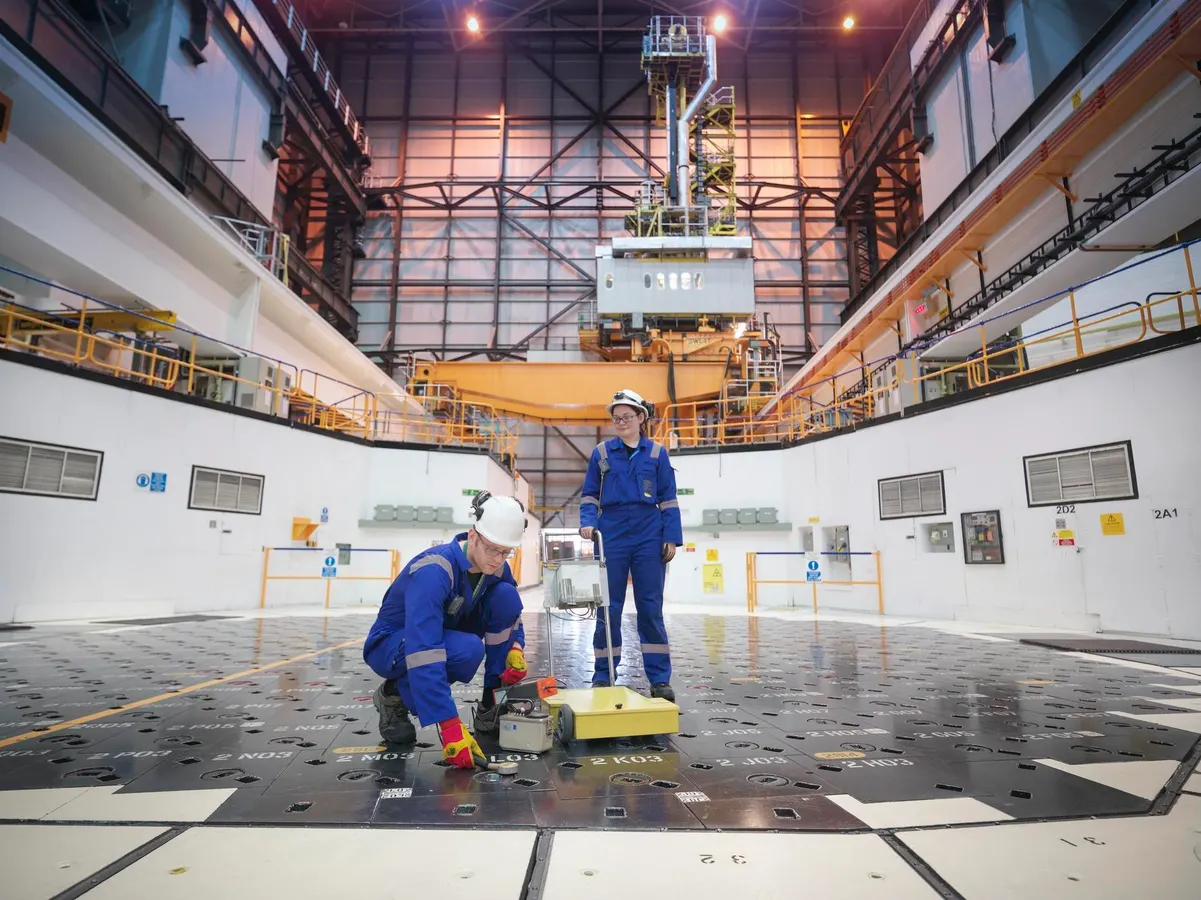

AI is driving demand for nuclear energy while also helping to unlock the tools to build it faster.
getty
The authoritative IPCC report makes it abundantly clear that we need nuclear power if we want to keep temperatures within the 2-degree limit, while also building data centers, electrifying everything, and lifting over 8 billion people into energy abundance.
Despite this urgency, nuclear reactors cost billions of dollars to build in the U.S., yet the global experience has shown that it is indeed possible to complete six to eight reactors per year at a much lower cost. “Other countries are already doing this,” said Kevin Kong, founder and CEO of Everstar. “We don’t need to break any laws of physics to do the same.” Instead, we need to focus on the four steps: standardize reactor designs, build in series, develop an integrated domestic supply chain and train the workforce, and align the regulatory environment to support volume while maintaining safety.
This approach worked in France, South Korea, Japan, and China. It even worked in the United States decades ago. Reintroducing it would not require reinventing nuclear technology, but rather restoring the system that allows it to scale. Pre-licensed domestic designs already exist, ranging from larger power plants like Westinghouse to smaller modular reactors from NuScale. What is missing is a consistent demand signal and large order books that enable serial construction. After all, building the first nuclear reactor in decades is likely to be expensive. Once experience accumulates, successive power plants can be built faster and at lower cost. Yet each nuclear project still confronts a maze of regulations and deeply manual workflows, with key information trapped in decades-old documents and filing systems.
The nuclear industry has a new and unusual ally: artificial intelligence (AI), which is capable of moving hardware at the speed of software. “Nuclear physics works, and the industry’s safety record is unmatched. What’s broken is the process,” Kong explains. “You might want nuclear today, but it will take many years before you get shovels in the ground.” His company’s approach is to apply AI across these bottlenecks, with the goal of making nuclear move at what Kong calls “the speed of national need.”
There are different types of AI models that can be employed to help build nuclear plants faster and more cheaply: language models, vision models, and emerging world and physics models. Each model addresses a different constraint in the system.
AI Language Models Read Documents
Much of nuclear work is, at its core, documentation, including regulatory filings, internal plant documents, safety analyses, and operational data. These documents are dense and technical. Processing them requires not just reading, but reasoning across standards, historical precedent, and real-time inputs. What would take a human lawyer or analyst hours can be processed quickly by a language model. AI can read complex regulatory guidance, standards, and data points, while understanding the relative importance of different documents, the hierarchy of regulations, and the context in which decisions are made. The result is a system that does not just generate text, but operates within the logic of the industry.
Consider monitoring the temperature of a lake adjacent to a nuclear facility. The water is likely used to cool the reactor and is returned to the lake at a higher temperature. The concern is that this increase might harm aquatic ecosystems, so it is strictly regulated. Determining whether the temperature increase falls within regulatory limits requires gathering sensor data, weather patterns, and historical baselines, then projecting them forward. If a threshold is exceeded, a regulatory filing may follow, potentially resulting in a multi-million-dollar problem for the operator. Traditionally, this type of analysis can take weeks. AI can do that in minutes, as it combines language reasoning with deterministic computation. The result is not just speed, but a shift in how engineers operate, spending less time parsing documents and more time making judgment calls.
AI Vision to Analyze Nuclear Blueprints
AI vision models interpret visual technical data. In nuclear facilities, schematics are everywhere, including piping and instrumentation diagrams, electrical circuit diagrams, and plant blueprints. Engineers must understand how components connect, how failures propagate, and what the downstream safety implications might be. “If component A breaks, B and C are downstream, leading to potential safety issues,” Kong explained.
Given a two-dimensional diagram, an AI model can identify components, map connections, and determine how a failure in one part affects others. Once relationships between components are understood, the system can anticipate cascading effects and guide inspection or mitigation efforts, saving operators significant costs while ensuring reliable and safe operation. These systems can also be used for inventory management, maintenance planning, and safety analysis. According to Kong, accuracy is already approaching 99 percent. Similar needs exist in data centers, construction, aerospace, and defense.
Physics and World Models to Simulate Scenarios
The third category, still developing, involves physics and world models. These aim to simulate how reactors and their environments behave over time, across a wide range of conditions. Reactor safety analysis today relies on established simulation techniques, which can be computationally intensive, especially when multiple physical processes interact.
AI offers a way to accelerate these simulations dramatically, in some cases by orders of magnitude. This allows for the exploration of far more scenarios, increasing the overall coverage of possibilities and leading to more robust insights.
One immediate application is site selection. Siting a nuclear plant requires evaluating weather patterns, water access, environmental constraints, and regulatory requirements across federal, state, local, and tribal jurisdictions. This process can take several years. AI can compress this timeline by running many analyses in parallel. Instead of investigating a handful of sites, developers could evaluate hundreds of qualified locations within the same timeframe. This significantly increases the likelihood that projects move forward.
These models can also incorporate climate scenarios. Users can define assumptions about future temperature, precipitation, and extreme events, then evaluate how those conditions affect site viability over decades. This allows for a more systematic exploration of climate uncertainty.
AI Enables Humans to Focus on Decisions
Today, much of the industry’s effort is spent on baseline tasks: drafting documents, searching for precedent, and running lengthy simulations. By accelerating these processes, AI enables engineers and regulators to spend more time on critical decisions. Consider catastrophic events like Fukushima. It is extremely difficult to anticipate low-probability, high-impact scenarios, such as a tsunami striking a nuclear power plant. While AI can expand the number of scenarios analyzed, it cannot determine which risks are acceptable. That remains a human responsibility. What AI can do is make it feasible to evaluate more possibilities, faster.
A critical element of building AI for nuclear is domain specificity. In other words, general-purpose AI models are not sufficient for nuclear applications. They do not “speak nuclear.” Models must be trained on regulatory documents, technical standards, and internal plant data. Their outputs must also be verifiable and traceable. That is why specialized nuclear AI is needed to support the construction and operation of nuclear power plants.
At its core, the current nuclear effort is about scale. How do we put 300 gigawatts of nuclear capacity onto the grid? While AI is driving a surge in electricity demand, nuclear offers a pathway to meet that demand with firm, large-scale generation. AI is, quite ironically, both the cause of the problem and part of the solution. It is driving an unprecedented surge in electricity demand, while also giving us the tools to finally build nuclear at the speed and scale that is required.












Leave a comment