


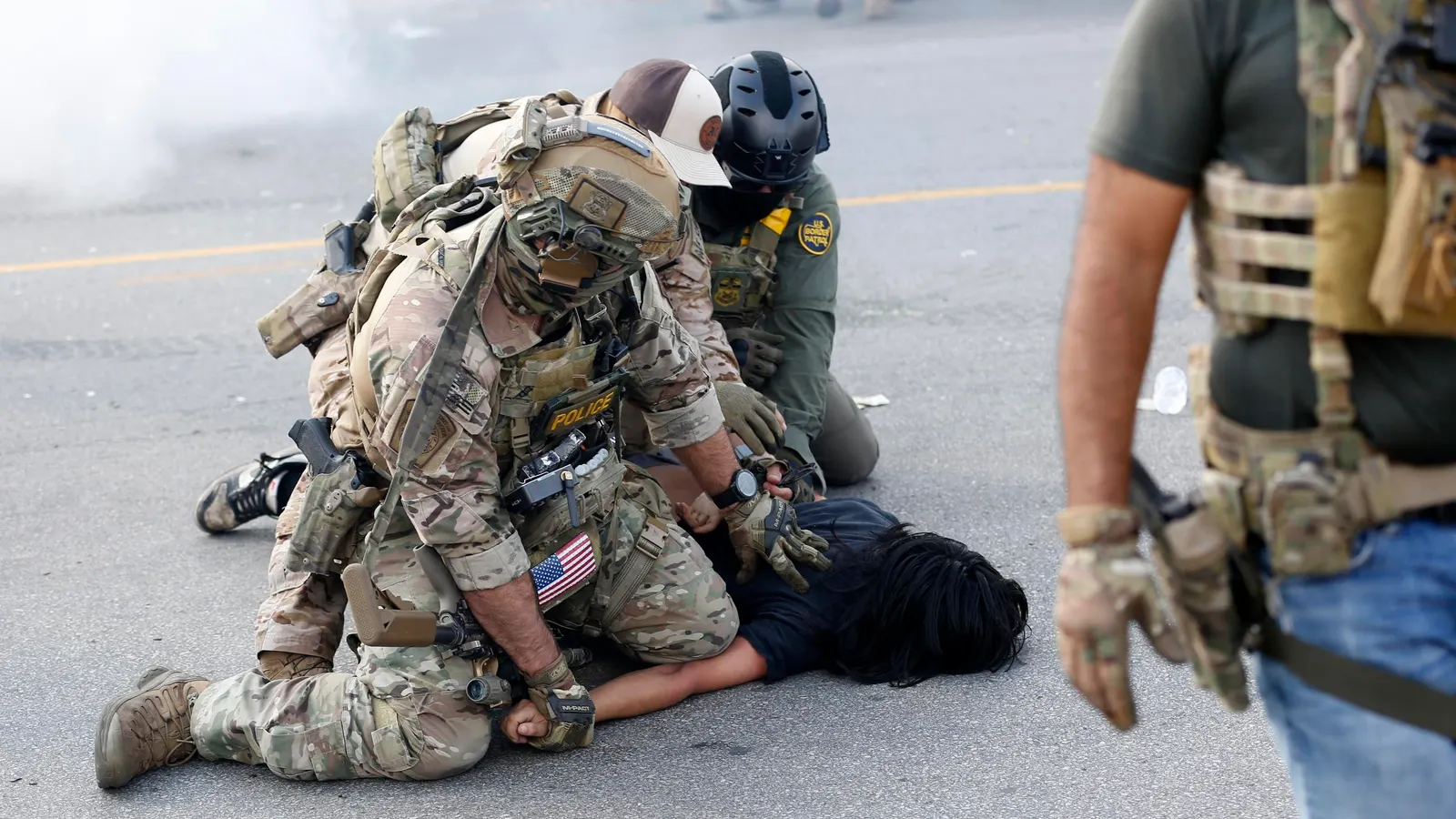

A person is detained as residents of Chicago’s Brighton Park neighborhood confront U.S. Border Patrol and other law enforcement agents at a gas station after Immigration and Customs Enforcement agents allegedly detained an unidentified man riding in his car, in Chicago, Illinois, on October 4, 2025. ICE wants to deport a 12-year-old boy, despite his attorney’s evidence that he is a U.S. citizen. (Photo by OCTAVIO JONES/AFP via Getty Images)
AFP via Getty Images
Immigration and Customs Enforcement wants to deport a 12-year-old boy, even though his attorney has provided evidence that the boy is a U.S. citizen. That evidence includes an affidavit from the boy’s U.S. citizen father. However, U.S. Citizenship and Immigration Services refuses to accept the evidence without the father submitting DNA evidence, which the father has been unwilling to do, according to the boy’s attorney. That has prevented the child from obtaining a Certificate of Citizenship. The boy faces deportation without a resolution in his favor.
For critics, the case presents another example of ICE prioritizing the deportation of children and other individuals who do not present a criminal or other threat. In April 2026, ICE arrested and detained an 85-year-old widow after her stepson, a federal official embroiled in an inheritance dispute with the woman, contacted ICE agents, leading to her detention and deportation. The boy’s case also sheds light on the situations that could arise should the Supreme Court rule in favor of the Trump administration’s executive order ending birthright citizenship for many individuals.
An Immigration Case Could Lead To A 12-Year-Old Boy’s Deportation
A 12-year-old boy living in Alaska faces deportation. The child is a U.S. citizen, according to his attorney and other documents, but USCIS is demanding more proof, or it will not recognize the boy’s citizenship, which is needed to prevent his deportation.
The boy entered the United States on a visitor visa with his mother, who is originally from Nigeria. ICE put him into proceedings to deport him, since he overstayed a visitor’s visa. To defend against deportation, he filed an application for a Certificate of Citizenship with USCIS, which adjudicates citizenship applications, according to Margaret Stock, an attorney at Cascadia Cross Border Law Group. She began representing the child because of her past work assisting military families with documenting that a child born abroad is a U.S. citizen at birth.
“USCIS will routinely grant the benefit because the father swore under oath that he was the father and would provide support,” said Stock in an interview. “He also provided his DD214, issued upon separation from U.S. military service, and his Certificate of Citizenship. But then USCIS demanded a DNA test, and when the father wouldn’t do it, they denied the N600, application for a Certificate of Citizenship. That means the child no longer has a defense against deportation.”
According to Alaska Public Media, “The boy’s mother is originally from Nigeria and gave birth to him in Turkey before coming to Alaska and applying for asylum. The man the boy’s attorney asserts is his father . . . has so far avoided multiple court-ordered paternity tests.”
Alaska Public Media reported that the father is a naturalized U.S. citizen, born in Nigeria, and a U.S. Navy veteran. He visited Africa and began a long-term romantic relationship that resulted in pregnancy, according to Stock. “The mother eventually got a visa to travel to Turkey, where she gave birth to her son in December 2013, according to documents Stock provided. She later came to the United States and settled in Anchorage, where she applied for asylum,” reported the Alaska news outlet. The mother’s case is pending.
“In early February and March, Alaska Public Media called publicly listed phone numbers for [the father], leaving multiple messages, and sent several emails. . . . An Alaska Public Media reporter also hand-delivered a letter to a Washington, D.C. address listed on tax records,” according to Alaska Public Media.
Stock said the father and son have met in person several times. “The father has always acted like a father and acknowledged paternity. The father calls him on his birthday every year to wish him a happy birthday,” she told Alaska Public Media.
According to an affidavit I have seen, the father attests to being a citizen. He also attests that he is the boy’s father and was a citizen at the time of the boy’s birth. That would make the child a U.S. citizen.
“DHS agencies should not be trying to deport a U.S. citizen child and denying him proof of his U.S. citizenship because his father is defying court orders to provide DNA,” Stock told me. Stock said she confirmed with the U.S. Navy that it has a DNA swab on the father but needs a request from a federal agency to release it. USCIS has not requested the Navy to release the DNA.
Stock believes these types of situations will become more frequent if the Supreme Court upholds the Trump administration’s executive order reinterpreting the 14th Amendment on birthright citizenship. “That executive order requires children to prove their biological relationship to their fathers in order to claim U.S. citizenship,” according to Stock. “So, thousands more children will potentially face deportation if they are unlucky enough to have biological fathers who refuse to provide DNA. The U.S. family law courts aren’t easily able to force parents to comply with court orders, as this case illustrates.”
When asked to comment on the case, a USCIS spokesperson responded on background, “As a matter of practice, USCIS does not comment on individual immigration cases.”
“This case is yet another illustration of how Trump’s mass deportation policy has become a way for private parties to evade their moral and financial obligations,” said Margaret Stock. “The deportation system has been weaponized against the vulnerable.”
















Leave a comment