


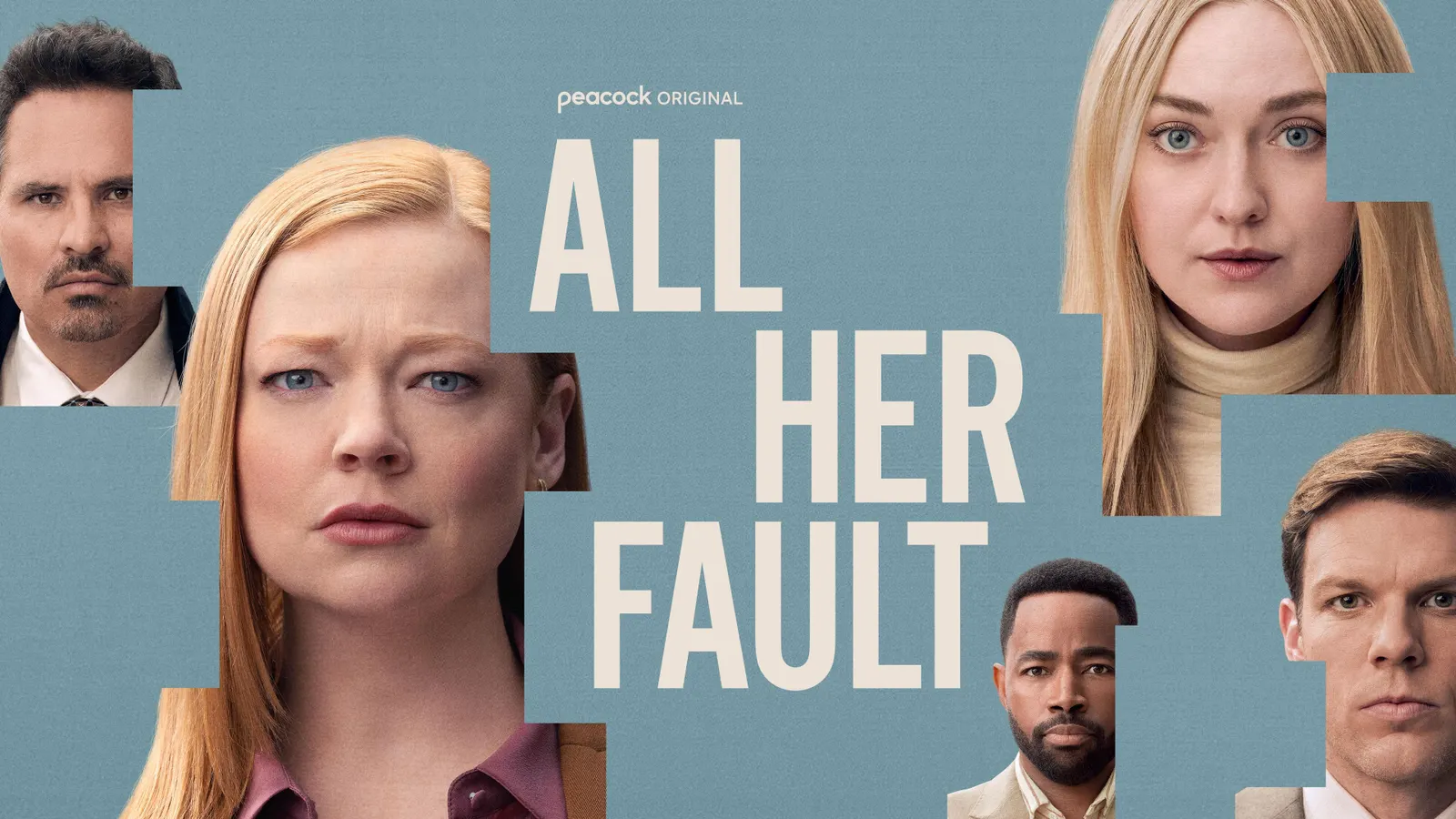

All Her Fault, A Peacock Original
Peacock
Since its November 2025 debut, All Her Fault has become Peacock’s biggest original series launch to date, with 46 million hours viewed in its first three weeks and a sustained run atop the platform’s streaming charts. The show has also garnered significant critical acclaim, including Critics’ Choice nominations and a win for the prolific actress Sarah Snook, as well as Golden Globe nominations.
Beyond its success, what makes All Her Fault especially compelling for women audiences is its cultural resonance and reliability. Adapted from Andrea Mara’s bestselling novel, the series taps into the growing conversation about the “mental load” of motherhood—describing what mothers, nationally and globally, may be experiencing: invisible household labor, with many reporting burnout, having to juggle the responsibilities at home and in the workplace, with little to no support from their partners and society. By framing these pressures within a gripping thriller structure, the show has struck a powerful chord with audiences and has resonated with many mothers juggling difficult obligations.
ALL HER FAULT — Episode 108 — Pictured: (l-r) Sarah Snook as Marissa Irvine, Dakota Fanning as Jenny Kaminski — (Photo by: Sarah Enticknap/PEACOCK)
Sarah Enticknap/PEACOCK
At the center is an all-female creative leadership team: creator, executive producer, and writer Megan Gallagher; star and executive producer Sarah Snook; director and executive producer Minkie Spiro; executive producer Joanna Strevens; and author Andrea Mara, who have translated a deeply personal, often underrepresented experience into prestige, awards-caliber television.
I spoke with Gallagher, creator, writer, and executive producer of the show; Spiro, director and executive producer; and Andrea Mara, the best-selling author of All Her Fault, to highlight how this team is redefining genre storytelling through a distinctly female lens, both on screen and behind the camera.
Megan Gallagher On Adapting Stories For Television:
When I’m looking at material to adapt, a part of me is practical, and a part is emotional. The practical part of me is looking for a SOLID genre motor, good twists and turns, and a surprising ending. The emotional part of me is looking for a story that moves me or stirs something inside me…something I can imagine thinking about and working on for years (because that’s what it takes to get a TV show on the air).
Andrea Mara’s book lit up both my practical and emotional sides. The twists and turns are relentless, and the ending is so much fun. But emotionally speaking, I was really drawn into the relationship between Marissa and Jenny, and all the story could say about working mothers, and the loads they carry. As soon as I finished the book, I knew I had to adapt it. I couldn’t wait to dig in.
But in terms of evolving the material for the small screen, the adaptation process was more additive than anything else – fleshing out character storylines, developing and deepening relationships, and enriching everyone’s interactions. 8 hours of television is a lot of time, and I like to write at a pretty fast pace, so I usually need a lot of material.
Gallagher On Choosing Sarah Snook:
Generally speaking, you’d have to be insane not to want Sarah Snook to lead your TV show. But specifically, Sarah was perfect for bringing Marissa Irvine to life because Marissa spends 95% of the story in agony over her missing child. There’s trauma, tears, and heartache everywhere. But I didn’t want to lose her character to all those tears. I still wanted to see Marissa and who she was despite the trauma. I wanted to see her humor, her sarcastic edge, her wit. I wanted to get a sense of who she was outside the kidnapping, even though the story takes place during it.
Not many actresses have the skill set to navigate all that trauma, yet somehow find the personality underneath and let it shine through. Sarah did it so well that it looked easy.
Gallagher On Redefining Genre Storytelling Through A Female Lens
All Her Fault is about the mental load on working mothers. It’s about women who spend all day earning a paycheck, and then come home and keep working. This is a ‘quiet’ issue. It’s a domestic issue. It’s an issue that cannot be easily measured or quantified because it’s happening within people’s homes and in their relationships.
This issue would never make it to screen without a creative team that was eager to tell a story through a female lens. I hope that we’ve done our part in advancing genre storytelling simply by telling this kind of story.
Minkie Spiro On Parental Guilt And The Pressures Placed On Mothers:
I have always been drawn to impactful stories that center around strong women – from Fosse Verdon and Toxic Town to Dead to Me, and most recently, Five Star Weekend.
It is incredibly rewarding to explore stories that challenge societal discrepancies in whatever form they take. So when Megan Gallagher and I first sat down to discuss All Her Fault, we were immediately drawn to probing the disparity that exists in parenting responsibilities. As working mums, we are painfully aware of the pressures placed upon us. The idea of delving into this in a nuanced way, within the framework of a delicious thriller, felt extremely enticing and became a very intentional drive. However, there is little value in preaching or ‘hitting people over the head’ with judgments, so it was vital to find a seamless path to weave this emotional turmoil into the show’s DNA.
I think we found a satisfying way to expose Marissa and Jenny to the pressures and guilt of juggling careers and parenting – and in so doing, hit a nerve and allow working mothers to feel seen!
Andrea Mara On Motherhood And Emotional Labor:
When I first watched All Her Fault with my husband and kids, I paused it just after the scene where Marissa and Jenny discuss the emotional load of motherhood. I joked to my husband: ‘I tried to tell you I needed more help, but you didn’t listen, so I wrote a book, but you didn’t read it, so I had to get a TV show made!’ Back when I wrote All Her Fault, my kids were 11, 9, and 7, and I wrote while they were at school and late into the night after they went to bed. My husband was and is amazing at doing his share of housework and childcare, but the mental load is where the discrepancy arose. He did everything I asked him to do, but sometimes I just needed him to know what to do.
This comes up in the book and on the show – there’s a scene, for example, where Marissa is struggling with newborn Milo, and Peter says, ‘Just tell me what you need me to do.’ A collective sigh of exasperation sounded in my living room when I watched the show with my friends – we’ve all been there. We are the managers of our homes, and our husbands are the very competent right-hand men. But instead of ‘Tell me what to do and I’ll do it,’ we want to hear ‘Here’s what I’ll do.’
This emotional labor is something I wanted to explore in the book when I was writing it – to get it out of my system and onto a page. I wanted to write about the struggle with guilt; my husband never felt guilty about being at work while our kids were in daycare, whereas I did. And the challenge of trying to juggle it all, to think of everything. And the fact that so-called downtime – the moments when we’re not at the office or minding our kids – is spent running the home. And the self-recrimination when things go wrong.
The dial has moved over the generations – we no longer think it’s okay for fathers to sit reading the paper while mothers cook and clean. But the next step is emotional labor – knowing what needs to be done, so we don’t have to tell them what to do.
















Leave a comment