


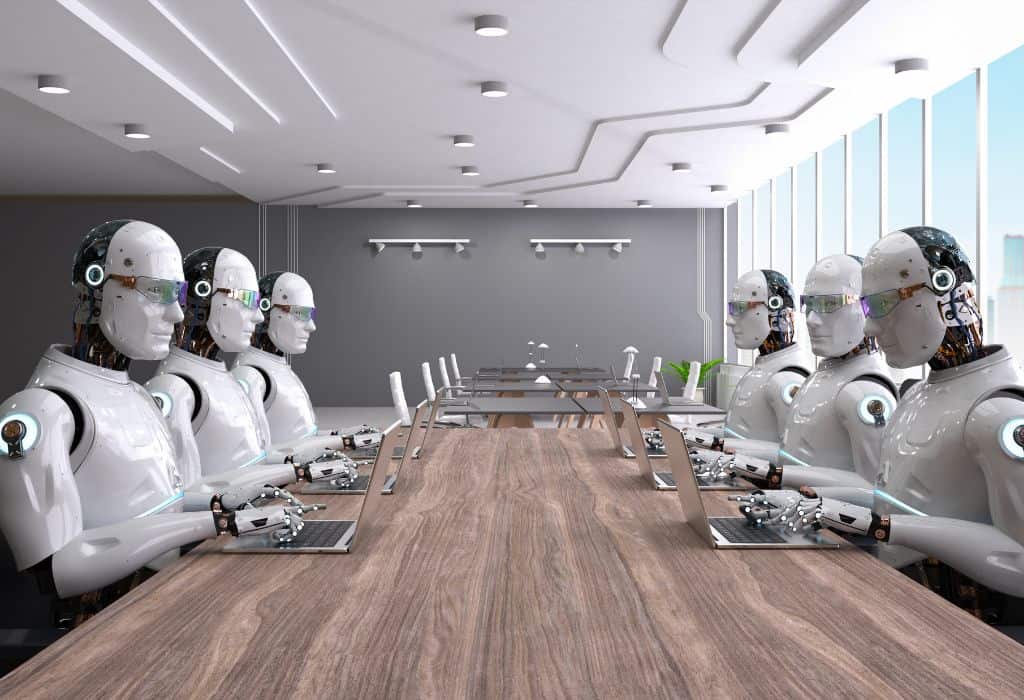
🤖 AI Won’t Replace Our Jobs. But the People Who Master It May Well Do.
By Jamie McIntyre
Artificial intelligence is rapidly becoming the defining technological revolution of our era. Every boardroom conversation now seems to revolve around AI. Every startup claims to be powered by it. Governments are scrambling to regulate it while corporations race to monetise it.
But beneath the noise and marketing hype sits a far more important reality:
⚡ AI itself may not directly replace everyone’s jobs.
🚀 The people and companies who learn to master AI probably will.
History tells us technological revolutions rarely unfold in a straight line. They arrive in waves of excitement, speculation, chaos, collapse, reinvention, and finally long-term adoption.
🌐 The Dot-Com Boom: A Lesson From History
The dot-com boom of the late 1990s offers the perfect example.
At first, the internet sparked irrational enthusiasm. Companies with no profits and barely functioning business models achieved astronomical valuations overnight. Investors poured money into anything ending in “.com.”
Then came the crash.
💥 Billions were wiped out.
Many concluded the internet revolution had been overhyped.
But they misunderstood what had actually happened.
❌ The speculation bubble collapsed.
✅ The technology itself did not.
Over the following two decades the internet quietly transformed nearly every industry on earth.
📌 Retail
📌 Banking
📌 Media
📌 Communication
📌 Entertainment
📌 Travel
📌 Advertising
📌 Logistics
📌 Education
📌 Finance
—all were fundamentally reshaped.
Entire industries disappeared.
Entirely new industries emerged.
Fortunes were created not necessarily during the bubble itself, but during the long-term adoption phase that followed.
Artificial intelligence may now be following a remarkably similar path, except potentially on an even larger scale.
📈 The AI Boom May Follow a Familiar Pattern
Right now we are likely in the early “boom phase” of the AI cycle.
💰 Capital is flooding into the sector.
📢 Every business wants exposure.
⚠️ Some companies are already overpromising what AI can realistically deliver in the short term.
At some stage there may well be a correction, consolidation, or even an AI-related market crash.
But that should not be confused with failure.
Because much like the internet, the long-term trajectory of AI adoption appears enormous.
The real transformation may unfold gradually across the next 10 to 20 years as AI becomes embedded into nearly every operational layer of society.
Not simply chatbots.
🤖 Entire systems.
AI agents are already evolving beyond simple question-answer tools into autonomous systems capable of handling:
- Scheduling
- Administration
- Marketing
- Logistics
- Research
- Customer service
- Software management
- Operational workflows
—all with limited human supervision.
Businesses are beginning to build digital workforce layers operating 24 hours a day at near-zero marginal cost.
That changes economics dramatically.
👨💼 Will AI Replace Jobs?
Yes. Almost certainly.
Pretending otherwise helps nobody.
Many repetitive digital, administrative, analytical, and even creative tasks are likely to become increasingly automated over time.
Entire employment sectors may shrink substantially.
But history also suggests technological revolutions create new categories of work even as they destroy old ones.
The transition, however, can be painful.
Workers displaced by AI may require massive reskilling efforts unlike anything modern economies have previously experienced.
Governments, educational institutions, and private industry may all face pressure to rethink how societies prepare people for employment in an AI-driven world.
🧠 The winners may not necessarily be those with the highest degrees.
⚡ They may be the fastest adapters.
People who understand how to work alongside AI rather than compete against it may gain enormous advantages in productivity, creativity, and economic opportunity.
The modern workforce could increasingly divide into two categories:
✅ Those using AI effectively.
❌ And those being replaced by those who do.
🏗️ Infrastructure Ownership May Become the Ultimate Advantage
One of the least discussed aspects of the AI revolution is that access alone may not create lasting competitive advantage.
Almost everyone can now access advanced AI systems.
Far fewer control the infrastructure underneath them.
The biggest winners may ultimately be the companies controlling:
- Cloud infrastructure
- Data centres
- Semiconductors
- Energy systems
- Software ecosystems
- Distribution platforms
—all powering artificial intelligence globally.
Just as the internet created trillion-dollar infrastructure giants, AI may do the same.
This is why the battle for AI dominance is increasingly becoming a battle over:
⚡ Infrastructure ownership
⚡ Energy capacity
⚡ Computing power
⚡ Data control
Those owning the digital railways may ultimately profit more than those merely riding them.
🌍 Will AI Ultimately Benefit Humanity?
Most likely yes.
Artificial intelligence has the potential to improve:
✅ Productivity
✅ Healthcare
✅ Scientific research
✅ Education
✅ Logistics
✅ Engineering
✅ Agriculture
✅ Countless other industries
It may dramatically lower operational costs while accelerating innovation at speeds previously unimaginable.
Used wisely, AI could help solve major global challenges and improve living standards for billions of people.
But it would also be naive to ignore the risks entirely.
Powerful technologies throughout history have always carried unintended consequences alongside benefits.
Artificial intelligence is unlikely to be different.
While Hollywood’s 🎬 “Terminator” style doomsday scenarios remain speculative, the broader risks surrounding:
- Autonomous systems
- Surveillance
- Cyber warfare
- Misinformation
- Economic displacement
- Concentrated technological power
—should not simply be dismissed.
Humanity has created extraordinarily powerful tools before.
The challenge has never been invention alone.
It has been whether civilisation develops the wisdom to manage those tools responsibly.
🚀 Final Thought
AI may ultimately become one of the greatest economic accelerators in history.
Or one of the most disruptive.















Leave a comment