


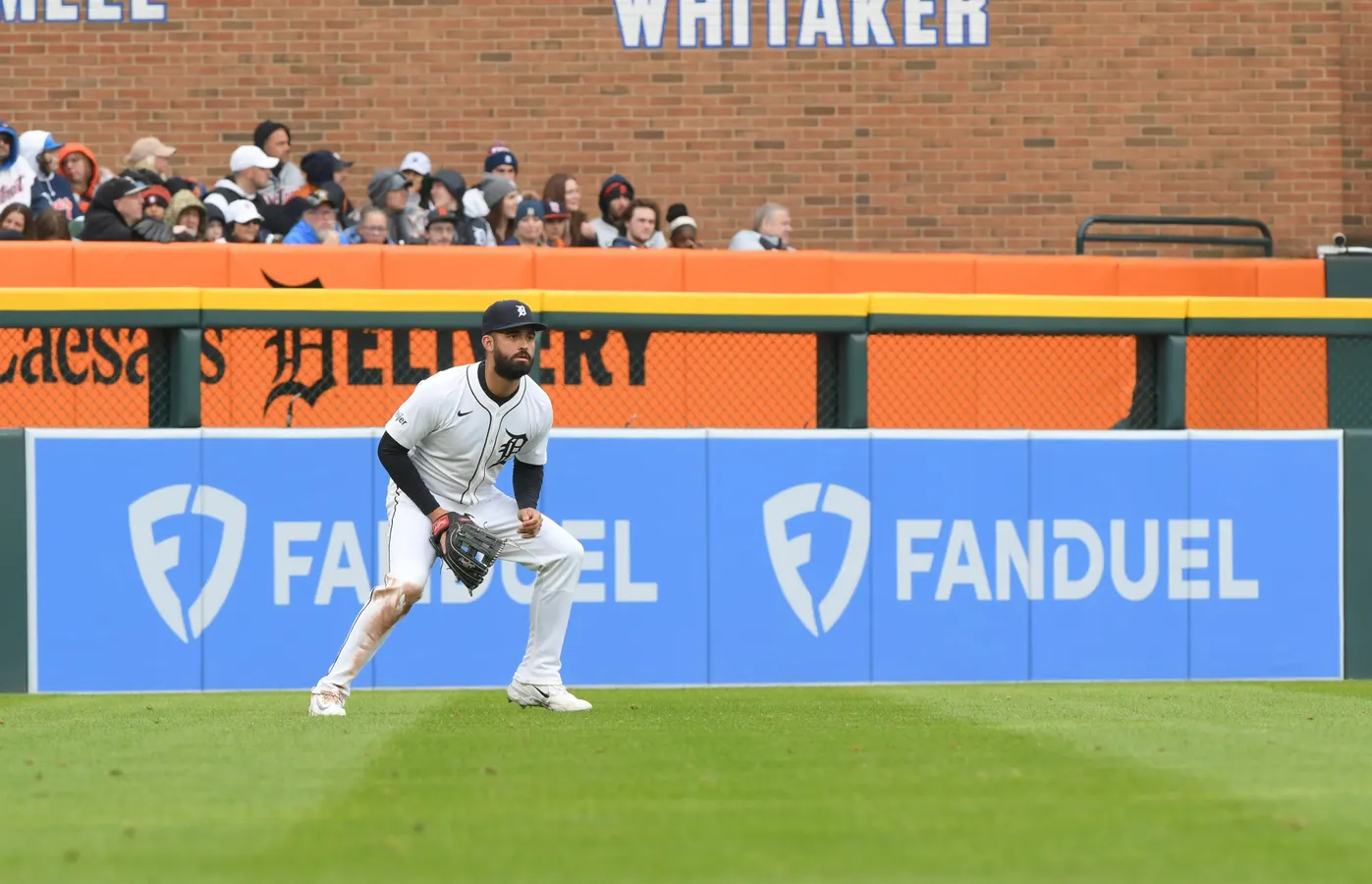

DETROIT, MI – APRIL 05: Riley Greene #31 of the Detroit Tigers stands in front of the FanDuel Sports Network sign in the outfield during the game against the Chicago White Sox at Comerica Park on April 5, 2025 in Detroit, Michigan. The Tigers defeated the White Sox 7-2. (Photo by Mark Cunningham/MLB Photos via Getty Images)
MLB Photos via Getty Images
The old regional sports network model has been collapsing over the last five years, with many teams across the NBA, NHL and NBA left with some key questions:
How do you replace that revenue?
And how do you deliver games and related content without those networks in place any more?
The pieces are just starting to come together there, but centralization is at the crux of it all – after two decades of largely disjointed approaches to local rights.
ESPN As A Content Hub
ESPN’s direct-to-consumer app has quickly emerged not just as a streaming home for the flagship sports network and catch-all for overflow content, but a hub for live games whether they appear on ESPN or not.
Much in the way that Venu was supposed to be a one-stop shop for live sports across a variety of media companies, ESPN is taking up that mantle on its own instead.
ESPN previously secured out-of-market NHL games, and has the rights to specific local MLB.TV games under its reconstituted agreement, where fans will pay ESPN for the right to stream their in-market team. And as recently announced, CW sporting events will also stream on ESPN starting this summer. Despite not being produced by ESPN either.
These dynamics show how ESPN is fundamentally changing its business, morphing into what’s effectively a sports-only vMVPD and acquiring as many live games as it can get its hands on – including the ones it wasn’t originally going to pay for, like the Pac-12 and select ACC games that moved to CW.
There could be more coming, too, as the NBA potentially consolidates regional rights in the same way MLB has. While that could go through Amazon or the NBA’s own app (which introduced its own hub model this season), ESPN also has the infrastructure in place already to make it work – and the extra interest in local TV success.
What Makes Local Different
Local TV’s effectiveness has always come from its direct access to a hyper-targeted audience.
Local TV had some form of programmatic advertising since long before programmatic advertising was a thing. And with streaming added to the mix, it increases the effectiveness of local advertising down to the zip code level.
Streaming is probably where these displaced sports rights go, and many already have. But without an umbrella strategy in place, teams have either been going to their own services or turning back to local broadcast; where many of these games lived before regional sports networks popped up.
“Today, local broadcasters are saying, ‘hey, wait a minute, we’re still here. We’ve always been here. Maybe we can sop up some of this (game) inventory,’” said Anthony Campanella, VP, Inventory Partnerships & Operations at Madhive, which as part of its business, partners with local advertisers around sports inventory.
“While certainly not with the same economics of an RSN, these networks are at least a viable alternative in the interim to give these teams and advertisers targeted local reach,” he said.
Though these local broadcast games don’t bring in the same subscriber revenues that RSNs have, they’re more accessible as a result of being free over-the-air. And in-market, that conceivably makes that ad inventory more valuable from a sales perspective since it’s a larger and similarly engaged, targeted audience.
SALT LAKE CITY, UT – FEBRUARY 28: Ace Bailey #19 of the Utah Jazz drives to the basket against Derik Queen #22 and Karlo Matkovic #17 of the New Orleans Pelicans during the first half of their game at the Delta Center on February 28, 2026 in Salt Lake City, Utah. NOTE TO USER: User expressly acknowledges and agrees that, by downloading and or using this photograph, User is consenting to the terms and conditions of the Getty Images License Agreement. (Photo by Chris Gardner/Getty Images)
Getty Images
Local Streaming And Remaining Gaps
Earlier this year, Truthset research revealed that marketers were wasting $7.4 billion on connected TV ad spending due to inaccurate targeting data. Adding to that, a new iSpot report shows that 75% of marketers surveyed plan to purchase ads via demand-side platforms (DSPs) this year.
The reliance on external data and indirect buying comes with some assumptions of risk and uncertainty that are growing particularly with live sports. But it’s a challenge technology can potentially solve for, too.
“Right now, the biggest thing the industry needs to figure out when it comes to live sports is how to better support local buys programmatically,” said Campanella. “For example, understanding how to increase and directly target during a Florida-Georgia football game is the gap right now between traditional broadcast and the streaming offerings.”
As streaming sports continue to explode, NFL commissioner Roger Goodell recently went so far as to suggest that streaming was beating broadcast’s audience for some games, and local broadcast will have to close the gap to remain a viable alternative.
That doesn’t let streaming off the hook for local targeting, either. And there are improvements to be had across the board.
Local broadcast has a golden opportunity to reshape the sports conversation, though. If they can crack the code on optimizing its valuable inventory.









Leave a comment