


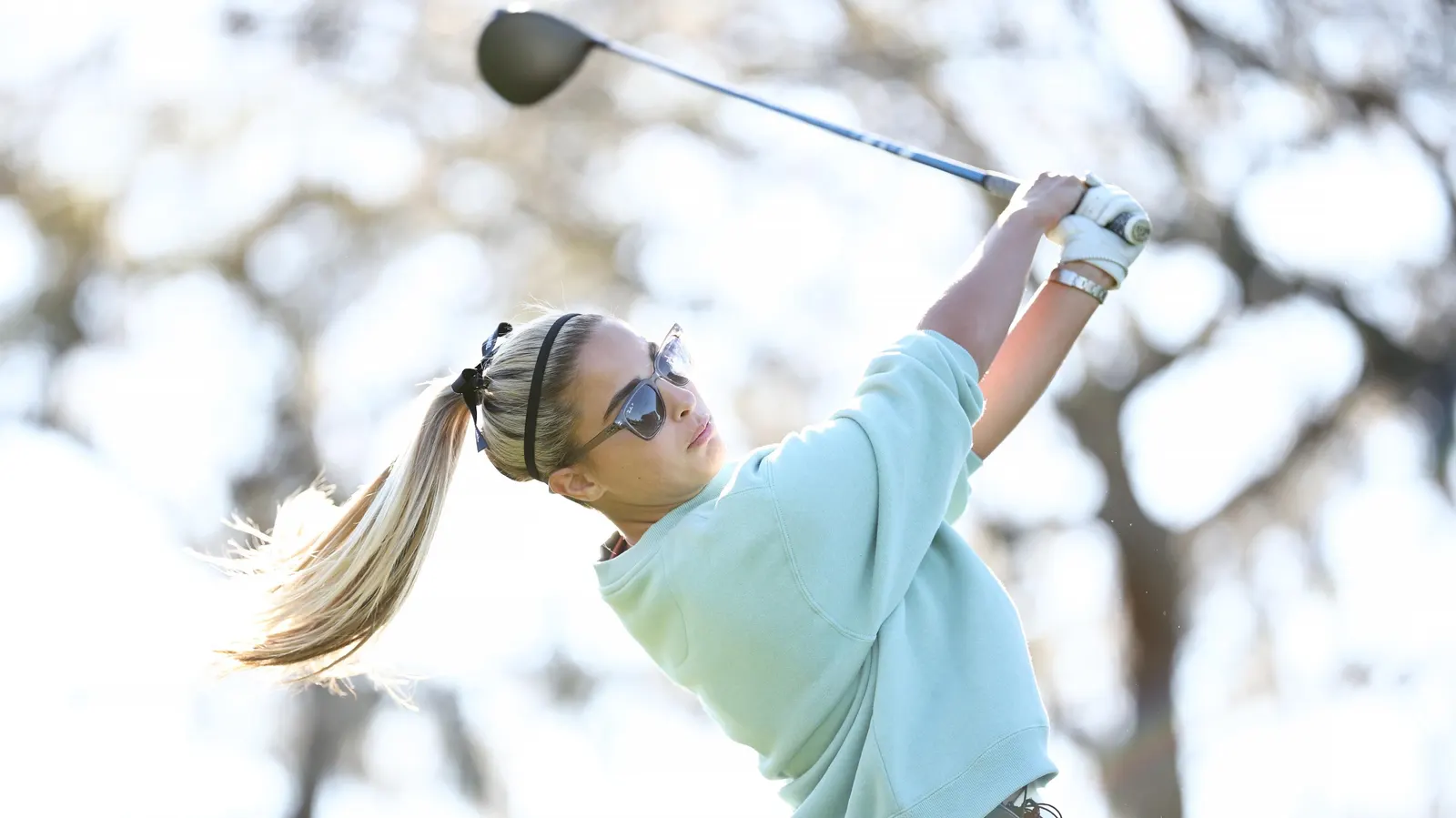

Content creator Gabriella “Gabby Golf Girl” DeGasperis plays her shot from the 12th tee during last year’s Creator Classic prior to THE PLAYERS Championship on the Stadium Course at TPC Sawgrass (Photo by Jared C. Tilton/Getty Images)
Getty Images
Not many opponents can say they’ve earned an ovation from Steph Curry in the thick of competition.
But that’s exactly what happened during a one-on-one match between the four-time NBA champion—also an American Century Championship winner—and Gabriella DeGasperis, after the content creator split the fairway with a titanic drive midway through their round. The match ended all square in regulation before DeGasperis prevailed in a chip-off playoff.
“I hadn’t been nervous in a while—honestly the only times I’ve felt that were playing with Jon Rahm and with Steph Curry,” she said. “I didn’t think I was going to win, but as it went on I realized, ‘wait, I can actually win here,’ and that was incredible.”
Winning has quickly become her norm. DeGasperis, better known online as “Gabby Golf Girl,” has amassed nearly two million followers across Facebook, YouTube, Instagram and TikTok.
The West Palm Beach, Florida-based stick is one of the fastest-growing creators in the sport. She first picked up a golf club at age two, after receiving a set of pink clubs for her birthday and soon began competing in junior tournaments.
She began posting regularly ahead of her freshman year of high school, initially using social media as an outlet to cope with social isolation and bullying. After one of her early Instagram reels drew 20,000 views, she started to see the potential to turn what began as a hobby into a business.
Gabby, now 18, has gone well beyond trick-shot clips—like the one where she scoops up a ball, flips it over her shoulder and watches it drop in the cup as she walks away.
She’s developed a recognizable on-course identity, including a signature tee-box routine—a shoulder tap, twist and extension sequence before the follow-through that breaks down classic swing fundamentals into simple, repeatable checkpoints that resonate with a social-first audience. What reads as stylized on camera functions as a kind of training cue, designed to reinforce muscle memory through exaggeration. And like the “Happy Gilmore” run-up once did, the Gabby move is increasingly being emulated by younger golfers looking to match her level of fairway finding consistency.
She also isn’t just playing matches, she’s producing them. Her content has evolved into something much closer to episodic television, where the outcomes still matter but the cart banter and chemistry between her and her opponents drive engagement.
That evolution reflects a broader shift on the platform itself. YouTube’s share of total TV viewing reached roughly 12% in 2025, according to Nielsen—higher than any individual network or streaming service—as it increasingly functions like a destination for long-form, episodic content alongside short clips.
Instead of challenging other influencers to golf duels—still de rigueur on YouTube—she’s leaned into unpredictability, approaching strangers on driving ranges and sizing up both their swings and their on-camera presence in her “random golfer” series.
The result is a fresh one-on-one format for YouTube Golf blending competition with human connection. As she puts it, it’s no longer about “just straight up watching golf,” but about surfacing personalities that might otherwise go unnoticed, like a Texas A&M fraternity cheering on their chapter’s lowest handicapper as he takes on Gabby.
“I think it’s important to show that I’m really going up to regular people who are just out playing golf, and showing that they can be on YouTube too—that they have character as well, rather than just playing golf with other influencers.”
That shift has been guided as much by instinct as by data. DeGasperis pores over her analytics obsessively, “every single day,” she says to improve her content but she’s just as concerned with pacing and narrative tension.
What keeps viewers from clicking away isn’t just shot-making, but the emotional stakes layered into each interaction. “Tension,” she explains, is the key variable, whether it’s competitive friction, unexpected chemistry, or the reveal of a personality that defies expectations. At times, that dynamic can resemble the awkward, get-to-know-you energy of a first date—two strangers sizing each other up in real time, with the outcome of the match only half of the appeal. Those insights have pushed her content beyond pure sport and into a hybrid format that mirrors broader trends across digital media sports channels, where audience retention, in the end, comes down to storytelling as much as skill showcasing.
The dual focus of performance and production also defines how she views her role. DeGasperis still approaches her craft like an athlete, adhering to a strict daily routine built around practice and recovery, but she’s equally conscious of the business she’s building around it. “I see myself as both,” she says when asked about balancing hours on the course with a growing operation that includes family and employees.
That hybrid identity is also increasingly attractive to brands. Last month, premium hydration brand Electrolit signed DeGasperis to its athlete roster, betting that her combination of competitive credibility and creator reach can help the brand connect with golf audiences, an area they’d yet to explore.
For DeGasperis, who has consumed the product for years, the partnership fits naturally into the athlete side of her routine, which revolves around regimented practice sessions in the Florida heat, recovery and content production on a steady rinse and repeat cycle.
As brand partnerships scale in lockstep with her audience growth, she’s become more selective, prioritizing deals where she can “spearhead” a category, as is the case with this one, rather than simply join an ambassador roster already chock full of golfers.
Playing college golf was once the goal, but that is no longer a given. DeGasperis says she’s received Division I offers and long planned to compete at that level, but with her platform accelerating, that path is now on hold.
“My whole goal for a very long time was to play college golf, but for me right now, we’ll see what happens,” she said.“I’m really not 100% sure yet—I’m still working it out as we go.”
For now, as her following and business scale in real time, the more immediate path may not run through a campus at all, but through a creator economy that increasingly rewards golfers who can build an audience alongside their game.







![The Macklemore And Ed Sheeran Situation Explained [Updated]](https://businessaustralia.news/wp-content/uploads/2026/09/1789898968_0x0-200x154.jpg "The Macklemore And Ed Sheeran Situation Explained [Updated]")


Leave a comment