


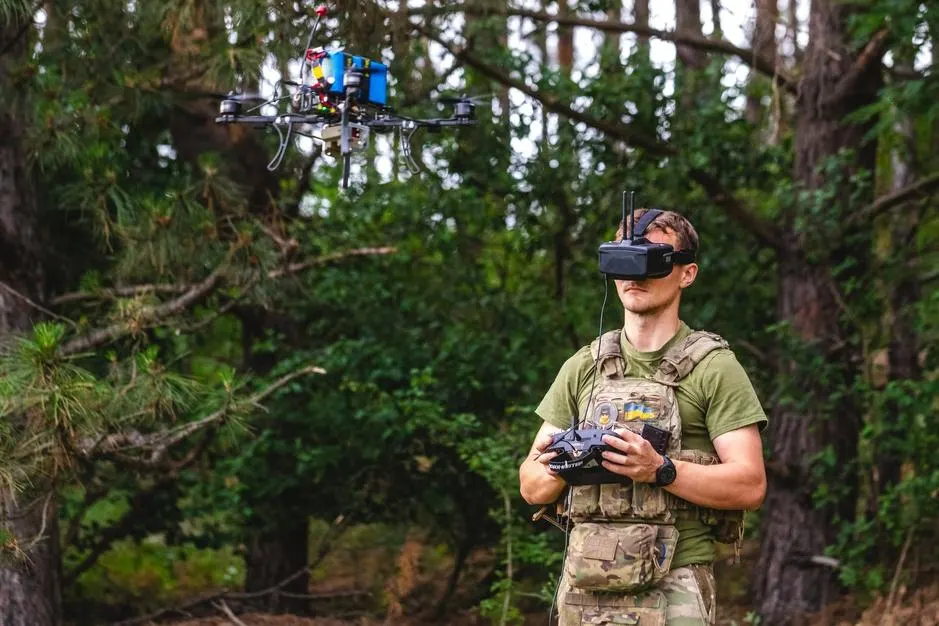

Ukrainian pilots of the 116th Mechanized Brigade practice flights on FPV drones in the Kupiansk direction. (Photo by Arsen Dzodzaiev/Global Images Ukraine via Getty Images)
Global Images Ukraine via Getty Images
A drone costing a few hundred dollars can kill a tank worth millions. A cluster of them, smuggled inside cargo containers, can destroy a strategic bomber. Ukraine turned that reality into a way of war. Now the Pentagon is sending people to learn how.
U.S. Defense Secretary Pete Hegseth told senators this week that American military personnel have been deployed to Ukraine to study how drones are being used in combat.
“I’ve personally approved additional personnel there to learn from that drone battlefield, both on offense and defense,” Hegseth said, adding that the Pentagon was working to incorporate lessons from Ukraine as drone dominance becomes central to modern warfare.
The comments came during Senate hearings in which Senator Mitch McConnell pressed Hegseth on whether senior U.S. officials were facing restrictions on traveling to Kyiv. McConnell had noted on April 28 that Army Secretary Dan Driscoll and then-Army Chief of Staff Gen. Randy George visited Ukraine last year to see “the rapid evolution of battlefield tactics and technologies.” Driscoll described Ukraine as the “Silicon Valley of warfare.”
That assessment is not limited to the Pentagon. In an interview with Fox News on May 14, U.S. Secretary of State Marco Rubio called Ukraine’s armed forces the “strongest, most powerful” military in Europe, arguing that the war has forced Ukraine to develop “new tactics, new techniques, new equipment” and “hybrid asymmetrical warfare.”
Ukraine’s Drone Warfare Lessons
Fighting an asymmetric war with limited resources, Ukrainian soldiers told me they had to adapt quickly, using whatever they could get their hands on, including off-the-shelf drones. Bohdan Garkavyy, a drone pilot in the Unmanned Systems Battalion of Ukraine’s 110th Separate Mechanized Brigade, told me that Ukraine’s drone production accelerated after the battle for Avdiivka in early 2024, as U.S. aid delays deepened Kyiv’s artillery shortage.
“After Avdiivka, I think Ukraine really started ramping up drone production,” Garkavyy said. “If Ukraine had more artillery back then, it wouldn’t have needed to rely as much on drones.”
A general view of the city’s destroyed buildings on February 15, 2024 in Avdiivka district, Ukraine. The Russian army is advancing on the flanks of the city, firing non-stop artillery, shelling the city with guided aerial bombs (FAB-500). (Photo by Kostiantyn Liberov/Libkos/Getty Images)
Getty Images
Small first-person-view drones costing hundreds of dollars now routinely destroy systems worth millions. When I was with a Ukrainian tank unit near the front in the summer of 2024, soldiers told me the drone threat had changed how they used armor. Tanks were acting more like mobile artillery, firing from cover and moving quickly before Russian drones could find them.
Analysts say the cost imbalance is becoming hard for militaries to ignore.
Small drones have also proven capable of striking far behind the front line. In June 2025, Ukraine conducted Operation Spiderweb smuggling low-cost FPV drones into Russia inside containers and using them to strike strategic bombers worth tens or even hundreds of millions of dollars each. Cheap drones could threaten some of the most expensive military assets in the world without ever crossing a front line.
The same pattern is now spreading beyond Ukraine. The Guardian reported on May 12 that Hezbollah is using $300 to $400 fiber-optic FPV drones in Lebanon, adapting tactics from Ukraine to evade Israeli electronic warfare and challenge a far better-equipped military.
“Ukraine and Russia have both demonstrated that large numbers of relatively inexpensive drones can overwhelm defenses and shape the battlefield even against modern militaries,” Treston Wheat, chief geopolitical officer at Insight Forward, told me.
Cheap Drones, Expensive Losses
The urgency reached U.S. forces directly. When the U.S. conflict with Iran began on February 28, Tehran unleashed barrages of drones across the region. The U.S. and its allies shot down many of them, but the scale of the attacks exposed how hard it is to defend against cheap, mass-produced systems.
In an April analysis for War on the Rocks, Maximilian Bremer of the Stimson Center and Kelly Grieco, a senior fellow at the Stimson Center and adjunct professor at Georgetown University, described Iran’s campaign as an “asymmetric counterair” effort aimed at the enablers of U.S. airpower. They argued that cheap drones and missiles are increasingly capable of threatening expensive, hard-to-replace systems parked at fixed bases.
On March 13, U.S. President Donald Trump dismissed the idea that Washington needed Ukrainian help. “We don’t need their help in drone defense,” he told Fox News. “We know about drones more than anybody. We have the best drones in the world, actually.”
Meanwhile, the U.S. has invested heavily in far more expensive unmanned systems. More than a dozen MQ-9 Reaper drones, each reportedly costing about $16 million, were destroyed during operations against Iran, ABC News reported on March 17, citing U.S. officials.
Sam Nahins, a former U.S. military Reaper drone operator, told me any U.S. ground operation against Iran would be extremely dangerous without extensive FPV training. “The only way we could ever put troops on the ground against Iran, without mass casualties, is if we master the FPV game,” Nahins said.
Why The Pentagon Wants Ukraine’s Drone Expertise
Washington also wants access to Ukraine’s drone industry. A draft U.S.-Ukraine defense memorandum would allow Ukraine to export military technology to the United States and manufacture drones in joint ventures with American companies, according to a May 13 report by CBS News. CBS also noted that one Ukrainian manufacturer plans to build more than 3 million low-cost FPV drones in 2026, while the U.S. produced only 300,000 in 2025.
A report from Axios in March claimed that Ukrainian officials had previously offered Washington battle-proven technology for shooting down Iranian-made Shahed drones, including a proposal for protecting American forces and allies in the Middle East. The offer was reportedly dismissed before the U.S. later asked Ukraine for anti-drone assistance during the Iran conflict.
Ryan O’Leary, an American former fighter who led the Chosen Company volunteer unit in Ukraine, told me Ukraine has accumulated more drone combat experience than any military in the world, but much of what Ukraine knows hasn’t formally reached the West.
“Ukraine has been the live-fire classroom for this,” O’Leary said. “U.S. troops who haven’t trained against an FPV threat or learned to use one offensively are going to take casualties they shouldn’t be taking.”
Bryan Pickens, a former U.S. Army Green Beret who fought in Ukraine, told me the gap between Ukrainian and Western battlefield experience is larger than many NATO militaries realize. The value of Ukraine’s experience, he added, goes far beyond battlefield survival.
“Even for someone with 16 combat deployments, I had to relearn how to fight,” Pickens said. “Ukrainian counterparts were teaching me.”
Traditional fundamentals like maneuver and command-and-control still mattered, he said, but integrating drone systems, avoiding detection and linking strikes across different ranges were areas where Ukrainian forces had moved far ahead of most Western militaries.
“We need Ukraine to help professionalize Western warfighters – to teach how these systems are used and how to defend against them,” Pickens said. “If the tactics, techniques and procedures used by Russia in Ukraine are ever used against the U.S., we won’t lose a few soldiers – we’ll lose entire elements.”















Leave a comment