


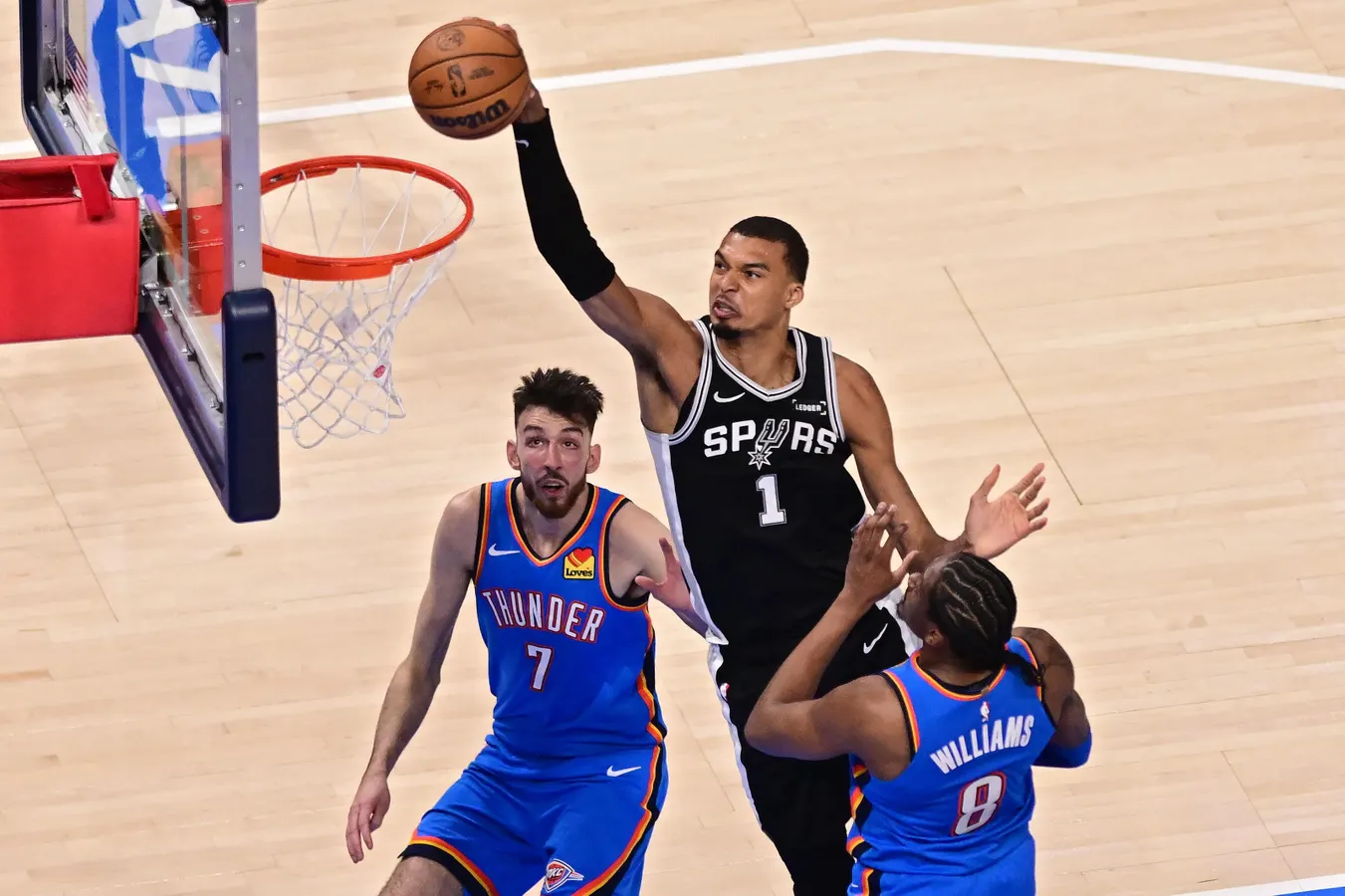

OKLAHOMA CITY, OKLAHOMA – MAY 18: Victor Wembanyama #1 of the San Antonio Spurs drives to the basket against Chet Holmgren #7 of the Oklahoma City Thunder during the fourth quarter in Game One of the NBA Western Conference Finals at Paycom Center on May 18, 2026 in Oklahoma City, Oklahoma. NOTE TO USER: User expressly acknowledges and agrees that, by downloading and or using this photograph, User is consenting to the terms and conditions of the Getty Images License Agreement. (Photo by Alex Slitz/Getty Images)
Getty Images
The Oklahoma City Thunder and San Antonio Spurs kicked off the Western Conference Finals in epic fashion on Monday night.
Led by Victor Wembanyama, the Spurs stole home-court advantage with a 122-115 double-overtime victory on the road against the reigning NBA champions. Wembanyama finished with 41 points, 24 rebounds, three assists and three steals, which made him the youngest player in league history to have a 40-20 game in the playoffs.
Only 14 players in league history have ever had 40 points and 20 rebounds in a playoff game. Kareem Abdul-Jabbar, Moses Malone and Charles Barkley are the only other three who did it in the conference finals.
The Spurs needed every one of those points and rebounds—including an audacious game-tying three-pointer in the final 30 seconds of overtime—to knock off the defending champions. Although Shai Gilgeous-Alexander (24 points on 7-of-23 shooting) and Chet Holmgren (eight points on 2-of-7 shooting) struggled on the night, Alex Caruso (a playoff career-high 31 points) and Jalen Williams (26 points) nearly helped the Thunder overcome the heroics of Wembanyama, Stephon Castle and Dylan Harper.
The rest of the West—and perhaps the NBA at large—must be sitting at home and wondering what they can possibly do to catch up to the Spurs and Thunder.
If both teams maintain that level of play throughout the rest of the Western Conference Finals, that could spark a leaguewide team-building crisis this offseason.
Keeping Up With The Wembys
The Thunder and Spurs were the only two West teams to win even 55 games during the regular season this year. The Spurs won 62, while the Thunder won 64.
The Thunder are led by Gilgeous-Alexander, who just won his second straight MVP award, and they also have a pair of other All-Star-caliber players in Williams and Holmgren. The Spurs are led by Wembanyama, who became the first unanimous Defensive Player of the Year in league history this year, along with a triumvirate of dynamic guards in Castle, Harper and De’Aaron Fox.
If both the Thunder and Spurs were top-heavy squads with thin benches, other West teams would have hope in the near future. That isn’t the case, though. Both are teeming with depth and future draft picks that will allow them to continually replenish their supporting cast as they begin to shed talent for financial reasons.
Nothing is set in stone in the NBA, particularly in the second-apron era. But the Thunder and Spurs appear poised to dominate for at least the next few seasons.
That raises some uncomfortable questions for the rest of the West, particularly after some demoralizing playoff beatdowns.
Is The Parity Era Already Over?
The second-apron era was designed to create parity in the NBA. The Thunder and Spurs are thumbing their noses at that.
The Thunder will begin to feel the financial crunch this offseason when Williams and Holmgren begin their max contract extensions. Gilgeous-Alexander also has an extension starting in 2027-28 that begins at 35% of the salary cap that year.
They’ve already begun to plan accordingly.
It’s no coincidence that the Thunder have team options on Isaiah Hartenstein ($28.5 million), Lu Dort ($18.2 million) and Kenrich Williams ($7.2 million) in 2026-27 along with Isaiah Joe ($11.3 million) and Jaylin Williams ($7.8 million) in 2027-28. They won’t have much financial flexibility to add to their core moving forward, but they’ve built themselves enough escape hatches to avoid the second apron for now.
The Spurs are further removed from those concerns. Wembanyama becomes extension-eligible this offseason and will undoubtedly receive a max contract that could rise as high as 30% of the 2027-28 salary cap if he wins MVP or Defensive Player of the Year or gets named to an All-NBA team next year. Castle still has two years left on his rookie-scale deal, while Harper has three.
The Spurs have Devin Vassell locked up for three more years on a contract that descends by $2.35 million right as Wembanyama’s new deal kicks in. They also have Keldon Johnson on a $17.5 million expiring contract and Luke Kornet on a three-year deal with only $2.5 million in guaranteed money remaining after 2026-27. They have a $3.0 million team option on Justin Champagnie in 2026-27, too.
Both the Spurs and Thunder will have to reconfigure their supporting casts in the coming years as contracts expire and role players get priced out. But both are sitting on a mountain of future draft picks that should allow them to replenish the talent around their star-laden cores.
Other teams around the West in particular have to ask themselves how—or if—they can get on the Spurs’ and Thunder’s level anytime soon.
“You’ve either got to be a problem or have a solution,” Minnesota Timberwolves head coach Chris Finch told reporters after the Spurs knocked his squad out in the Western Conference Semifinals. “You’ve got to either be built in a way that troubles your opponent, that’s something they don’t have, or you’ve got to have a counter to what they do have, so I’m sure GMs across the league, these are things that they wrestle with all the time.”
Teams already wrestled with that question during the height of the Golden State Warriors’ dynasty in the late 2010s.
“It’s the only thing we think about,” then-Houston Rockets general manager Daryl Morey told ESPN Radio’s Ryen Russillo in 2017. “I think I’m not supposed to say that, but we’re basically obsessed with ‘How do we beat the Warriors?’
“Last year, the Spurs knocked us off, so we’re very worried about the Spurs. They’re always one step ahead of every organization and guard us better than anyone. But we calculated it — it’s like 90 percent if we’re gonna win a title, we’ve gotta obviously beat the Warriors at some point. So we’re extremely focused on that. A lot of our signings and what we do during the year is based on that.”
Morey and the Rockets weren’t afraid to take the Warriors head-on back then, but other teams punted on even trying to bother. And that was just when there was one superteam in the West. What happens when there’s two?
Again, the Thunder and Spurs won’t be able to retain everyone on their current rosters. The Thunder in particular may start hemorrhaging bodies from their supporting cast this offseason. The Spurs won’t be far behind.
But the rest of the league may need to adopt Morey’s mindset from 2017 if they’re hoping to contend for a championship anytime soon. Building a roster is no longer a question of “how do we put the best talent together?”
It’s now “how do we beat the Spurs and/or Thunder in a seven-game series?”
Unless otherwise noted, all stats via NBA.com, PBPStats, Cleaning the Glass or Basketball Reference. All salary information via Spotrac and salary-cap information via RealGM. All odds via FanDuel Sportsbook.
Follow Bryan on Bluesky.













Leave a comment