


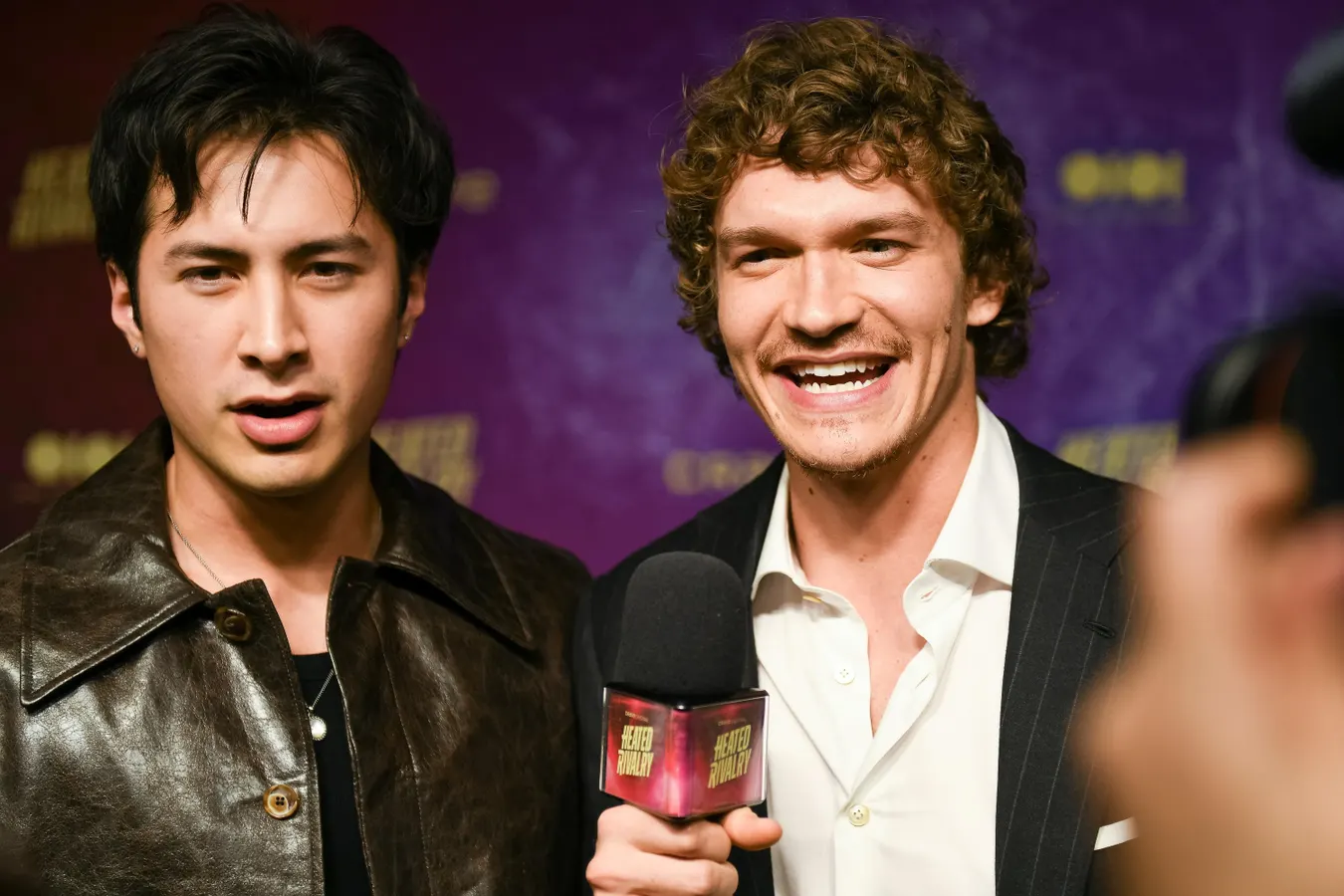

TORONTO, ONTARIO – NOVEMBER 24: Hudson Williams and Connor Storrie attend the premiere of “Heated Rivalry” at TIFF Lightbox on November 24, 2025 in Toronto, Ontario. (Photo by Harold Feng/Getty Images)
Getty Images
The Crave smash hit isn’t just sustaining momentum between seasons — it’s building an entirely new kind of fandom infrastructure.
There’s an unspoken rule in the digital age of entertainment: when the cameras stop rolling, so does the conversation. Heated Rivalry didn’t get that memo.
Since the Canadian-produced hockey romance series wrapped its first season on Crave — scoring a 96% on Rotten Tomatoes and landing on HBO Max to an audience hungry for exactly this kind of emotionally devastated queer love story — the show has somehow only grown louder. No new episodes. No official promotional push. Just a fandom that has refused, categorically, to let go.
And now, as summer approaches, the cultural machinery around Shane Hollander and Ilya Rozanov is expanding in directions that no studio greenlit and no algorithm predicted.
The Stars Are Now Fashion Fixtures
If there was any remaining doubt about whether Heated Rivalry had officially crossed into pop culture royalty, the Met Gala put it to rest. Stars Hudson Williams and Connor Storrie made their Met Gala debuts this month, walking the carpet for the first time after being launched to stardom earlier this year. Storrie arrived in a polka-dot halter-top ensemble by Saint Laurent’s Anthony Vaccarello, accessorized by Tiffany & Co., while Williams turned up in a custom Balenciaga look styled by Anastasia Walker, a baby blue suit with black embellishments and a dramatic cape draped from the waist, with makeup and hair inspired by Darren Aronofsky’s Black Swan. Williams told Vogue he wanted the look to be an ode to cinema. The looks were bold, singular, and completely unbothered by the weight of a first appearance on fashion’s biggest night.
The two actors were spotted partying together at the after parties, fueling the intense online discourse around the pair that fans have dubbed “HudCon” — a portmanteau of their names and a shorthand for the fandom’s ongoing fascination with their off-screen dynamic. Whether that discourse is warranted or simply an extension of the fandom’s love for the on-screen characters is almost beside the point. The cultural conversation is happening, and it’s happening loudly.
The Fans Built Their Own Universe
Perhaps the most remarkable aspect of the Heated Rivalry phenomenon is how little of it is officially orchestrated. Across the country, fans have been hosting watch parties, trivia nights, themed raves, and look-alike contests, a sprawling ecosystem of fan-generated events including watch party and trivia nights, themed raves in Brooklyn, and look-alike contests that have turned the show into a year-round social occasion rather than a seasonal television event.
TV watch parties, as a format, are having a broader renaissance right now, but Heated Rivalry has become one of its defining examples, alongside Survivor and Traitors, as a show fans want to experience collectively, in real time and real life.
And then there’s what’s happening Off-Broadway. Following eight sold-out concert presentations, Heated Rivalry: The Unauthorized Musical Parody has moved into a full Off-Broadway run, with Broadway veterans Jay Armstrong Johnson as Ilya Rozanov and Jimin Moon as Shane Hollander. The show’s tagline describes Shane’s journey from “power center to power bottom,” and somehow that sentence captures exactly why this fandom is the way it is.
Pride Month Just Got a Headliner
The institutional recognition keeps coming. NewFest, New York’s leading LGBTQ+ film and media organization, has included Heated Rivalry as a centerpiece of its sixth annual NewFest Pride summer film series, with a free public outdoor screening at Pier 17 at South Street Seaport on May 31. NewFest Executive Director David Hatkoff called the lineup “unapologetically dazzling,” saying “our community doesn’t wait for permission to celebrate” — and framing the Pier 17 screening as emblematic of Pride existing at the intersection of party and protest.
For a show about two closeted professional athletes navigating the cost of hiding who they are, being screened as a free, open-air Pride event in New York City is not a small thing. It’s a full-circle moment that the story itself seems to have been building toward.
TORONTO, ONTARIO – NOVEMBER 24: Rachel Reid attends the premiere of “Heated Rivalry” at TIFF Lightbox on November 24, 2025 in Toronto, Ontario. (Photo by Harold Feng/Getty Images)
Getty Images
Spotify Makes Its Move
Spotify made its most romantic booking of the year: a private immersive event in New York City, bringing together fans, tastemakers, and author Rachel Reid herself for an evening built around the Heated Rivalry universe and the Books on Spotify experience. The evening spotlighted two of Spotify’s newest features: a partnership with Bookshop.org that lets users purchase print editions directly through the app, and Page Match, a tool that lets readers transition seamlessly between audio, print, and e-book formats without losing their place in the story.
That Spotify chose Heated Rivalry as the vehicle to introduce these features to the cultural conversation says everything. This isn’t a niche romance novel phenomenon anymore. It’s a tent pole.
The Formula for a Cultural Institution
What Heated Rivalry has accomplished in the months since its first season is something the industry talks about endlessly but rarely actually achieves: it built a fandom infrastructure rather than just an audience. The difference is significant. Audiences watch and move on. Fandom infrastructure means the show lives between seasons in watch parties, unauthorized musicals, Met Gala fashion, Spotify activations, and free screenings at iconic New York venues.
The series, created by Jacob Tierney and based on Rachel Reid’s 2019 novel, follows rival professional hockey players Shane Hollander and Ilya Rozanov, whose intense on-ice animosity conceals a secret romantic relationship that develops over several years. That premise — built on longing, secrecy, and years of unresolved tension — turns out to be extraordinarily good at generating exactly the kind of emotional investment that sustains fandoms between content drops.
With Season 2 production set to begin this summer, and Unrivaled on the horizon with promises of complexity and friction for Shane and Ilya’s next chapter, the question isn’t whether Heated Rivalry can hold on to its cultural moment. It’s how much bigger it gets when there are actually new episodes to talk about.
The off-season, it turns out, was never really an off-season at all.













Leave a comment