


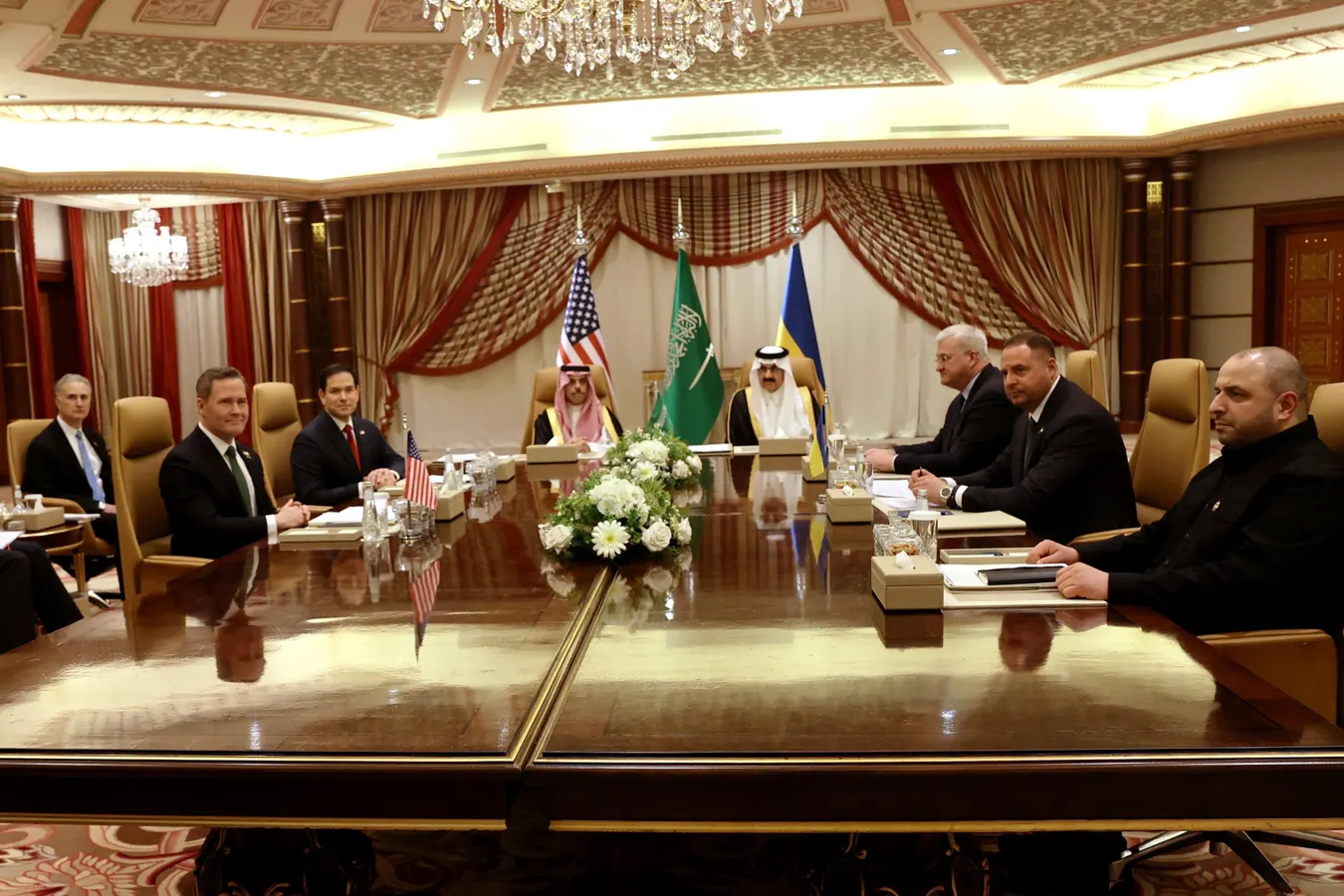

Ukraine’s Drone expertise has opened the doors to collaboration with Gulf countries in ways that could displace US military options (Photo by Salah Malkawi/Getty Images)
Getty Images
Having turned things around on the battlefield and changed the nature of modern warfare in the process, Ukraine is now about to transform the world in yet another leap forward – by becoming a geopolitical power. Hitherto, most countries who worked with Ukraine did so as providers of support. That they did so in drip-feed style, often too little too late, forced Kiev to develop its own initiatives for survival. That habit of enforced self-sufficiency has now allowed it to move from defense to offense on multiple fronts, including the area of geopolitical influence – an area in which no one thought it could compete against Russia. Until now.
Here are some instances: most recently Kyiv has offered to help Moldova militarily contain the next-door threat of Moscow’s client enclave, Transnistria, with troops and advisers and tech knowhow. This is a particularly shrewd gambit – on multiple symbolic and practical levels. It counters Russia’s moves on a wider chess board that will affect Ukraine – in this case the Kremlin’s attempt to intimidate Europe from its eastern flank to stop helping Ukraine. It demonstrates to European countries that Ukraine will defend Europe against direct threats, even if the EU can’t or won’t, by making direct deals with member states. It pre-empts the menace of a looming political upheaval in nearby Romania where a pro-Moscow populist seems likely to win office in the next election. It bypasses all the red tape of Ukraine’s accession to the EU or Nato by simply reversing the process and putting Ukrainian troops in Europe.
A comparable entente is being discussed currently between the US and Ukrainian military. While the White House seems determined to stop providing aid to Ukraine to defend itself, the Pentagon takes a more exigent practical position. The armed services chiefs know they’re lagging crucially behind in the techniques of modern drone warfare, and the resulting cheaper cost revolution. This applies not just to basic UAV technology but to all the related tech, the automation via AI, the drone jamming and counter jamming, aerial surveillance, the naval and robotic ground-drone tech and the like. Functional collaboration of this kind in areas so central to future planning would put the US military once again in direct symbiosis with Ukraine’s, quietly bypassing the political headwinds higher up.
But there is another factor: the danger that cheaper, quicker, less conditional help from Ukraine will displace or reduce America’s lucrative arms deals with the Gulf, worth over $100 billion over the last decade. Kyiv’s new alliances there puts it in a position to make counter-conditions on the Pentagon offer. Here, again, Ukraine’s drone ministry to other countries gives it geopolitical clout across the globe.
In the Gulf and Saudi, the shock of vulnerability to Iran’s Shaheds and missiles has opened a door to Kyiv’s military presence. The damage inflicted by Iran, with help from Russia and China, was sufficiently widespread – despite expensive US supplied defenses – as to threaten the Gulf’s entire economic model for the foreseeable future. Ukraine’s involvement provides know-how not just defensively against Shaheds but an affordable counter-threat of massed waves of precision strikes against Iranian targets.
Another fundamental innovation, one that nobody has yet factored into the future of warfare, is that Ukraine has adapted drone usage essentially to replace the need for boots on the ground – in effect drone war in place of ground war. We have seen the application of this in multiple ways such as targeting soldiers in trenches, tree lines, houses, cars and numerous other places where ground troops were hitherto needed to the job. In effect, the old house-to-house fighting or even the practice of patrolling streets will no longer be necessary.
This particular breakthrough would critically alter the US military’s impasse in Iran, for example, where they have failed to put pressure on the regime after massive aerial bombing devastation because the next step would require invasion. It is, in effect, the equivalent of Israel’s pinprick mass elimination of Hezbollah elements in Lebanon via their cellphones. Except that this is no one-off coup de guerre but a continuous campaign strategy – which would overcome Washington’s paralysis in the standoff against the Iranian regime.
The principle for the US army in the region applies not just in Iran. Recent reports indicate many of the missiles that hit the installations of Gulf countries came from pro-Iranian elements within Iraq. The perpetrators melted away into city streets or garages. Mobile or small cluster targets hiding in residential areas are far better dealt with by drones, causing minimal surrounding damage, especially when dealing with a nominally friendly country like Iraq.
Above all, Ukrainian Gulf presence means it can reach across continents to neutralize Moscow’s international strategic depth by directly hitting from nearby at Iran, Russia’s staunchest helpmate in the war against Ukraine. In the Baltics and Taiwan similar ententes with Ukraine are under way.
Russia’s sheer size, spanning from the Atlantic to the Pacific, the north pole to the mideast, has meant it can bring to bear allies from one end of the world to conflicts in the other. North Korean troops, for example, or war materials from China, for use in Ukraine. Moscow is fighting a world war, even if Western countries won’t acknowledge it. Ukraine is the only country actually addressing the challenge wholistically. Ukraine’s drone diplomacy worldwide is allowing it to orchestrate its strategic needs in ways hitherto reserved for superpowers.
















Leave a comment