


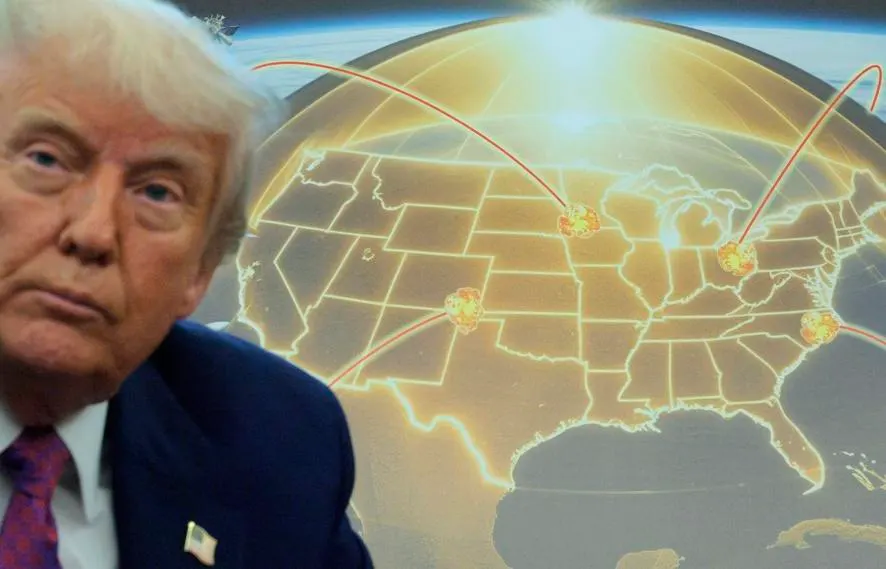

WASHINGTON, DC – MAY 20: U.S. President Donald Trump speaks in front of a map of Trump’s proposed “Golden Dome” missile defense system in the Oval Office at the White House on May 20, 2025 in Washington, DC. President Trump announced his plans for the “Golden Dome,” a national ballistic and cruise missile defense system. (Photo by Chip Somodevilla/Getty Images)
Getty Images
The leaders of the military tech sector I Silicon Valley and beyond are nothing if not self-assured, confident that they can achieve capabilities never before accomplished at costs that are lower than their competitors in the legacy defense firms like Lockheed and RTX. There is some evidence to support their views, like Space-X’s displacement of Boeing and Lockheed Martin as the primary supplier of space launch services for the U.S. military, or the potential for drones to provide air combat capability at a lower cost than an air fleet composed mostly of complex piloted aircraft like the F-35.
Anduril founder Palmer Luckey took these arguments to an optimistic extreme when he told an interviewer for CNBC that if the Pentagon stopped buying the wrong things the United States could be defended with a Pentagon budget of $500 billion per year, one half of current levels and one-third of the Trump administration’s latest budget request for the department. To be exact he said the following:
“We need to get our act together so that we can get everything that currently costs $1.5 trillion for well under a trillion dollars,” he said. “I would love to see a sub $500 billion defense budget if it’s getting us the things that we need.”
Perhaps so, but a cut of that magnitude cannot be achieved by paring the weapons budget alone. It would require a reduction in the size of the armed forces and a more realistic strategy that isn’t premised on the U. S. seeking the ability to intervene anywhere in the world on short notice.
Luckey has one possible answer to that problem in his suggestion that the United States put more emphasis on giving allies the wherewithal to defend themselves. But this would require a more discriminating choice of clients, to avoid aiding wars like Saudi Arabia’s brutal campaign in Yemen or Israel’s mass slaughter in Gaza.
Putting aside these larger strategic questions, what are the “wrong weapons”? One candidate is surely President Trump’s proposed Golden Dome missile defense system, or at least the version that claims it can produce a leak proof defense against missiles of all sorts, with interceptors in space playing a prominent part.
The dream of a leak proof missile defense system goes back at least as far as President Ronald Reagan’s pledge to develop one in his 1983 “Star Wars” speech. Over 40 years and $350 billion in tax money later, investments in missile defense have not even come close to achieving that goal, and there has not been a single test that comes close to replicating what would be needed to thwart an actual attack by a significant number of long-range nuclear armed missiles.
The problem is that an incoming warhead could reach a speed of 15,000 miles an hour, and in the weightless environment of space it could be accompanied by coated balloons that would be indistinguishable from an actual warhead. An attack by hundreds of missiles involving thousands of warheads and decoys would be enough to overwhelm any defensive system, no matter how extensive. As a report by Taxpayers for Common Sense has noted, estimates of how many interceptors would be needed to even attempt to mount a leak proof defense come in at up to 1,600 interceptors per incoming warhead. An analysis by the conservative American Enterprise Institute indicates that an expansive version of Golden Dome could cost up to $3.6 trillion in the years to come.
In addition to the high cost and extremely low prospects for success, the plan to put interceptors in space as part of a Golden Dome system is dangerously misguided. While it is hard to hit a fast moving nuclear warhead, it is relatively easy to hit a civilian or military satellite moving in a predictable orbit. That’s why even during the height of the Cold War the norm against putting weapons in space was maintained. Breaking that stricture now would put all manner of civilian and military activities tied to satellite-based communications at risk. That’s a high price to pay for a missile defense system that cannot meet its most ambitious objectives.
The above-mentioned realities pose a moral and practical dilemma for defense firms in general and military tech firms in particular. Will they publicly acknowledge the challenges of building a leak proof defense against missiles of all kinds and propose a less expensive, more realistic alternative, or will they let the administration’s unrealistic goals go unchallenged and take government funding based on those premises? It’s obviously not just up to defense executives to inject a note of reality into the Golden Dome debate – scientists, members of Congress, Pentagon analysts, the media, and the broader public need to scrutinize the claims being made for Golden Dome as well. But the voices of leaders of the tech sector who stand to benefit from Golden Dome spending whether the project produces a useful defense system or not would be particularly powerful.
















Leave a comment