


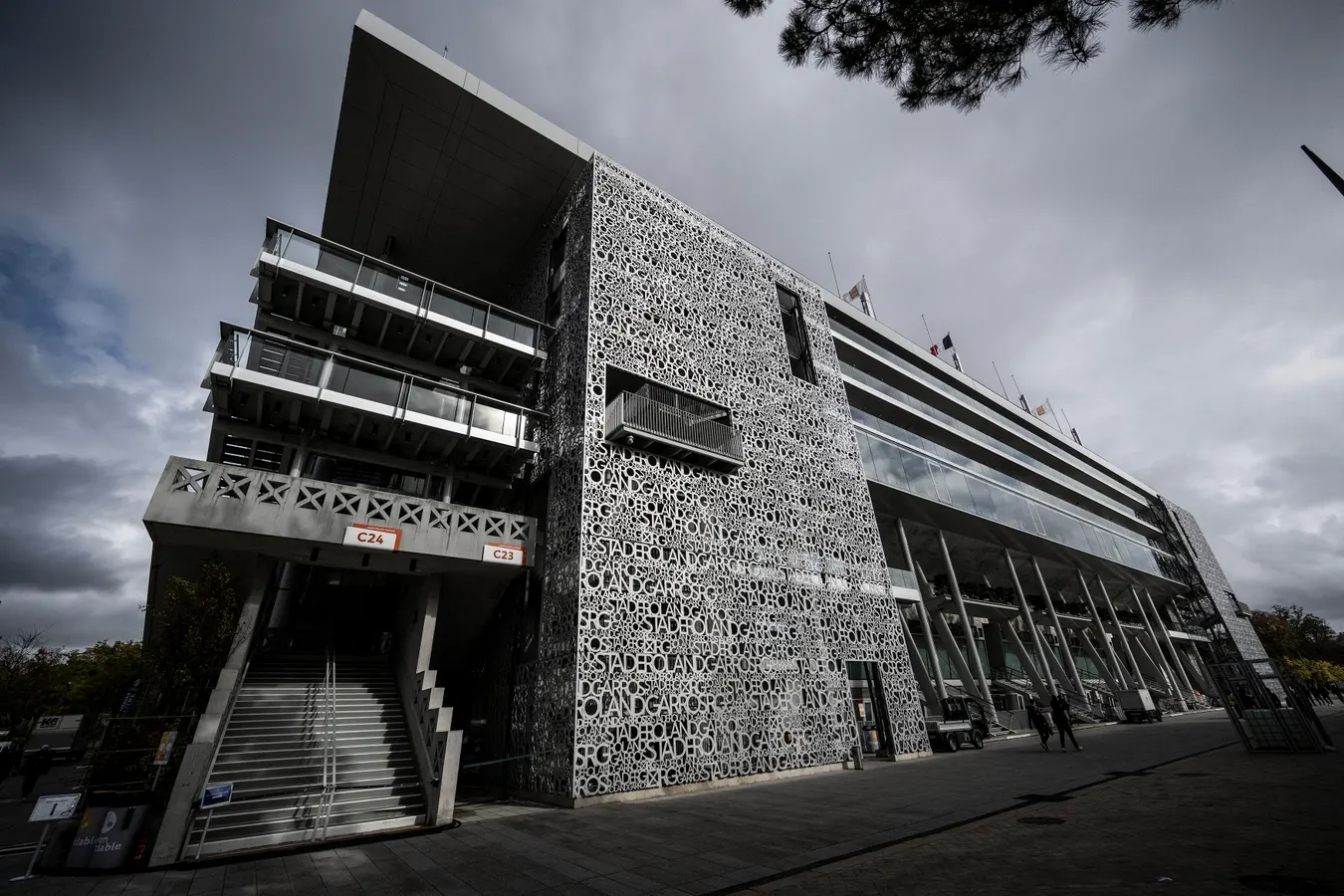

An exterior view of Court Philippe Chatrier in Paris, France. (Photo by Dean Treml/Red Bull via Getty Images)
Red Bull via Getty Images
Credit the Four Musketeers of French tennis for what we know as Roland Garros. French tennis wasn’t created by the quartet of players Jean Borotra, Jacques Brugnon, Henri Cochet and René Lacoste, but the group—Les Quatre Mousquetaires—really made French tennis popular in the 1920s. They also gave Roland Garros the start it needed.
French tennis began its one-day men’s singles championship competition for members of French clubs in 1891, holding the event in the Stade Francais club in Paris. Six years later women joined, and in 1925 international competitors were welcomed to an event that was bouncing between Stade Francais and Racing Club de France.
But it was the Four Musketeers thrilling Davis Cup victory over the United States in 1927 that gave French tennis a reason to focus on stadiums. Ahead of the Davis Cup defense in 1928, the Four Musketeers called for a stadium worthy of the competition. Stade Francais stepped up, gifting over seven acres of land near Porte d’Auteuil to the French Tennis Federation. It came with one condition: the new stadium be named Roland Garros after a club member and World War I aviation hero who had died 10 years prior.
A view of the courts outside Court Suzanne Lenglen at Roland Garros in Paris. (Photo by Julian Finney/Getty Images)
Getty Images
The original Centre Court of Roland Garros opened in 1928, built in just eight months with an initial seating capacity of 10,000. The quickly slapped together stadium featured cement loge boxes and temporary wooden stands. Architect Louis Faure-Dujarric used the Saint Andrew’s cross design to help keep costs down while offering the site some architectural flair.
The main stadium hasn’t moved since.
But 1928 wasn’t just about one stadium. The Roland Garros site also opened Court 2 and Court 3 in that initial year. One year later the wooden stands were gone, replaced by concrete, beginning the gradual expansion of the grounds.
MORE: Behind The Scenes U.S. Open’s Player Spaces
A major stadium expansion in 1979 pushed seating on the main court, added another stadium court and crafted three partially sunken courts. By 1980, Roland Garros was up to 10 courts. Over the next two decades, the original seven acres stretched to 21 acres, complete with the main stadium named Court Philippe Chatrier (the name was added in 2002), the 1994-built Court Suzanne Lenglen and 20 total courts.
A picture taken from inside the contemporary greenhouses of Auteuil shows the new Simonne Mathieu tennis court in Paris. (Photo PHILIPPE LOPEZ/AFP via Getty Images)
AFP via Getty Images
Changes haven’t stopped across the smallest footprint of the four majors in tennis. Roland Garros added Court 14 in 2018 and the distinct Court Simonne Mathieu in 2019 when the site expanded into a portion of the adjacent gardens. Court Philippe Chatrier received a major refresh and retractable roof in 2020 and Court Suzanne Lenglen was adorned with a roof in 2024.
The historic Court Philippe Chatrier underwent demolition after the 2018 tournament, reworked in one year with a new seating bowl for the up to 15,000 fans. The rebuild of the seating bowl also allowed for a new space for players beneath the stadium (and a tunnel connecting to Lenglen).
MORE: Unraveling The Labyrinth Of Player Spaces At The Australian Open
Court Simmone Mathieu opened in the southeastern part of the grounds near the Serres d’Auteuil gardens, the third-largest stadium on the grounds with 5,000 seats. The court is surrounded by four greenhouses, inspired by the architecture of the adjacent historic Formigé greenhouses. The semi-sunken nature of the court design encourages the stadium to blend into the gardens and greenhouses and houses a collection of tropical plants from the Americas, Africa, Oceania and Asia.
In 2019, Roland Garros also opened the refreshed Fonds des Princes section of the site with updates to courts 10, 11, 12, 13, 15 and 16. Courts 2 and 3 opened in 2020, along with all the outdoor courts getting lights. In the ensuring years, the upgrades continued with the two retractable roofs, new courts 6 and 8 and refreshed fan spaces.
Now approaching 100 years of existence, the history of Roland Garros has grown from the success of the Four Musketeers.
















Leave a comment