


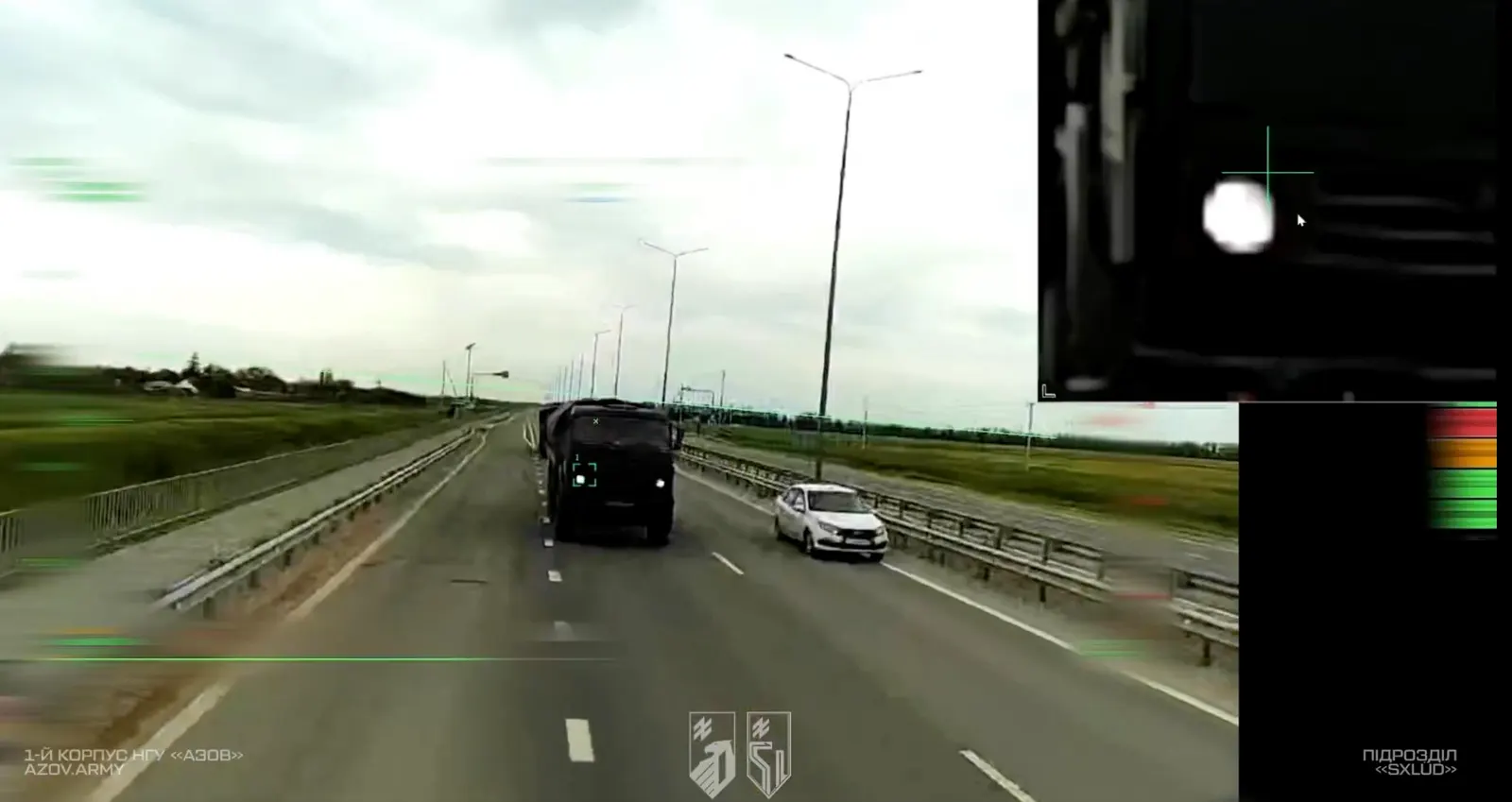

AI-enabled drone strike by Ukraine’s 1st Azov Corps.
Social Media Capture
Ukraine’s drone war is moving deeper into Russia’s rear, and the land bridge to Crimea is becoming a dangerous place to drive.
In recent weeks, Ukrainian drone units have intensified attacks on Russian logistics routes across occupied southern Ukraine. Open-source analyst Clément Molin has counted more than 125 strikes along the corridor, where Russian forces rely heavily on truck convoys to move troops, fuel and ammunition to the front.
Ukraine Targets Russia’s Land Bridge To Crimea
Much of that traffic runs from Rostov-on-Don through occupied Mariupol, then either west toward Crimea along the M-14 or north toward Donetsk along the H-20, both now under intensive drone attack designed to disrupt ammunition, fuel and reinforcement flows before they reach the front.
Russia has allocated roughly $11.8 billion for infrastructure across occupied Ukraine, including the “Azov Ring” highway network linking Russia to Crimea through the occupied south, according to a Reuters report from March 2026.
Russian military blogger Vladimir Romanov recently claimed Ukrainian strikes along the corridor were already contributing to fuel shortages in Sevastopol, describing them as the “beginning of the consequences” of systematic attacks on oil infrastructure and tanker trucks supplying Crimea.
Many of those strikes are being carried out by larger numbers of AI-assisted drones operating deeper behind the front, giving Ukraine a growing ability to hunt Russian logistics at scale.
For Russia, the problem is not just the number of drones. It is where they are hunting. The Institute for the Study of War wrote on May 25 that “Ukraine’s operational art has matured,” with commanders combining shaping operations, intermediate-range strikes and tactical drone superiority to support battlefield maneuvers.
George Barros, director of innovation and open source tradecraft at the ISW, told me that “Ukrainian forces do appear to have a marginal upper hand in terms of technology and drone innovation.”
Roy Gardiner, an open-source weapons analyst and former Canadian officer, told me Ukraine has sharply expanded the number of drones available for mid-range strikes this year, allowing attacks much deeper behind the front. The growing use of AI-enabled Hornet drones, he said, is creating growing problems for Russian forces in rear areas they once considered relatively safe.
Dmytro Putiata, a drone operator with Ukraine’s 20th Unmanned Systems Brigade, told me Ukraine is “actively undermining Russian logistics” with drones designed for operational-depth strikes. Alongside larger drones carrying 50-100 kilogram warheads, he said Ukraine is increasingly using cheaper systems capable of flying 100-150 kilometers to hit logistics routes and other military targets.
Gardiner said Hornet attacks on Russian logistics vehicles are helped by Starlink connectivity and AI autonomy, making them harder for Russian jamming to stop. He added that the growing number of simultaneous Hornet strikes points toward more coordinated swarm-like tactics.
But operating deeper behind the front also creates new communications vulnerabilities. Starlink is not invulnerable. Ryan O’Leary, an American former fighter who led the Chosen Company volunteer unit in Ukraine, told me Ukrainian drone units need backups such as mesh radio networks, also known as MANET systems.
Unlike a traditional one-to-one drone link, a mesh network turns drones, ground stations and unmanned vehicles into relays. If one link is jammed or lost, the signal can reroute through another node, making the network harder for Russian electronic warfare to cut. As Ukraine pushes drones farther behind the front, autonomy is becoming increasingly important.
AI And Swarm Tactics Expand Ukraine’s Reach
Viktor Sakharchuk, CEO of Twist Robotics, told me AI drone systems require extensive frontline training data and constant battlefield adaptation.
On forested fronts such as Kharkiv, AI-assisted targeting can struggle. Trees, shadows and cluttered terrain can confuse algorithms. But the land bridge to Crimea is different. Open highways across the occupied territories leave trucks, fuel tankers and military vehicles exposed to both human operators and AI-assisted targeting.
Deborah Fairlamb, founder and managing partner of Green Flag Ventures, told me that autonomy is now about decision-making: if one drone in a swarm is destroyed, others adjust automatically. “Ukraine has built massive video databases since 2014, particularly after 2022,” she added. “They are using that data to train algorithms to recognize objects and battlefield scenarios.”
I saw Hornet drones in action with Ukraine’s Khartiia Brigade last year. During strikes, operators watched AI-assisted markers and automatic target cues appear across their screens, helping crews identify targets and make faster decisions even when electronic warfare disrupted communications.
On May 26, the open-source monitoring group Oko Gora reported that more than 60 burned trucks and fuel tankers had been documented on the M14 and H20 highways over the previous three weeks. That figure excludes lightly and moderately damaged vehicles, and Oko Gora said it likely represents only a small share of total Russian military traffic.
For Kyiv, the aim is not to destroy every Russian vehicle. It does not have to. Cutting the flow of fuel, ammunition and spare parts may be enough. “The vehicles transporting logistics and conducting troop rotations are also being actively attacked,” Putiata said. A few burned ammunition trucks and fuel tankers can matter more than one destroyed gun.
Recent 1st Azov Corps footage shows the logic in action. A Russian “Patrul” 4×4 appears to be hit first. Follow-on drones then target the recovery vehicles sent to retrieve it, turning one strike into a cascading logistics loss.
Kyle Glen, an open-source analyst, told me these attacks can already be described as swarms. Some videos show multiple drones operating simultaneously along the same routes.
Glen said he initially assumed a reconnaissance drone was guiding the strike drones, but the simpler explanation may be that Ukraine is launching enough Hornets to find and hit targets of opportunity along the roads.
Counters such as drone nets take time to build, and Russian logistics units cannot simply stop using the highways.
In a social media post on May 27, Ukraine’s 412th Nemesis Brigade said the strikes have already forced Russian authorities to restrict heavy military traffic along parts of the R-280 “Novorossiya” corridor linking Mariupol, Melitopol and Crimea.
The brigade claimed that attempts to use dirt and field roads have also struggled, as Ukrainian drones can still detect and strike vehicles off the main highways. The brigade said it is using previously undisclosed strike “wings” developed with manufacturers for this mission, suggesting Ukraine continues to invest in new drone systems specifically for deep logistics interdiction.
That is the logic behind Ukraine’s drone interdiction campaign. The farther drones operate from the front, the larger and more important the cargo is likely to be.
Barros said sustained drone strikes at operational depth can help set the conditions for Ukrainian infantry to retake ground, not by producing sudden breakthroughs, but by gradually exhausting Russian forces, disrupting rotations and weakening resupply. For Russia, the land bridge to Crimea is becoming harder to protect and more costly to use.















Leave a comment