


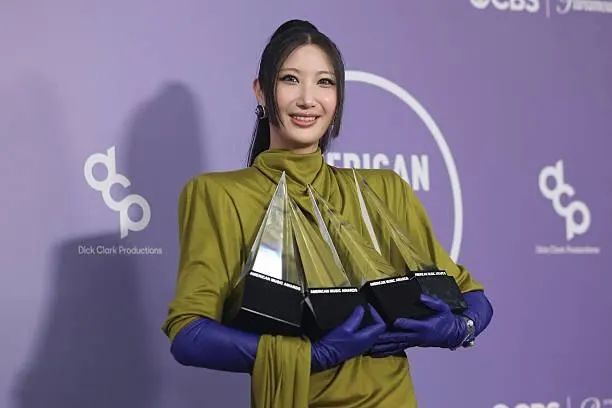

EJAE, winner of Song of the Year, Best Pop Song and Best Vocal Performance for “Golden,” poses in the press room during the American Music Awards at the MGM Grand Garden Arena in Las Vegas, Nevada on May 25, 2026. (Photo by Ian Maule / AFP via Getty Images)
AFP via Getty Images
Ever since KPop Demon Hunters premiered on Netflix, EJAE—the Korean-American singer-songwriter who co-wrote and performed many of the songs from the film’s soundtrack—has seemingly been everywhere, zipping across the globe to give interviews to domestic and international outlets and performing on coveted stages like the Oscars, Coachella and the Macy’s Thanksgiving Day Parade.
Her smash hit “Golden,” the KPop Demon Hunters banger that she co-wrote with Mark Sonnenblick and producers from THEBLACKLABEL, has racked up billions of streams and a slew of accolades, including a Golden Globe, a Grammy and an Oscar, becoming the first K-pop song to win any of the three awards. More recently, it also won three American Music Awards, including Best Vocal Performance, Best Pop Song and Song of the Year, while KPop Demon Hunters took home Best Soundtrack at the 2026 AMAs.
Last month EJAE was honored at the 2026 Billboard Women in Music, where she, Audrey Nuna and REI AMI—who altogether provide the singing voices for the fictional K-pop trio HUNTR/X in KPop Demon Hunters—were named Billboard’s Women of the Year. EJAE has also recently released two singles, “In Another World” and “Time After Time,” and was profiled in The New York Times earlier this month.
For a former K-pop trainee whose dream of debuting never materialized, hers feels like a Cinderella story. After training for over a decade for a shot at K-pop stardom, EJAE was eventually dropped by her agency and never given the chance to debut. She found comfort in songwriting instead, going on to pen K-pop hits like Red Velvet’s “Psycho” and aespa’s “Drama” and “Armageddon.” But her greatest success wouldn’t come until the 2025 release of KPop Demon Hunters, Netflix’s most successful title ever.
LOS ANGELES, CALIFORNIA – FEBRUARY 01: (L-R) Audrey Nuna, EJAE, and Rei Ami attend the 68th GRAMMY Awards on February 01, 2026 in Los Angeles, California. (Photo by Neilson Barnard/Getty Images for The Recording Academy)
Getty Images for The Recording Academy
Earlier this year, I spoke with EJAE shortly after her Grammy win and before she would go on to win at the Oscars. At the time, she was still taking in the moment with a kind of gratitude she had never felt before.
“Honestly, especially with the Grammys, it means so much to me as a Korean American person, because you don’t see that many Korean American girls in the industry, especially in songwriting. It’s so rare,” she told me. “For me, if I were growing up right now, that would give me courage to go that route.”
During our interview, she reflected on her Korean American identity, the impact of her song “Golden,” and the need for Asian and Asian American representation.
Below are excerpts from our conversation.
EJAE on Asian and Asian American representation in music and the future of K-pop recognition at American awards shows
Regina Kim: What impact do you think “Golden” winning a Grammy will have on the future of K-pop representation at award shows? Is there anything that you hope to see in the future around K-pop recognition at these award shows?
EJAE: I think there needs to be more Asian representation, personally speaking. The fact that Korea is getting more known is so cool to me, because growing up in the States, I had friends who didn’t know where Korea was, or what it was. That famous “Are you North Korean or South Korean?” question. It’s so cool to see the evolution of it all.
KPop Demon Hunters was a great bridge. Because in one hour and 30 minutes, you’re able to see the essence and the beauty of Korea. And I love that it was animation, because with animation, you can express things a lot more creatively. With live action, it’s more limited.
I just think it was a beautiful bridge, and it doesn’t stop here. This is just the beginning.
HOLLYWOOD, CALIFORNIA – MARCH 15: EJAE attends the 98th Oscars at Dolby Theatre on March 15, 2026 in Hollywood, California. (Photo by Emma McIntyre/Getty Images)
Getty Images
How working on KPop Demon Hunters made EJAE examine her Korean American identity
Kim: How do you navigate your dual identity as a Korean American, especially now that you’re essentially representing Korea and Korean culture on the global stage? Has KPop Demon Hunters changed your relationship with your Korean heritage in any way?
EJAE: Absolutely. The movie—not just when it came out, but writing for the film—has changed everything. It really made me go, “I’m Korean American. I’m not Korean or American; I’m Korean and American.” That’s a very important distinction, because I’m not picking and choosing what is Korean or American. It’s just who I am. There are some parts of me that’s more American, some parts of me that’s more Korean. And it was really fun to dive into my Korean side and learn more about that side of myself.
EJAE on how “Golden” has given hope to so many people
Kim: I know you mentioned stories of nurses singing “Golden” to patients, and parents singing it to their kids in hospitals. And you talked about how fans have reached out to you to tell you how much impact the song has had on them. Are there any particular stories that really stood out to you or really moved you that you might want to share?
EJAE: There is. Oh God, I don’t know if I should, because some are personal. But there is one that stood out to me from the very beginning. There’s a girl who I met at a wedding; her fiancé [pulled me aside] and was like, “Hey, just want to let you know I’m so thankful. My fiancée—her family member passed away, and she’s been very sad. I turned on KPop Demon Hunters—because, you know, the name is really interesting—and once your song started coming out, she started slowly coming to the living room to watch it and was completely immersed in the film. And after the film, she felt completely better. The song ‘Golden’ helped her get through the grieving process.”
That made me feel incredible. That’s why I write. My dream as a kid—if I were to be a K-pop idol, I wanted to be a music therapist afterwards. Music is therapy. It helped me, so to have the same effect for someone I don’t know who went through something so hard…what can I say?
Kim: Wow, that’s such an amazing story. Have you encountered any interpretations or emotional reactions from fans that have changed how you understand “Golden,” even though you wrote it?
EJAE: Yeah. There was a video that was sent to me where there was someone who was passing away, and the nurse came with a guitar and did a rendition of [“Golden”] for the patient about “you’re going up, up, up” to heaven. And that it’s gonna be okay. It makes me really emotional right now, but that’s the last song they’re listening to before they pass. That’s crazy, you know? To have that song be your last song before you pass is such an honor.
Kim: Oh my gosh. Okay, I did not expect to cry.
EJAE: It’s hard not to cry with that story.
Kim: Why do you think “Golden” has resonated so well with so many people across different cultures, including with people who don’t consider themselves to be K-pop fans? Like that’s what’s really surprising, at least for me.
EJAE: Because this film—yeah, it’s technically an animation. Yes, they’re fictional characters. But the emotions that these characters are feeling are absolutely real, and it’s very human. And I think right now, hopelessness is a very common feeling that everyone’s feeling. So the song represents hope. I think that’s why it resonated with a lot of people, not just kids but with adults. Everyone feels hopeless.
[There’s] one thing that a friend told me that his friend told him: “Right now the world is going through a dark time, and KPop Demon Hunters gave my kids a light to hold on to. I think that’s why it’s so special.”
And I’m like… (jaw drops). That’s the thing about the beauty of films and music, right? I think that’s why a lot of people leaned on it.
EJAE on what kept her going all this time
Kim: What kept you going this whole time, despite not being able to debut as a K-pop idol? Were there special mantras that you kept saying to yourself, anything that you did or said to yourself to stay motivated and to continue in the music industry?
EJAE: After getting dropped [as a K-pop idol], I was very determined to get through the depression, and what helped me was songwriting. Once I fell in love with it, I gave it my all. So I think that’s where the tenacity or resilience came from. I was desperate to be healed, and it was my way of feeling hopeful.
Even with songwriting, obviously we have our ups and downs. I think for me, what kept me going is always realizing that even the most successful people have those moments as well. You’re not alone in that; it’s part of the process. And just like in the film, depending on your loved ones. You have to be able to talk to your loved ones about things. This was not a journey on my own—so many people helped me. I leaned on a lot of people.
But the biggest thing that helped me keep going is to always have a growth mentality. You’re not going to be perfect the first time. Even if you are successful, there’s so much to learn. I still feel like I have to keep growing. So those are the things that kept me going.
EJAE on her grandfather Shin Young-kyun, a legendary Korean actor
Kim: You’re the granddaughter of Shin Young-kyun, who is a legendary Korean actor. Did that influence you at all about going into entertainment, and has your family been supportive of your decision to pursue music this whole time?
EJAE: My mom did. My grandpa, sort of, because he’s very protective. He’s in the entertainment industry, so he was more against it. Singing-wise, he was for it, but songwriting-wise, he was actually against it. Songwriters didn’t make much money, and it was a very unstable career back in his day. He was born in 1928. So he was worried for me and was kind of against it.
But I think what I learned from him was, just looking at his life, he is the most resilient person ever. He always [told me] from a very young age (switches to Korean) “You have to work hard!” So that work ethic and mindset of you have to work hard in what you do in order to find success was always embedded in my head.
This interview was condensed and edited for clarity.
KPop Demon Hunters is currently streaming on Netflix.













Leave a comment