


Topline
This growing list captures the controversial allies of President Donald Trump saying they’ll apply for payments from his so-called $1.8 billion anti-weaponization fund—even as it faces criticism, and court challenges, calling it an unlawful move by Trump to seek a payout for political allies.
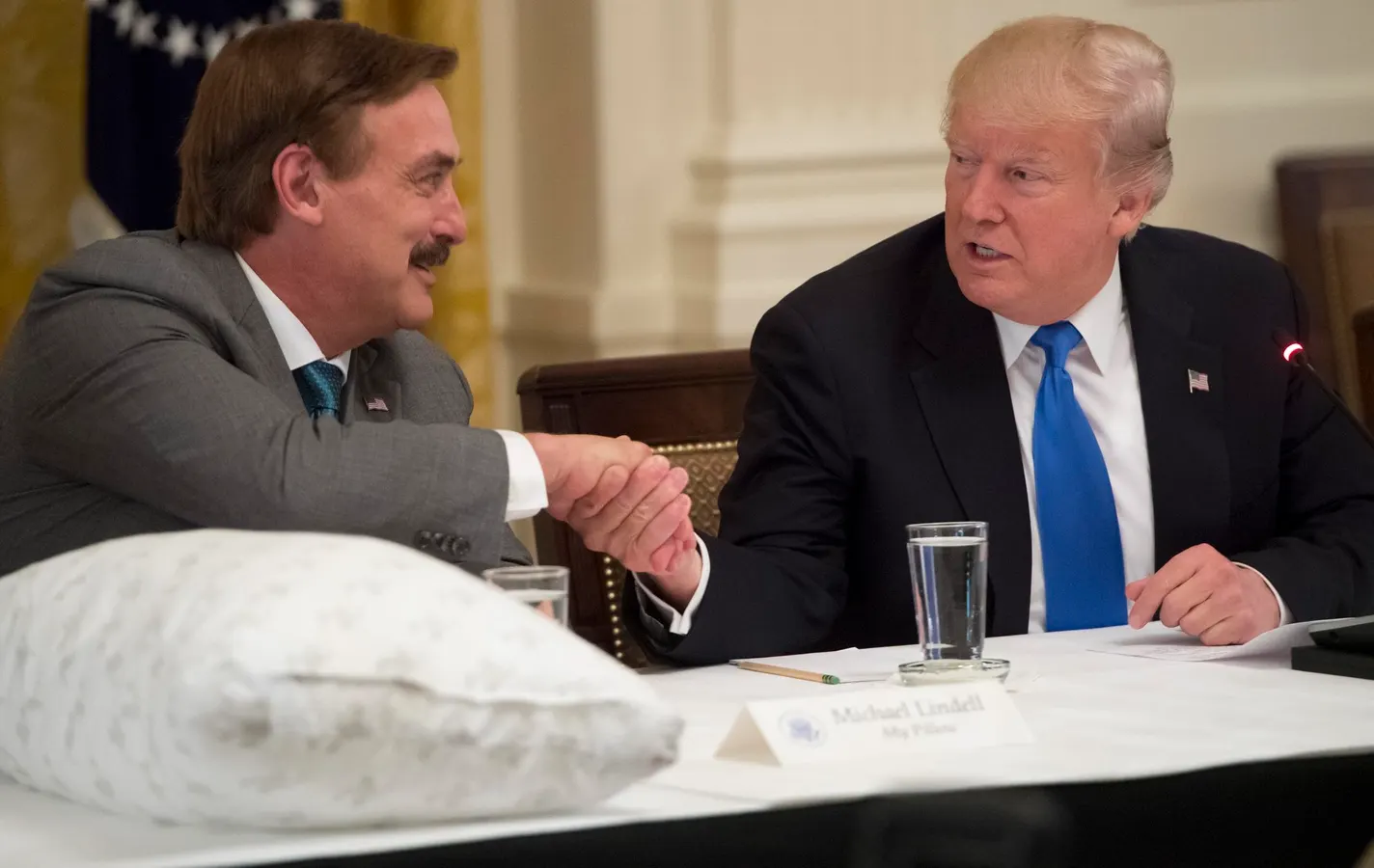
Trump shakes hands with Mike Lindell, founder of My Pillow, on July 19, 2017.
AFP via Getty Images
Key Facts
Michael Caputo: A former Health and Human Services spokesperson during Trump’s first term, Caputo was the first known applicant to the fund and is seeking $2.7 million, claiming he was unfairly targeted by an FBI investigation into Russian efforts to interfere in the 2016 election and another government investigation into a One America News documentary he produced about former President Joe Biden and Ukraine.
George Santos (Photo credit: Getty Images): The former Republican congressman, who was sentenced to seven years in prison for wire fraud and identity theft before he was pardoned by Trump after less than three months, said he was considering applying for the fund, but wants a formal apology from the government rather than a monetary settlement, he told The Washington Post.
Michael Cohen: Trump’s former fixer-turned-nemesis who pleaded guilty to multiple criminal charges related to both his personal business and work with Trump, told The Wall Street Journal he’s already started working on his application.
Roger Stone: Pardoned by Trump in 2020 days before he was to report to prison to serve a sentence for lying to Congress and obstructing a congressional investigation, Stone told The Journal he believes he would “certainly be entitled to make a claim,” but wants to see the criteria first.
Mike Lindell: The MyPillow CEO, who aggressively amplified Trump’s false claims he won the 2020 election and helped organize the Jan. 6 protests, said he will apply for the fund, and believes his employees are entitled to compensation because his companies lost money over election-related lawsuits and government investigations into his role in the election fraud scheme.
Mark McCloskey: He and his wife notoriously pointed guns at Black Lives Matter demonstrators outside their St. Louis home in 2020, then pleaded guilty to misdemeanor charges in the incident the following year. McCloskey, who was later pardoned by the Missouri governor, represents rioters who want to apply and is also considering applying himself, telling The Washington Post the fund was “great news.”
Tina Peters (Photo credit: Getty Images): Calling Peters an “innocent grandmother,” Vice President JD Vance said it’s “reasonable for her to get some compensation,” after she was convicted and sentenced to prison for attempting to breach the state’s election system and help push unfounded claims of fraud in the 2020 election while serving as a clerk in Mesa County, Colorado. Democrat Colorado Gov. Jared Polis commuted her sentence, and she is set to be released from prison on June 1.
January 6 defendants: More than 1,500 people were prosecuted for their roles in storming the Capitol, and some have said publicly they’ve already started working on pursuing claims from the fund, while several lawyers who represent Jan. 6 defendants have said they’ve seen heightened interest from their clients, including Florida lawyer Peter Ticktin, who told ABC News he believes about 400 of his Jan. 6 clients will apply. Almost immediately after taking office, Trump pardoned all but 14 people (whose sentences commuted) convicted in connection with the Jan. 6 riots and ordered any pending cases be dismissed.
Enrique Tarrio (Photo credit: AFP via Getty Images): A former leader of the extremist group, the Proud Boys, Tarrio received the longest sentence of any Jan. 6 defendant—22 years for seditious conspiracy and other charges—before he was pardoned by Trump, and told PBS News he believes he’s owed “somewhere in the mid-tens of millions” of dollars.
Adam Johnson: Photographed carrying then-House Speaker Nancy Pelosi’s, D-Calif., lectern during the Jan. 6 attack and sentenced to 75 days in prison, Johnson announced his intentions to pursue a claim on X, writing, “what they did to me will have a generational effect on my family and their livelihoods.”
Michigan “fake electors”: Meshawn Maddock, one of the former Michigan GOP representatives accused of signing fake certificates claiming Trump won their states’ Electoral College votes in 2020, told CNN the fund was an “emotional relief.” Kevin Kijewski, a lawyer who represents another one of the accused lawmakers, Clifford Frost, also indicated his client might apply, calling the fund a “good idea.”
John Eastman: The conservative lawyer was disbarred in California earlier this year for his role in trying to help Trump overturn the results of the 2020 election and told The Washington Times podcast he is considering applying for the fund, but wants to know more details first.
Sam Nunberg: The Wall Street Journal, citing a source familiar with his plans, reported that Nunberg, a former 2016 Trump campaign aide, will seek a payout from the fund over the subpoena he was served in the investigation into coordination between the Russian government and the 2016 Trump campaign.
Rod Blagojevich: Also pardoned by Trump eight years into his 14-year prison sentence on corruption-related charges, the former Illinois governor didn’t rule out the prospect of applying to the fund, telling The Washington Post, “I’m not going to stop seeking vindication, if this is the vehicle, I haven’t given it much thought.”
Anti-abortion activists: The Justice Department specifically noted Biden-era prosecutions against people for blocking access to abortion clinics as an example of the alleged government overreach the fund is designed to address, and Steve Crampton, an attorney for anti-abortion activists told The Wall Street Journal he is “actively exploring available avenues to seek compensation for clients who were unfairly targeted by politically motivated government overreach.”
Moms for Liberty: In announcing the fund, the Justice Department falsely accused the Biden administration of calling parents who protested at school board meetings against COVID-19 restrictions and other curriculum changes, “domestic terrorists,” an apparent reference to the Biden administration monitoring threats against school officials at the time, though the administration did not refer to any parents as “terrorists.” Chief Executive of the conservative parents’ rights group, Moms for Liberty, Tina Descovich told The Wall Street Journal, “like many conservative organizations, Moms for Liberty was targeted by the Biden administration” and is “currently exploring our options to seek restitution.
t s
Donald Trump, left, outside the Federal Courthouse in Newark, N.J., with Roger Stone, the director of Trump’s presidential exploratory committee Monday, Oct. 25, 1999, for the swearing-in of Trump’s sister as a federal appeals court judge. (AP Photo/Daniel Hulshizer)
Copyright 2018 The Associated Press. All rights reserved.
Have Any Trump Foes Indicated They’ll Apply?
Yes. A group of anti-immigration protesters in Chicago who were accused of conspiracy to impede a federal agent, only for their charges to be dropped over alleged prosecutorial misconduct, might apply. A lawyer for the protesters, Christopher Parente, told reporters after the charges were dropped on May 21, the group “should be Exhibit 1.”
George Santos attends the world premiere of James O’Keefe’s debut film “Line In The Sand” at Regal Edwards Big Newport & RPX on October 08, 2024 in Newport Beach, California. (Photo by Phillip Faraone/Getty Images)
Getty Images
News Peg
U.S. District Judge Leonie Brinkema on Friday temporarily blocked the government from setting up the fund or making payments until June 12, when there’s a hearing in a lawsuit against it. The lawsuit was brought by a group claiming they were unfairly implicated in investigations motivated by Trump’s politics, but not eligible for recourse through the fund, because it only applies to people who were targets of Democrat-led investigations. Brinkema could decide to continue or lift the order on June 12.
Former chairman of the Proud Boys, Henry “Enrique” Tarrio, participates in the “Cuba Libre” rally in the city of Hialeah, Florida, on March 24, 2026. (Photo by GIORGIO VIERA / AFP via Getty Images)
AFP via Getty Images
Key Background
The $1.8 billion fund was created by the Justice Department in a settlement with Trump in his $10 billion lawsuit against the IRS over the leak of his tax returns. Trump dropped the case in return and also agreed to drop two separate civil claims related to the FBI raid on Mar-a-Lago and investigation into Russian interference in the 2016 election. The money would come from a pool of taxpayer funds Congress established in 1956 to pay people who won lawsuits against the federal government. Trump has repeatedly claimed he wasn’t involved in creating the fund and that his lawyers negotiated it. He defended it in a post on Truth Social last week, claiming he “gave up a lot of money” in allowing it to move forward, but instead he is “helping others, who were so badly abused by an evil, corrupt, and weaponized Biden Administration, receive, at long last, JUSTICE!”
Donald Trump and Michael Cohen in Portsmouth, New Hampshire, in April 2011.
Rick Friedman/Polaris/Newscom
How Will The Payouts Be Decided?
A five-member commission will be set up to determine who receives compensation and how much they’re awarded. Applicants are also eligible to receive an apology from the government. Acting Attorney General Todd Blanche will appoint the members, with consultation from congressional leaders on one of the members. Trump will have the power to fire members at his discretion, and Blanche could appoint replacements. The commission will assess the “totality of the circumstances” for each applicant, including any damages, attorney fees, punishment already served and any form of relief, the Washington Post reported, citing a Justice Department memo. Recipients of the fund would be required to drop any associated legal claims. Judicial reviews or appeals of the payouts are prohibited. The fund will remain active through the end of Trump’s term and any leftover money would go to an agency of Trump’s choosing.
Mesa County, Colorado, Clerk and Recorder Tina Peters at the Colorado State Capitol building in Denver, Colorado, on Tuesday, April 5, 2022. (Photo by Hyoung Chang/MediaNews Group/The Denver Post via Getty Images)
Denver Post via Getty Images
Who Is Eligible For The Fund?
Blanche said “anybody can apply” to the fund, and didn’t rule out Jan. 6 rioters when pressed recently by Congress about whether members of the Proud Boys and other extremist groups convicted of attacking police officers would be eligible. “The commission will set the rules . . . That’s not for me to set. That’s for the commissioners,” Blanche said. Vance also said the committee would decide whether to pay rioters, but told reporters the administration was “not trying to give money to anybody who attacked a police officer.” In establishing the fund, the Justice Department made clear who it was designed to accommodate, referencing “the sustained use of the levers of government power by Democrat elected officials, political and career federal employees, contractors, and agents in order to target individuals, groups, and entities for improper and unlawful political, personal, and/or ideological reasons” in the settlement agreement. The agreement also referenced specific actions by the Biden and Obama administrations, including prosecuting people for blocking access to abortion clinics, but no actions by Republicans. Trump and his family would not be eligible to receive payouts.
Adam Johnson carries the lectern of U.S. Speaker of the House Nancy Pelosi through the Rotunda of the U.S. Capitol Building after a pro-Trump mob stormed the building on January 6, 2021 in Washington, DC. (Photo by Win McNamee/Getty Images)
Getty Images
What To Watch For
Legislation and legal action seek to block the fund from taking effect. Multiple Republican lawmakers, including Senate Majority Leader John Thune, R-S.D., have expressed concerns or outright opposition to the fund. Many Republican critics have said that convicted Jan. 6 rioters, particularly those who attacked police officers, should not be eligible. Others in the GOP have raised concerns about a lack of oversight in the fund. Rep. Brian Fitzpatrick, R-Pa., is co-sponsoring legislation with Rep. Tom Suozzi, D-N.Y., to prevent any payouts. At least three federal lawsuits have been filed to abolish the fund, including one by police officers who were attacked by Jan. 6 rioters.
Attorney John Eastman arrives at the U.S. Supreme Court on April 1, 2026, in Washington, DC. (Photo by Al Drago/Getty Images)
Getty Images
Big Number
52%. That’s the share of Republicans who said they oppose the fund in a new Economist/YouGov poll. Forty-five percent of MAGA supporters said they oppose it.
Further Reading
Trump’s Supporters Reject His Anti-Weaponization Fund In New Poll: Nearly Half Of MAGA Oppose (Forbes)
Trump’s $1.8 Billion ‘Anti-Weaponization’ Fund Blocked In Court—At Least For Now (Forbes)













Leave a comment