


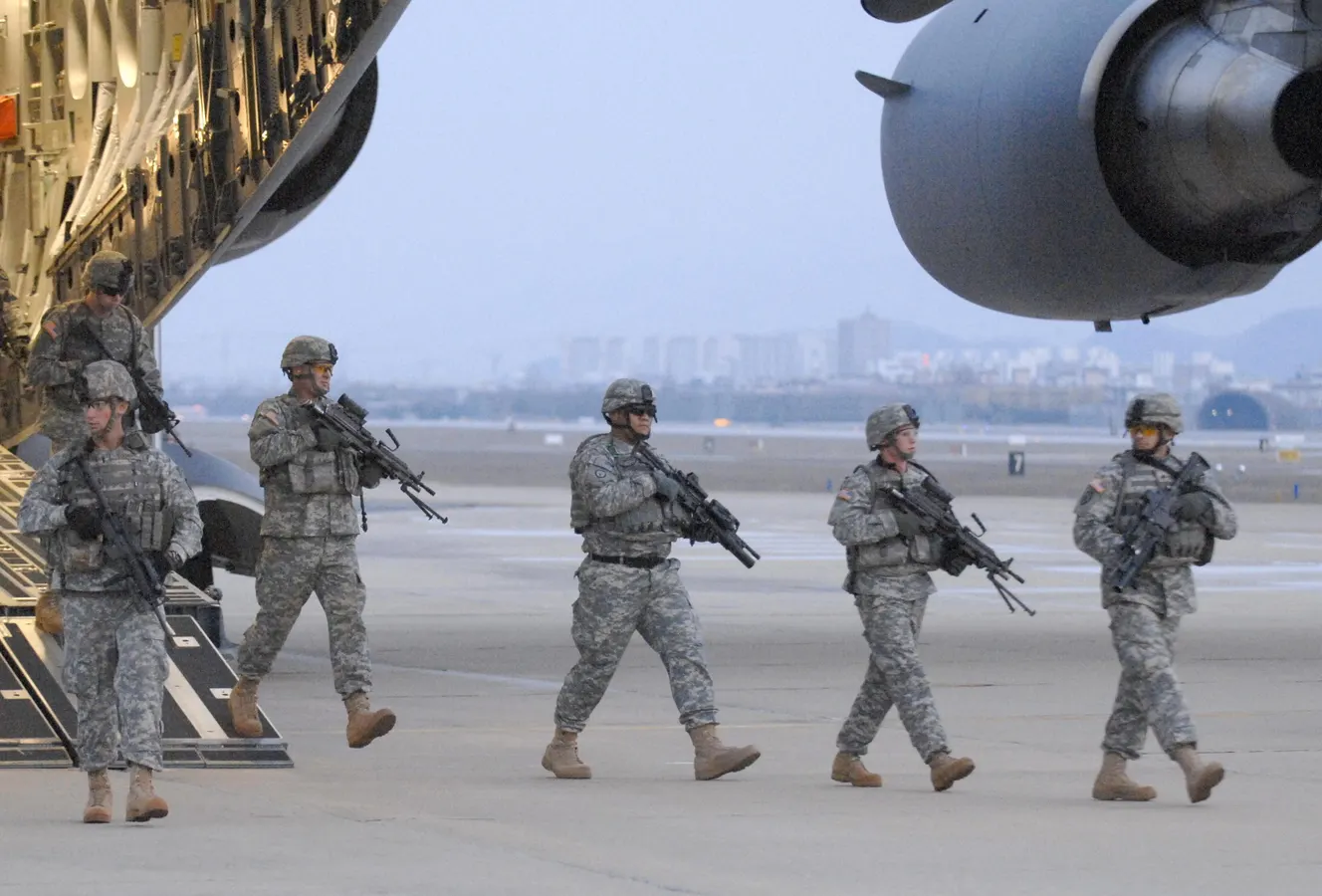

DAEGU, REPUBLIC OF KOREA: Members of a Stryker Platoon from Hawaii walk on the tarmac after their arrival at Daegu Air base, south of Seoul, 18 March 2007. The Ssouth Korean-US joint drills are due to begin on March 25, with hundreds of thousands of South Korean troops and some 29,000 US soldiers based here and abroad taking part, along with a US aircraft carrier backed by cruisers and destroyers. South Korea and the United States have defended the annual exercise as being purely defensive. AFP PHOTO/KIM JAE-HWAN (Photo credit should read KIM JAE-HWAN/AFP via Getty Images)
AFP via Getty Images
A buildup of military capabilities in the Pacific, from Guam to the entire Marianas Island chain, is a centerpiece of the Pentagon’s strategy from deterring —or in the worst case, fighting — a war with China. The extensive U.S. presence in Hawai’i is a crucial support system for that larger Pacific buildup, but that presence is facing growing opposition, for a variety of reasons, as outlined by a new task force report issued by the Institute for Policy Studies.
Hawai’i has been a key hub for the U.S. Navy for decades, stretching back to World War II and before. But the large naval deployment is just part of the picture. Hawai’i also hosts missile defense sites, a missile test range facility, numerous Army and Marine bases, three Coast Guard bases, and a large training facility. The military presence has been accompanied by serious environmental damage, most notably from the Red Hill fuel depot, which has leaked jet fuel that has impacted the water supply of over 90,000 people and caused a wide range of physical and neurological symptoms. A survey of impacted communities found that 86 percent of residents reported at least one worsening health condition since the jet fuel spill occurred in November 2021
The Red Hill depot is just one example of the environmental and public health impact of U.S. military bases in Hawai’i. In the chapter of the new Institute for Policy Studies report on the impacts of the U.S. military presence in Hawai’i, Laurel Mei-Singh and Neta C. Crawford point out that “U.S. military bases, operations, and training activities have polluted Hawai’i’s land and air, as well as the surface, ground, and ocean waters, with chemicals known or suspected to be neurotoxins, carcinogens, and mutagens.”
The environmental and health impacts of the military’s presence has sparked a growing protest movement in Hawai’i, whose leaders have pointed out that alternative activities in the civilian sphere could generate more economic benefits with far fewer environmental and public health risks.
The debate over the U.S. military presence in Hawai’i will heat up over the next few years due to the fact that the military’s lease on 46,000 acres of land on the islands is due to run out in 2029. Critics of the bases will argue for alternative uses that better serve the needs of Hawai’i’s population, while supporters of the status quo will cite the jobs created by military facilities and their role in deterring China. But the military-first strategy towards China that has evolved in recent years should itself be subjected to scrutiny.
A more balanced policy that includes economic cooperation and guardrails to head off an arms race on nuclear weapons and AI between Washington and Beijing would provide a better foundation for U.S. security than one that leans heavily on military preparations.













Leave a comment