


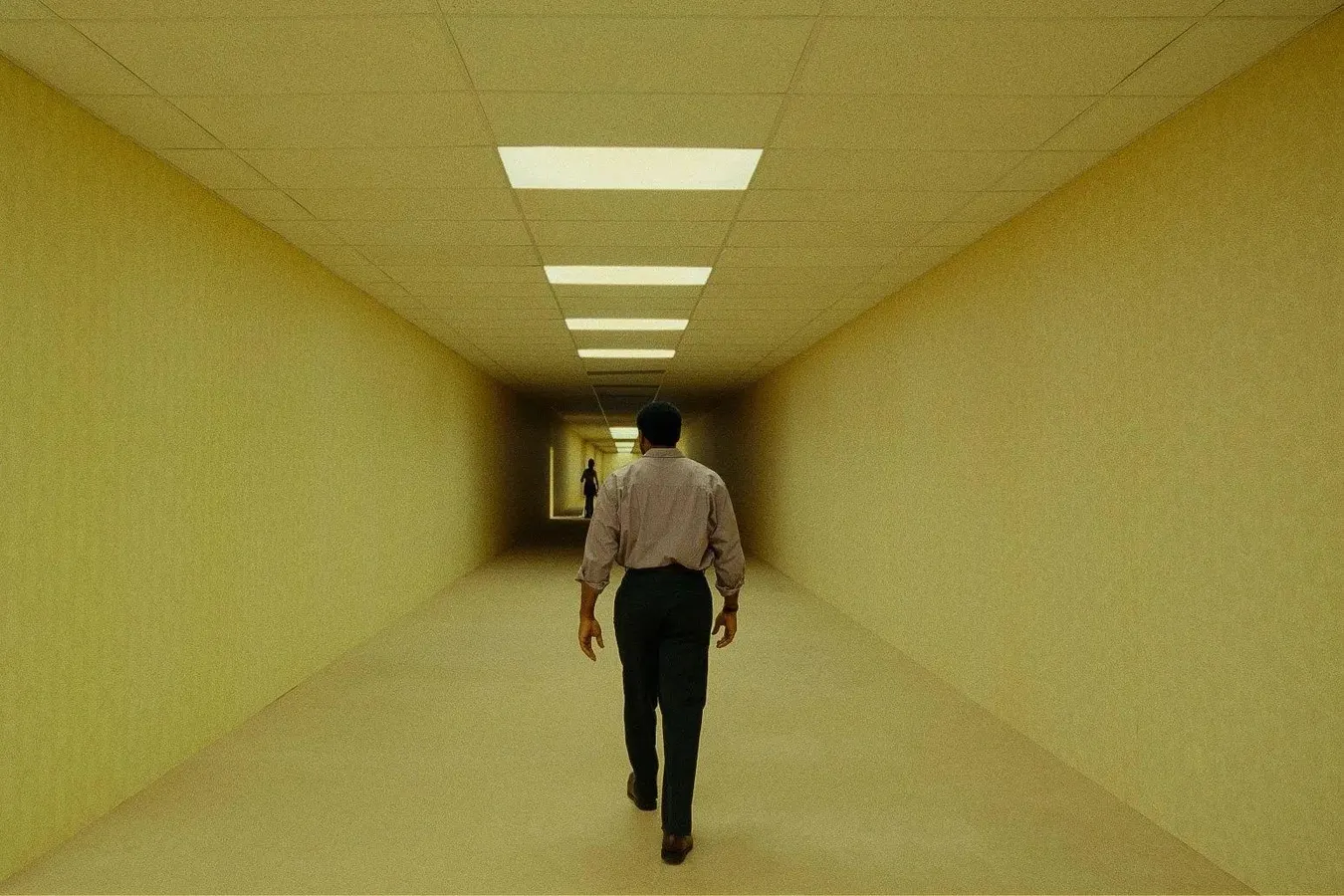
Chiwetel Ejiofor as Clark in Kane Parsons’ ‘Backrooms’
A24
Backrooms marks the moment in which a relatively niche internet horror story “broke containment,” spilling into the mainstream.
Backrooms broke five box office records in its opening weekend, a triumph for A24 and YouTuber-turned-director Kane Parsons, who helped popularize the concept with his viral YouTube series.
The hit horror film isn’t a traditional IP—Backrooms is an adaptation of a phenomenon that can only be described as “digital folklore,” related to internet trends like liminal spaces and analog horror.
Parsons did not create the Backrooms, but his vision has proved definitive in the pop culture landscape—here’s how his film differs from the original idea.
What Are ‘The Backrooms,’ Exactly?
The concept of the Backrooms first originated on 4chan, on /x/, a board dedicated to discussing the paranormal.
A now-iconic photo of a yellow interior, practically vibrating with bad vibes, was posted on 4chan in 2019, with a prompt asking users to “post disquieting images that just feel ‘off.'”
A single reply laid the foundations of the Backrooms mythology, in just a few sentences.
“If you’re not careful and you Noclip out of reality in the wrong areas, you’ll end up in the Backrooms, where it’s nothing but the stink of old moist carpet, the madness of mono-yellow, the endless background noise of fluorescent lights at maximum hum-buzz, and the approximately six hundred million square miles of randomly segmented empty rooms to be trapped in.”
“God save you if you hear something wandering around nearby, because it sure as hell has heard you.”
That sparse description resonated across the internet, inspiring a viral “creepypasta” (an urban legend/horror story that is repeatedly copied and pasted online).
Backrooms-themed communities sprang up, with fans writing stories and creating content centered around this single, disturbing idea—what if you were trapped in an endless office, alone?
Worse, what if there was something in there with you?
Why Did ‘The Backrooms’ Go Viral?
Every gamer has experienced the disconcerting sensation of slipping into the “wrong” area of a video game, usually an eerily vast, empty space where the rules no longer apply.
The Backrooms suggests that humanity’s artificial trappings are warping reality, as though life were nothing more than a glitchy simulation, where one can slip through the cracks and disappear into infinity.
Horror reflects the anxieties of the time period—Bradley Earl Wiggins argues that the Backrooms represents a “critique of consumerist society during perceived notions of late capitalism.”
Aftermath described the Backrooms as echoing “a culture that feels so utterly stuck inside nostalgia for corporate products of the past that it can only seemingly endlessly reproduce more of what’s already existed, to diminishing returns.”
The Backrooms seems indifferent to humanity, an unknowable, otherworldly labyrinth that swallows random victims, leaving them to die under the headache-inducing flicker of fluorescent light.
Notably, there are no windows in that original image.
Liminal spaces tend to highlight the uncanniness of environments designed to be passed through (malls, hotels, airports), the eeriness revealed only when these spaces are empty.
The original 4chan post also implies the presence of a monster, and the internet has conjured many entities to fill the empty space.
What Is The Online ‘Backrooms’ Lore?
The concept of the Backrooms has changed over the years—early writers were cautious to give too much detail, adding only a couple of industrial “levels” beyond the yellow rooms and hinting at the presence of otherworldly beings.
As the fandom grew, the details became more specific, and the amount of levels skyrocketed, some far removed from the initial theme.
Modern Backrooms lore resembles that of a massive open-world video game, with very detailed breakdowns of levels, exits, entities and items.
The introduction of multiple levels brimming with objects and entities split the Backrooms fandom—some preferred the existential dread of the early years, while others sought to map the rooms and fill the floors with objects.
Many compare the current Backrooms lore to that of the SCP Foundation, another internet collective storytelling project that covers a wide range of paranormal stories.
However, none of the Backrooms lore is really “canon,” other than the original 4chan post that introduced the concept.
Kane Parsons is undoubtedly the most influential contributor to the Backrooms lore, but even his vision is a personal interpretation.
How Does A24’s ‘Backrooms’ Compare To The Original Idea?
Backrooms maintains the existential dread of the original Backrooms concept, but focuses on the film’s protagonists, telling a fairly personal story.
Parsons references some of the lore he built in his viral YouTube videos, introducing viewers to Async, a corporation that is steadily researching and mapping the Backrooms.
In interviews discussing his film, Parsons has expressed a healthy skepticism regarding the abundance of lore, seemingly hesitant to stuff his version of the Backrooms with detail.
For the monster, Backrooms opts for a psychological approach, the entity taking on the characteristics of Clark (Chiwetel Ejiofor), a furniture-store owner who has trapped himself in a stagnant life.
In the film, Clark explains that the Backrooms are shaped by the individuals who enter it, the space absorbing their memories and distorting them.
His therapist, Dr. Mary Kline (Renate Reinsve), also finds the rooms conforming to her memories, but Clark’s analysis might be incomplete (or wrong), as the character has lost his mind when he proposes his theory.
Clark does not randomly fall into the Backrooms, as the original 4chan post states—he enters through an invisible entrance within the store, and is free to leave, if he wants to.
Parsons Backrooms seems to be a parasitic entity, drawing electricity from Clark’s furniture store and feeding on the minds of visitors.
Parsons’ film is faithful to the internet’s earliest interpretations of the Backrooms, adding a few elements, but maintaining the dreamlike, nostalgic dread of the viral creepypasta.
Parson even pays tribute to the Backroom’s real life origin—the yellow photo that sparked the trend was plucked from a blog post documenting the renovation of a furniture store in Wisconsin, later tracked down by social media sleuths.
Fittingly, Clark finds his entrance to the Backrooms within his own furniture store, a dead-end job which is revealed to be a prison of his own making.















Leave a comment