


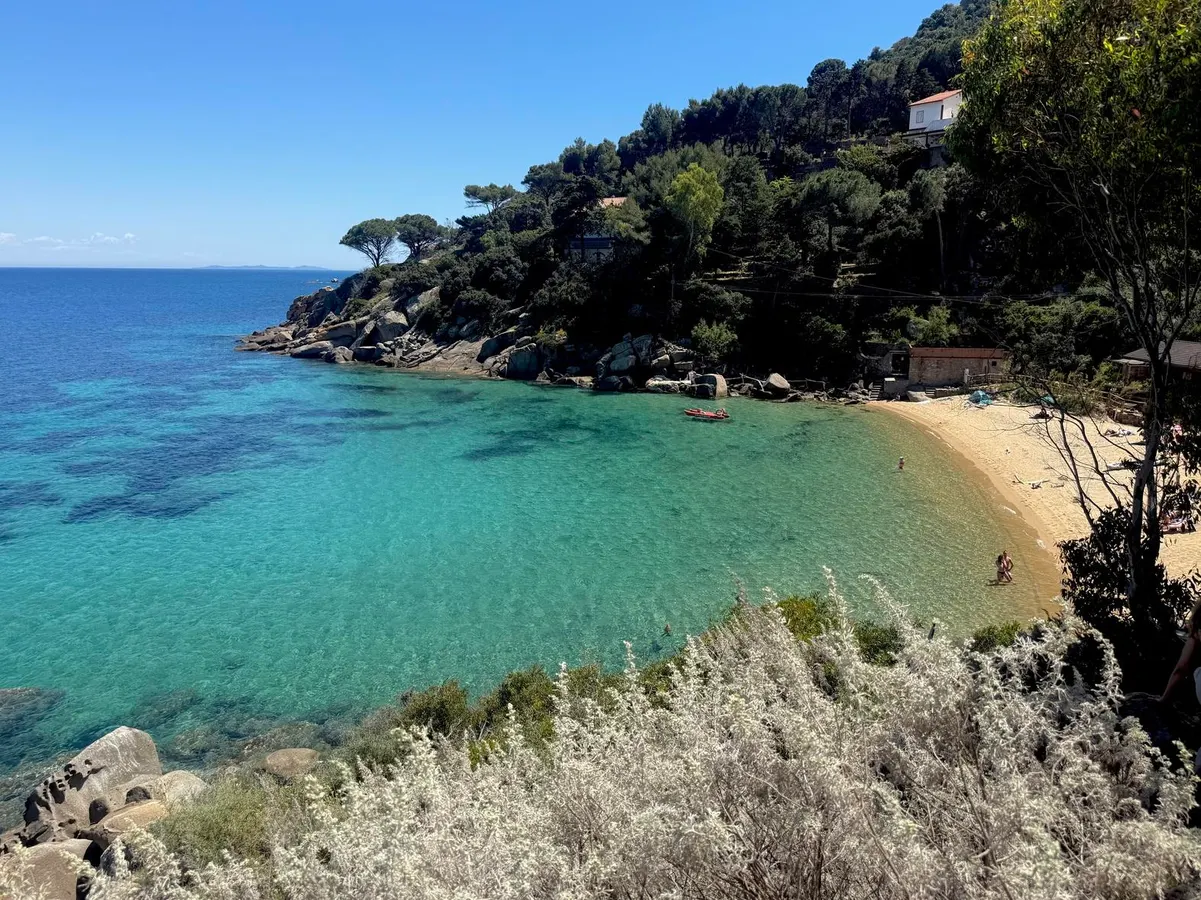

Caldane Beach on Giglio Island
Giammarco Sicuro
The story of l’Isola del Giglio does not begin with disaster, and it doesn’t end with it either. So much more defines this island that, through centuries, continues to emerge resilient. One of the seven Tuscan islands, it has lived somewhere between hardship and grace, where survival often feels improbably close to something beyond.
“What happened here was nothing short of a miracle. It was the hand that intervened to block the ship. It caused it to rest against that terrace, where the ship was later found. There were lives lost, but so many more could have been lost. It was a matter of a few meters, a miracle,” said Marina Aldi, a local of the island of Giglio and a tour guide.
Marina is referencing the Costa Concordia shipwreck, which happened on January 13, 2012, off the coast of the island. One of the largest shipwrecks in recent history, and the miracle is that although there was loss, there could have been so much more.
Giglio, one of the seven Tuscan islands, has always carried that tone in its history. Less known to foreign tourists, it is a place shaped by pirates and princes, by migration and agriculture, by endurance and reinvention. And, depending on who you ask, by the occasional miracle.
The land itself seems unlikely. Granite pushes close to the surface, leaving only a thin skin of soil for anything to grow. And yet, vines have survived here for centuries. What locals now call vino eroico, heroic wine, feels like both a description and a quiet act of defiance.
Ansonica wine production by the Fontuccia Winery
Fontuccia
In recent years, that defiance has taken form through the work of the Rossi brothers, Giovanni and Simone, of the Fontuccia Caperrosso Ansonica Winery. Their project is as much about preservation as it is production, a revival of a wine that was developed on this island and once seemed destined to disappear due to the aging population and changing local economy. Their cru Caperrosso has earned top recognition, but the real achievement lies in something less measurable: continuity.
“I saw that the vineyards here kept being abandoned, and I feared that this centuries-old tradition upheld by the Etruscans and the Romans could die. There are writings by Petrarch, Mazzini, and Cavour about this wine. I thought that to lose this piece of culture would be a shame. So I began almost as a hobby with a little plot of land…but then it grew to 7 hectares.”
Giovanni speaks about wine the way some might speak about memory. For him, the vineyard is not just agriculture; it is an inheritance under threat that needs to be preserved, a distilled memory of the terroir. Which is why he says it is even more important to make something true, authentic, and unique.
“We don’t follow trends or fashions, I make the wine that I like,” said Giovanni. “Its salinity comes from the sea, carried up onto the leaves by the wind. Then there’s the minerality from the soil. There are only about twenty centimeters of earth here, but beneath it lies solid rock, the minerals of the granite.”
The wines are all made with pure Ansonica grapes from the island, cultivated in the few hectares that face the sea. These are wines that pair beautifully with rich dishes, oily, unctuous fish with tomato, and pasta sauces that are rich and fatty.
“It’s a red wine disguised as a white,” Giovanni said.
The island itself owes much of its identity to agriculture, a legacy reinforced centuries ago by Cosimo de’ Medici. Marina Aldi recounts it with a kind of personal gratitude: “Oh, I love Cosimo de’ Medici, it’s thanks to him that I am here!”
Her sentiment isn’t unusual. After the Ottoman pirate Barbarossa devastated the island in 1554, kidnapping and enslaving nearly all its inhabitants, it was Cosimo who saw opportunity in this absence. He repopulated Giglio with agricultural workers from Siena and the neighboring areas, offering them land and freedom from taxes, on one condition: they had to produce wine.
It was a pragmatic decision, but it became something more enduring. Wine was not just sustenance; it was structure. It shaped the terraces, the economy, and eventually, the identity of the island itself.
Ushering in an era marked by recovery, agriculture and viticulture flourished again, alongside mining and granite quarrying. The same granite that forms Giglio’s backbone found its way into columns and buildings in Rome, tying the island physically to the mainland while it remained culturally distinct.
History here is layered: Greek origins as “Aigilon,” Roman development as “Aegilium,” centuries under powerful families and rulers. Yet the through-line is always resilience. The land is difficult, the past is heavy, and still, life persists.
Fontuccia’s vineyards that face the sea
Fontuccia
That persistence extends into the present in unexpected ways. At La Guardia, a hotel that has evolved alongside the island’s economy, the past and present meeting in subtle tension. Flaminia Pérez del Castillo and Flavio Caprabianca, co-owners of the hotel, came to the island years ago and decided in 2019 to make a total change, leaving their advertising work behind and rerooting their lives here.
La Guardia Hotel
La Guardia
“It was one of the first hotels on the island, established when the island’s economy was undergoing a major transformation. After years of relying on mining, a relatively poor economy that was eventually exhausted, the island turned to tourism. This marked the arrival of an entirely new economic model, which transformed the island. Agriculture had declined, and the vineyards had been abandoned for many years, but they were later revived by the Rossi brothers and other pioneers about twenty years ago,” says Flavio.
Iconic Italian singers and actors, Celentano and Mina, would come. “It was a bit like the Amalfi Coast in that era. Many actors and directors.”
And then the Costa Concordia happened, yet another chapter of the island’s life.
The shipwreck of the Costa Concordia
Giammarco Sicuro
“Then came the Costa Concordia disaster, and the property became a hub for the engineers and journalists involved in the recovery operation. A few years later, we took over, and Nick Sloane, who led the salvage effort, still returns regularly.”
Today, the hotel hosts unique cultural initiatives like LUMINA, dedicated to talent, creativity and a passion for cinema. A non-competitive showcase for short films by directors under the age of 25. A platform that celebrates the beauty of high quality short films. The chefs and employees here are all mostly under 25 as well something very important to the owners to help attract a new generation to the island.
La Guardia Lumina Shortfest for young filmmakers
La Guardia
But the mention of the Concordia lingers, even when people try not to dwell on it. Nick Sloane, the marine salvage engineer who led the recovery, still returns. The memory hasn’t disappeared; it has simply settled into another element of the backdrop.
Giammarco Sicuro, an international war correspondent for Italian public broadcaster RAI, was the first reporter on the island when the ship sank. He was one of the journalists who stayed in the hotel before Flavio and Flaminia revamped it. He describes the quiet relationship with the past that this place still has.
“The people of Giglio don’t want to speak about it. They often don’t even mention it, but not because it’s something to be embarrassed by or a mark on their history. It’s the opposite. They are aware of the role they had in saving many people, but they refuse the label of hero. They prefer to keep it as a memory, like something private, all for them, moving forward with their lives immutable and unchanged since the era of the Medici,” he says.
It is a telling detail. On an island where heroism is embedded in everyday acts of hauling vines up terraces, rebuilding after raids, quietly helping strangers in the night, the label itself feels unnecessary.
Faro Capel Rosso Lighthouse
Giammarco Sicuro
At the far southern edge of Giglio, the Capel Rosso Lighthouse stands, as it has since 1883, though now quite differently. Its beam has swept across the Tyrrhenian Sea, offering direction to those passing through. But its meaning goes beyond navigation.
Its last keeper, Luigi Baffigi, understood that better than most.
“If there were lightning storms, I would go and check the lighthouse myself,” he said. “I took care of the optical equipment with great attention.”
When automation replaced him, the loss was not technical, it was kind of personal. “It’s obvious, it’s not the same thing.” But he is still such an integral part of the lighthouse, now transformed into a hotel. One of the owners, Viola, made sure to keep it that way when endeavoring in this passion project. She also isn’t a local to the island, but devoutly in love with this unique place.
Faro Capel Rosso
Faro Capel Rosso
“I always check to see if the lights are on,” he said. “I still feel a bit responsible.” Luigi continues to work with the Capel Rosso Lighthouse, now a boutique luxury hotel. The journey to get there begins where the road ends, where, quite literally, the last part must be traveled on foot.
Here, part of the luxury is the slow pace; the sheer placement compels you to meditate.
Dining is an integral part of the experience at Faro Capel Rosso, with a seasonal menu inspired by the traditions of Giglio Island and the Tuscan mainland. Dishes like sea bream pasta with lemon zest and dried flowers were created by the hotel’s chef.
That sense of responsibility, quiet, enduring, almost instinctive, runs through Giglio in ways that are hard to name but easy to recognize. It is there in the vineyards, in the kitchens, in the stories people tell and the ones they keep to themselves.
Call it resilience, or perhaps history. Or, as some of the locals might, call it something closer to a miracle.











Leave a comment