


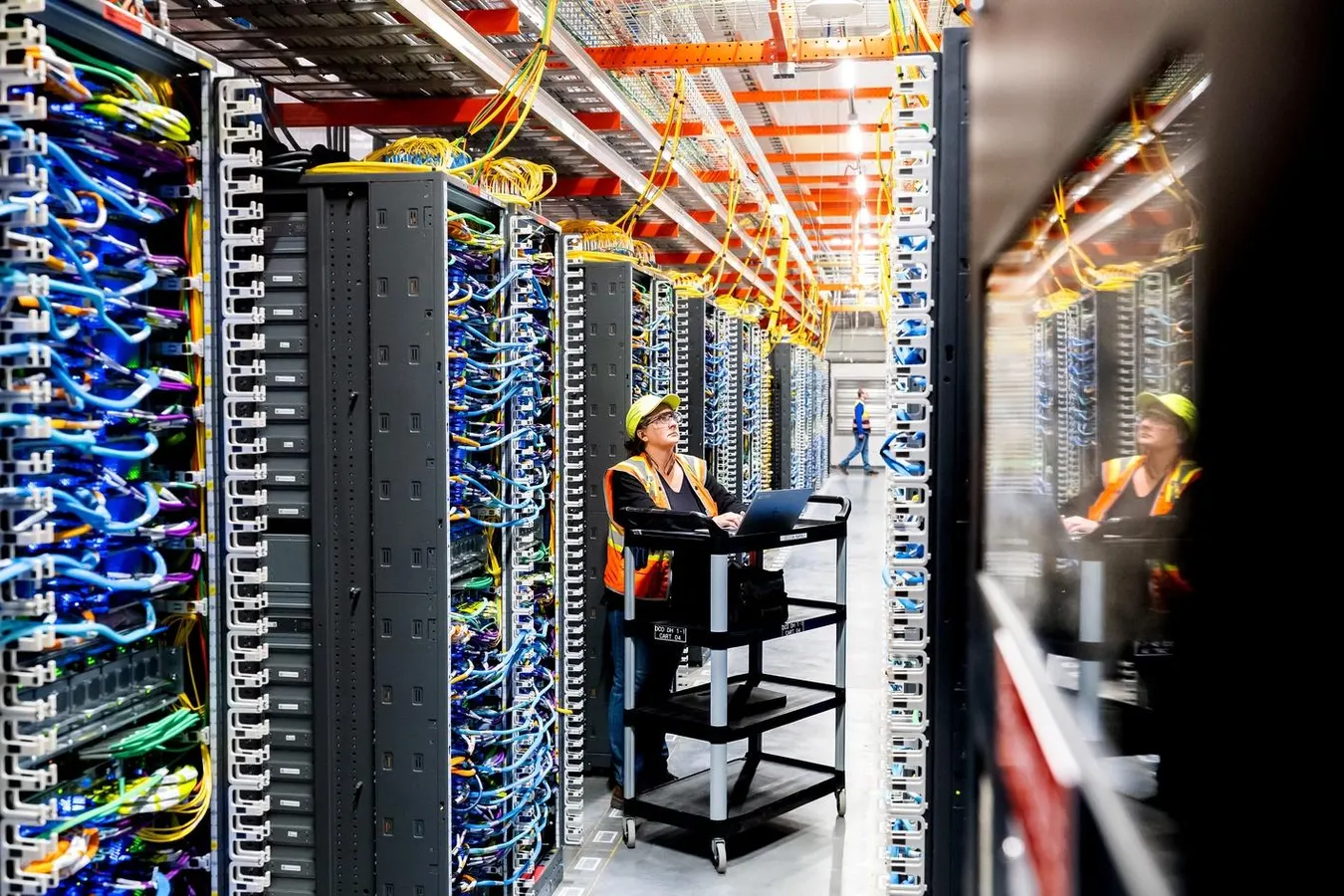

NEW CARLISLE, INDIANA – OCTOBER 2: In this handout provided by Amazon, a technician works at an Amazon Web Services AI data center in New Carlisle, Indiana on October 2, 2025. (Photo by Noah Berger/Getty Images via Amazon Web Services)
Getty Images
Most discussions about artificial intelligence focus on chips, data centers, power plants, and electricity demand. Those are all important. But another bottleneck is beginning to emerge, and it may prove to be an underappreciated challenge.
The AI boom needs electricians.
It also needs line workers, substation technicians, grid engineers, mechanical contractors, welders, construction crews, and commissioning specialists. These are not jobs that can be filled instantly with a software update or a new financing round. They require training, experience, and a steady labor pipeline that the power sector does not currently have in abundance.
That is an important reminder that the AI boom is not only a digital story. It is also very much a physical infrastructure story.
From Chips To Construction
The first phase of the AI buildout has been dominated by the race for computing power. Investors have focused on semiconductors, cloud providers, and the companies building massive data centers to support artificial intelligence workloads.
But every one of those facilities must be connected to the grid. It must have transformers, substations, backup generation, cooling systems, transmission access, and workers qualified to build and maintain that infrastructure.
That is where the problem becomes more complicated.
Reuters recently reported that the rush to build data centers is intensifying shortages of power and grid workers, including electricians, line workers, and other engineering, procurement, and construction roles. The issue is not just that demand is rising. It is rising while a large share of experienced construction workers is approaching retirement.
This creates a different kind of constraint than the ones most investors are used to thinking about. A utility can raise capital. A hyperscaler can sign a power purchase agreement. A developer can order equipment. But if the trained workers are not available, projects can still be delayed.
The Scale Of The Need
Goldman Sachs Research has estimated that U.S. data center power demand could rise from 31 gigawatts in 2025 to 41 gigawatts in 2026 and 66 gigawatts in 2027. That would more than double estimated data center capacity from the end of 2025 to the end of 2027.
Meeting that demand will require a massive buildout of generation, transmission, interconnection, and backup systems. Goldman has also estimated that the U.S. power sector will need roughly 510,000 additional workers by 2030 to satisfy rising demand, with Europe needing another 250,000.
Those numbers help explain why the labor issue could become a limiting factor. The power sector is not simply competing with itself. Data centers, utilities, renewable developers, manufacturers, industrial projects, and grid modernization programs are all chasing many of the same skilled workers.
The Bureau of Labor Statistics projects employment of electricians will grow 9% from 2024 to 2034, much faster than the average for all occupations. It also projects about 81,000 electrician openings each year, many of them tied to workers leaving the occupation or retiring.
For electrical power-line installers and repairers, the BLS projects 7% employment growth over the same period, also much faster than average, with about 10,700 openings per year.
Those are good jobs. But it takes time to train a qualified electrician or line worker, and the most experienced workers are often the ones needed for the most complex projects.
Costs, Delays, And Utility Bills
A shortage of skilled labor does not mean the AI buildout stops. It means the buildout may become more expensive and uneven.
Projects with the strongest sponsors, best locations, and clearest utility partnerships will likely move forward. Others may face delays, cost overruns, or longer interconnection timelines. The same pressure could also affect transmission upgrades, renewable projects, natural gas plants, and grid-hardening work.
This has direct implications for energy policy, utility customers, and investors.
If utilities must build more infrastructure to serve large data centers, someone has to pay for it. Regulators are already wrestling with whether the costs should be borne mainly by the large customers driving demand or spread more broadly across the rate base. Labor shortages add another layer to that debate because higher construction costs eventually show up in project economics.
That is one reason the data center boom is becoming more than a technology story. It is moving into utility regulation, construction labor, power markets, and local economic development.
Who Benefits?
For investors, the most obvious beneficiaries are not necessarily the AI companies themselves. The bottleneck will likely be electrical contractors, grid builders, equipment suppliers, and utility infrastructure companies.
Firms such as Quanta Services, MYR Group, MasTec, EMCOR, Eaton, and Vertiv sit much closer to the physical buildout than most software companies. The caveat is that labor shortages cut both ways. They can increase pricing power and backlog, but they can also limit how quickly projects can be completed. A second caveat is that shares of most of these companies have already notched huge moves up over the past year.
The Big Picture
AI may live in the cloud, but the cloud has to be built, powered, wired, cooled, and maintained. A model runs in the cloud. A chatbot answers a question. A search result appears instantly. But behind that experience is a chain of physical assets.
Chips may get most of the attention. Power plants and natural gas turbines are also getting more attention as electricity demand forecasts rise. But the labor force may become one of the most important constraints.
This is not an argument for or against AI or data centers. It is an argument for understanding the full supply chain behind them.
The companies best positioned for the next phase of the AI buildout may not only be those with the best chips or the largest data centers. They may also be the utilities, contractors, equipment suppliers, and infrastructure companies with access to skilled labor and the ability to execute large projects.
The AI boom may be digital at the surface, but underneath it is an old-fashioned construction challenge. And in that world, electricians and line workers may be just as important as algorithms.













Leave a comment