


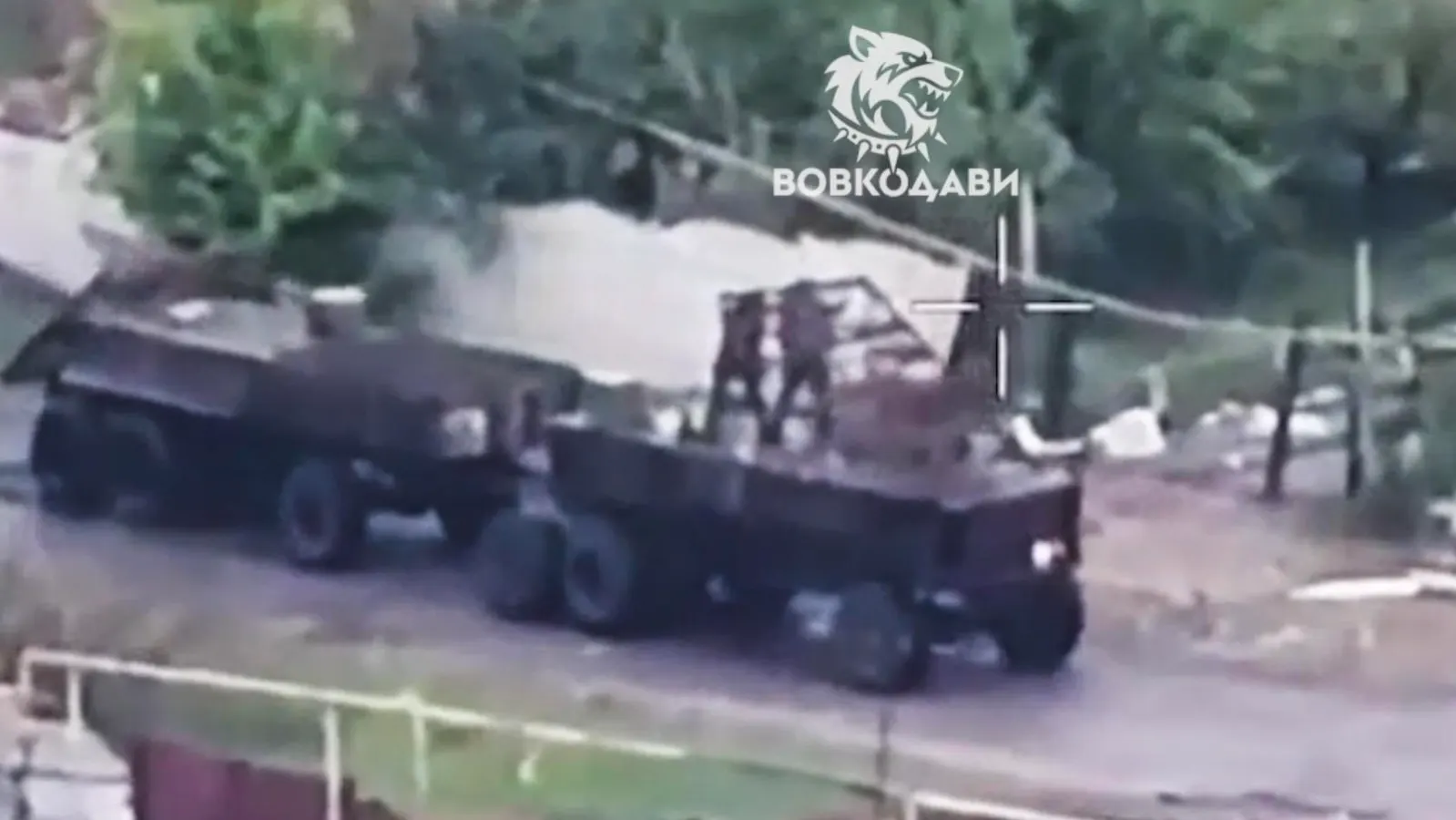

Image capture from video posted by the Ukrainian “Wolfhound” Unit showing a failed Russian river crossing in the town of Vovchansk. The Russian pontoon system appears to have been built by frontline soldiers out of existing vehicles and material.
Social Media Capture
River crossings have always been among the most complex military operations, and persistent drone surveillance has made them even more difficult. Throughout its war with Ukraine, Russia has struggled to move forces across rivers, losing a significant number of bridging assets in the process. One of the most notable examples occurred in May 2022, when the Russian 74th Separate Guards Motor Rifle Brigade lost an entire Battalion Tactical Group attempting to cross the Siverskyi Donets River. More than three years later, these challenges remain. A group of Russian soldiers recently attempted to improvise a pontoon from a modified vehicle to cross the Vovcha River. Although the effort was ultimately destroyed by Ukrainian drones, it demonstrates the extent to which front-line units are relying on improvised equipment to perform specialized military tasks.
Russia’s Improvised Pontoon Used In Failed Vovcha River Crossing
A recent video posted by the Ukrainian “Wolfhound” unit (2nd Battalion of the 57th Motorized Infantry Brigade) shows a Russian unit attempting to use an improvised pontoon system to cross the Vovcha River. The video’s commentators refer to this system as a “Frankenstein” vehicle because it appears to have been assembled from heavily modified components. The caption for the Telegram post translates to “Mad Ivan: The Road to Vovchansk,” a reference to the Mad Max film franchise, in which improvised vehicles assembled from salvaged parts are a recurring theme.
The pontoon system consists of a powered front unit and a rear trailer. Both sections appear to be built on a six-wheeled truck chassis, likely derived from common Russian military cargo trucks such as the Ural-4320 or KamAZ-4310. The original truck bodies have been replaced with rectangular prism-shaped structures measuring approximately 7 m long, 2.5 m wide, and 1.5 m tall. The front section includes a driver hatch and carries several soldiers on top. The rear section appears hollow and features what may be a deployable ramp. Together, the two sections form an improvised articulated vehicle whose combined length appears to be sufficient to span narrow sections of the Vovcha River.
Image capture from video posted by the Ukrainian “Wolfhound” Unit showing a failed Russian river crossing in the town of Vovchansk. The Russian pontoon system appears to have been built by frontline soldiers out of existing vehicles and material.
Social Media Capture
Drones from the Wolfhound unit spotted the vehicle traveling through the town of Vovchansk, northeast of Kharkiv City. The posted footage shows the vehicle moving at a relatively high speed in an attempt to minimize its exposure to a drone attack. The rear trailer swings widely while turning, frequently leaving the roadway. In one instance, the trailer knocks over a power pole. The trailer also triggers two anti-personnel mines, producing large plumes of smoke, although neither section appears to sustain damage. The vehicle eventually reaches the Vovcha River, where the soldiers start preparations to emplace the system. As the front portion is entering the water, the Wolfhound unit destroys the entire pontoon system with precision drone strikes.
Russia’s Challenges With River Crossings
This failed crossing reflects the challenges that Russian forces have faced with river-crossing operations throughout the war. In this case, the obstacle was the Vovcha River, a tributary of the Siverskyi Donets. The Vovcha is much narrower than major rivers such as the Oskil and Dnipro, yet it still presents a significant barrier. Most armored vehicles cannot safely ford the river, requiring a bridge or ferry to move personnel and equipment across. However, establishing these crossings has proven difficult, effectively stalling operations at multiple points along the front.
River crossings are inherently challenging. Suitable crossing sites are typically connected to existing roads, creating predictable approach routes and natural choke points. These routes are routinely monitored by Ukrainian drones searching for signs of bridging activity, making the approach to the river hazardous. The crossing itself is even more dangerous. Bridging vehicles and their crews must operate in the open while deploying the crossing system, making them vulnerable to artillery, drones, and other precision fires. The period before a bridge or ferry becomes operational is often the best opportunity to disrupt the crossing. Once emplaced, even a damaged crossing system may remain usable long enough for vehicles to continue moving across the river.
Image capture from video posted by the Ukrainian “Wolfhound” Unit showing a failed Russian river crossing in the town of Vovchansk. The Russian pontoon system was destroyed by a Ukrainian FPV drone.
Social Media Capture
Another notable aspect of the video is the use of an improvised “Frankenstein” bridging system rather than a standard Russian engineering asset. The Vovcha River is well within the capabilities of existing Russian bridging equipment. Russian engineer units field armored vehicle launched bridges such as the MTU-72, as well as PMP-series pontoon bridge systems capable of supporting armored vehicles across rivers significantly wider than the Vovcha. The use of an improvised system suggests that dedicated bridging equipment may not have been available to the local force.
This shortage likely stems from Russia having lost a substantial number of bridging assets during the war, particularly during failed river-crossing attempts. At the same time, the Russian defense industry has prioritized the production of high-demand systems such as artillery, armored vehicles, drones, and munitions. Bridging equipment represents a much smaller and more specialized category of military hardware, so replacement rates may not have kept pace with losses. Faced with these constraints, front-line units may have been forced to develop their own crossing solutions using available vehicles and materials.
Russian Frontline Innovation To Overcome Equipment Shortages
This incident highlights a broader trend in the Russian military. Over the past year, Russian units have increasingly modified existing equipment to address battlefield challenges rather than waiting for purpose-built systems. The most visible examples have been anti-drone modifications, including cages, nets, and improvised armor mounted on vehicles. Russian soldiers have also modified drones and ground robots to expand their utility and enable them to perform additional roles. Rather than introducing entirely new systems, Russian units are adapting available equipment to meet immediate operational needs.
Image capture from video posted by the Ukrainian “Wolfhound” Unit showing a failed Russian river crossing in the town of Vovchansk. The Russian pontoon system appears to have been built by frontline soldiers out of existing vehicles and material.
Social Media Capture
This trend likely reflects a lack of confidence among Russian soldiers that the military can provide the equipment and capabilities they need in a timely manner. Throughout the war, Russian units have frequently faced equipment shortages and challenges fielding platforms optimized for emerging battlefield threats. Battlefield requirements are evolving faster than equipment can be produced, modified, and delivered to front-line units through traditional acquisition processes. As a result, soldiers are modifying existing systems to address immediate tactical problems rather than waiting for purpose-built solutions.
As the war continues, both Russia and Ukraine will face increasing resource constraints, forcing front-line units to further develop local solutions to battlefield problems. The improvised pontoon used by Russian forces at Vovchansk is one example of this trend. Rather than waiting for dedicated engineering equipment, soldiers modified available vehicles to create their own river-crossing capability. Though the effort failed, it demonstrates how battlefield adaptation is increasingly filling the gap between operational requirements and the military’s ability to field new capabilities.














Leave a comment