


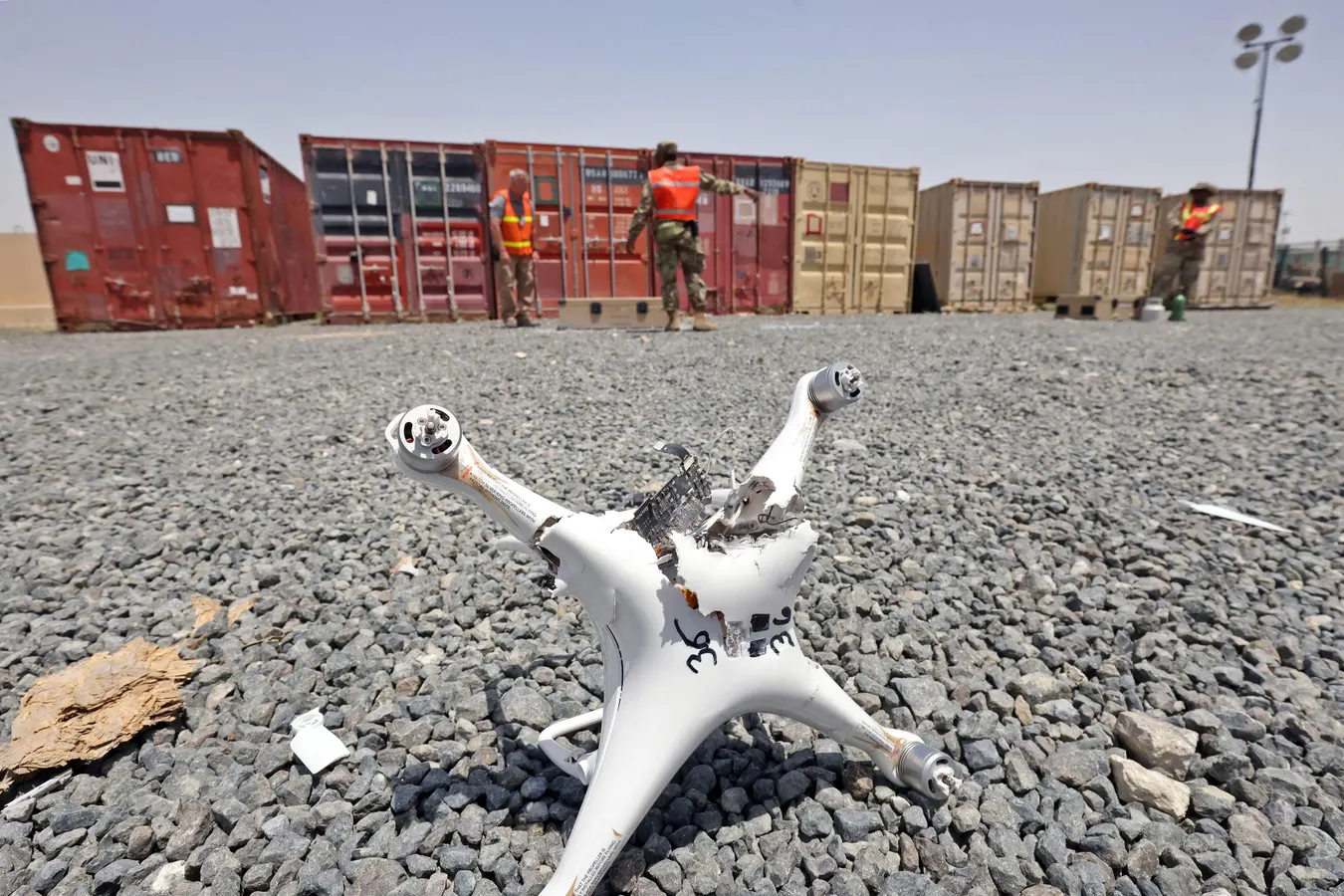

A damaged drone is pictured during a military drill at the US Camp Arifjan in Kuwait City, on May 4, 2023. (Photo by Yasser Al-Zayyat / AFP) (Photo by YASSER AL-ZAYYAT/AFP via Getty Images)
AFP via Getty Images
With its territory still facing regular attacks from Iranian ballistic missiles and explosive drones, the State of Kuwait has requested anti-drone systems to reinforce its national air defense. While Kuwait already boasts considerable air defenses, the Iran war has highlighted the necessity of building layered defenses with more plentiful, cost-effective systems and interceptors, especially for countering persistent threats like those posed by cheap but lethal Iranian drones.
Despite the ceasefire that went into effect on April 8, Iran and its allied militias have continued attacks against the Gulf states, including Kuwait. Kuwaiti border posts were targeted by militia drones launched from its northern neighbor, Iraq, in late April. In late May, Kuwaiti air defenses intercepted Iranian ballistic missiles targeting Ali Al Salem Air Base. Satellite imagery showed damage to that base; U.S. troops there suffered minor injuries from falling debris, and two MQ-9 Reaper drones were badly damaged. On Wednesday, a deadly drone attack on Kuwait International Airport left one person dead and 63 injured.
During the war, an Iranian drone attack targeting an operations center at Kuwait’s civilian Shuaiba port killed six U.S. service personnel, which became the first American fatalities of that war. Aside from concrete barriers, that makeshift base notably had nothing protecting it and those personnel inside from drone or missile attacks, according to a CNN report.
A press release from the State Department on Friday revealed that Kuwait has requested counter-unmanned aerial systems as part of a deal valued at $1.98 billion. According to the release, the Kuwaiti government requested the “Roadrunner-Munition and Anvil-Kinetic” along with supporting platforms and personnel training. Both C-UAS systems were developed by the American military technology company Anduril Industries.
According to an Anduril press release, the Roadrunner and Roadrunner-M, unveiled in December 2023, are jet-powered autonomous aerial vehicles capable of high subsonic speeds and vertical takeoff and landings. The Roadrunner-M is an interceptor variant “for ground-based air defense that can rapidly identify, intercept and destroy an array of aerial threats that are up to 100 times more expensive, or be recovered and reused at near-zero costs.”
Anduril also emphasizes the interceptor’s re-usability as a unique selling point, distinguishing it from traditional and far more expensive surface-to-air systems.
“Unlike legacy missile systems, you can reuse all craft that are launched but not consumed,” read the company’s release. “This radical shift in thinking allows for large-scale defensive launches at extraordinarily low cost, increasing redundancy for higher probability of lethality and enhancing the ability to simultaneously engage many targets.”
Anduril’s Anvil system, which Kuwait also ordered, is an unmanned combat aerial vehicle quadcopter designed to navigate autonomously in search of enemy drones and ram them at speeds up to 200 miles per hour if authorized by its remote operator. In the manufacturer’s words, the Anvil is designed to deliver “kinetic energy to the threat with minimal collateral damage.”
Given the events of the past five months and the continuous Iranian attacks on its territory, it’s no surprise that Kuwait is interested in these cost-effective interceptors.
Kuwait already has some considerable air defenses. It has the advanced MIM-104 Patriot PAC-3 air defense missile system that has effectively shot down incoming Iranian ballistic missiles. However, these are an ill-suited and expensive solution for dealing with drones. Patriot interceptors cost approximately $4 million each, so using them against drones that cost around $50,000 or considerably less isn’t sustainable and makes little sense.
A potentially more effective C-UAS presently at Kuwait’s disposal as it awaits its new C-UAS is the Swiss-designed Skyguard anti-aircraft gun and surface-to-air missile systems it has acquired over the years. Kuwait is known to have acquired the Egyptian variant, the ‘Amoun’ it ordered in the late 1980s, which Cairo deployed to Gulf states during the war, and the Spada 2000, according to the Stockholm International Peace Institute’s exhaustive arms transfer database. These systems are suitable for point defense of critical infrastructure, military bases, and other sensitive ground targets. Kuwait’s Skyguards fire the surface-to-air version of Italy’s medium-range Aspide 2000 missile for the system. The Aspide 2000 cost around $100,000 per missile, making them a more cost-effective but still imperfect solution against Iranian drones than those higher-end Patriot interceptors.
During a December 2012 live fire air defense exercise, Kuwaiti Aspide 2000s launched from a Skyguard system shot down two remotely piloted Banshee targets at a range of under four miles and an altitude of 5,000 feet. A contemporary report on the exercise noted that all 19 Kuwaiti Aspide 2000 test launches from 2007 to that date were successful, regardless of altitude, range, or weather conditions. It’s not immediately clear how extensively these systems and missiles were used during the Iran war or how successful they were.
Kuwait also flies F/A-18 Hornet and Eurofighter Typhoon fighter jets capable of intercepting drones, but, again, this is a prohibitively expensive way to do so. Interestingly, Kuwait wasn’t one of the three Arab Gulf states that simultaneously requested thousands of cost-effective Advanced Precision Kill Weapon Systems in the weeks after the April 8 ceasefire. The air-to-air APKWS enables fighters to intercept drones with small laser-guided rockets costing approximately $22,000 each, peanuts compared to traditional air-to-air missiles they carry, like the AIM-9X and AIM-120, that can cost in the region of $400,000 to $1 million each.
More generally, Kuwait’s air force and air defenses are not as advanced or as diversified as those of the United Arab Emirates, which boasts advanced F-16s and even the Terminal High Altitude Area Defense system, in addition to the Patriot PAC-3. Nevertheless, like the UAE, Kuwait is cognizant that even the most technologically sophisticated missile defenses alone cannot provide a complete defense against modern aerial threats, especially drones. That’s one reason Ukraine has eagerly pitched its wares in cost-effective, battle-tested drone defense systems to the wealthy Gulf states. The Ukrainian government has correctly pointed out that its homegrown C-UAS systems are among the cheapest in the world, with thousands costing the same as a single Patriot PAC-3. Kyiv has even suggested trades for those increasingly precious interceptors, of which it’s chronically in short supply to defend its cities against Russian ballistic missiles.
It’s not yet clear how many Roadrunner-Munitions and Anvil units Kuwait has on order, but it’s likely a substantial number given the estimated $1.98 billion price tag. These relatively simple solutions could go a long way in foiling future drone attacks against military and civilian targets on its territory in a much more inexpensive way than the present systems Kuwait has on hand.
















Leave a comment