


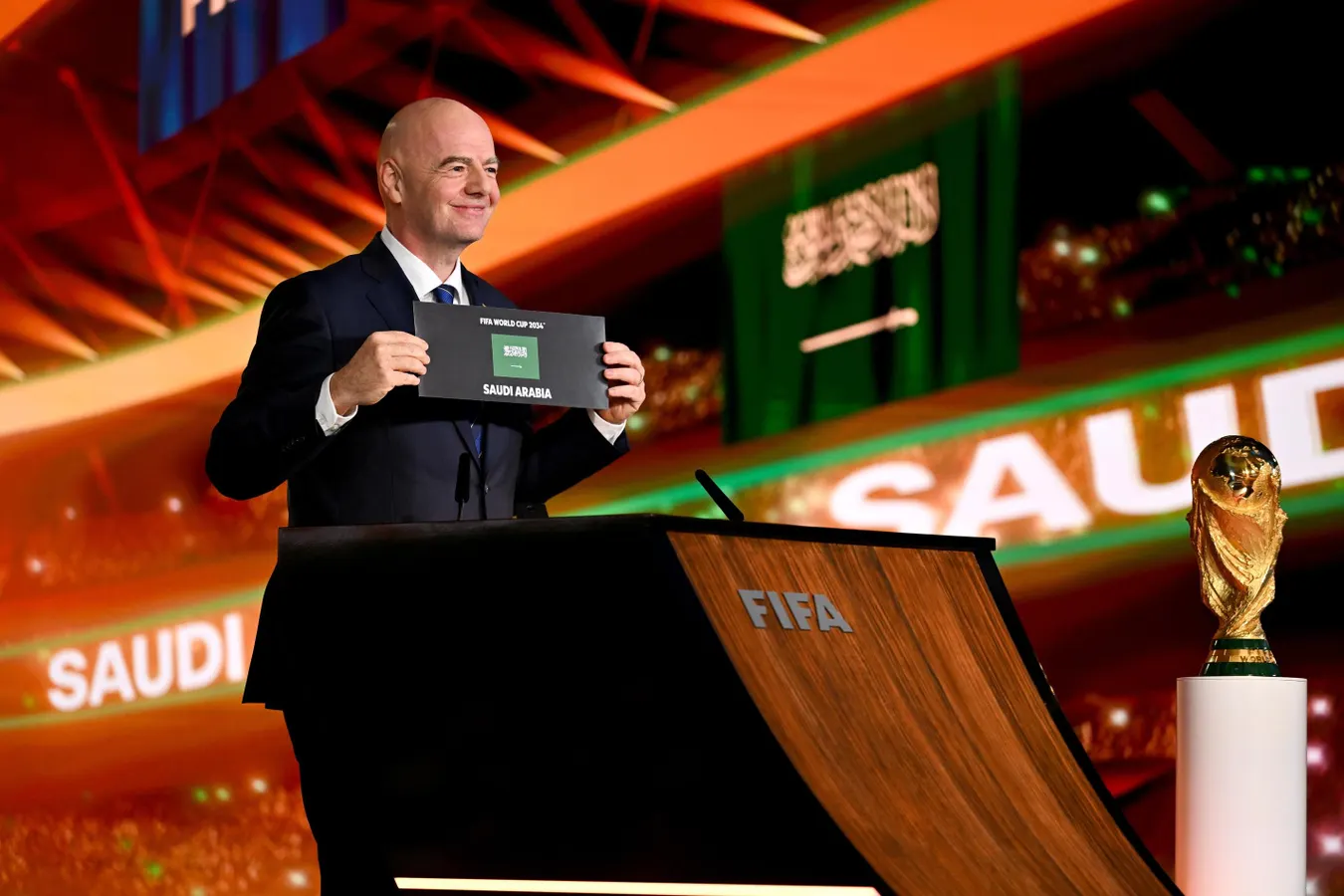

ZURICH, SWITZERLAND – DECEMBER 11: FIFA President Gianni Infantino announces Saudi Arabia as the host of the FIFA World Cup 2034 during the Extraordinary FIFA Congress 2024 at the Home of FIFA on December 11, 2024 in Zurich, Switzerland. (Photo by Harold Cunningham – FIFA/FIFA via Getty Images)
FIFA via Getty Images
When the World Cup was last held in the U.S., in 1994, the tournament was bookended by two European-hosted editions of the mega event – Italy in 1990 and France in 1998.
Since then, the world has changed, and we are in the midst of a pivot from the Global North to the Global South, which has given rise to new centres of power, directly affecting sport in general and the World Cup in particular.
FIFA’s showcase tournament has consequently travelled beyond its traditional European and South American heartlands since 1994, reaching Japan and South Korea in 2002 and South Africa in 2010.
The last World Cup, though, seems to have set a trend that has made the Middle East and North Africa (MENA) region a prominent and influential player in the global football industry.
A tournament hosting destination
In 2022, for the first time in the tournament’s history, the World Cup was held in the MENA region – Qatar –a controversial hosting choice when its successful bid was announced in 2010.
The next staging of the men’s showcase event in 2030 is intended to be a celebration of its 100th anniversary, with games to be played in several countries.
Morocco is one of the main co-hosts – alongside Portugal and Spain – and is likely to stage upwards of thirty matches.
Saudi Arabia will then host in 2034, having won the right to stage the tournament at an uncontested vote in December 2024.
FIFA’s overarching goal is to ‘make football truly global, accessible, and inclusive’; hence, its justification for taking the men’s World Cup to the MENA region would seem both reasonable and justifiable.
Soccer is immensely popular across the region, especially in Morocco and Saudi Arabia, where large populations ensure that elite professional football matches are typically well attended and that fans are highly passionate.
Even in Qatar, a country sometimes mocked for lacking an established football culture, one observer has highlighted its rich, six-decade-long grassroots passion for the sport.
However, there’s more than fairness, tradition, and fandom at play here.
The business and politics beyond football
For a start, FIFA’s drive to expand its revenue streams has been a defining feature of current president Gianni Infantino’s time in office, as evidenced by expectations that this summer’s World Cup could be the most lucrative in history.
Associations with Qatar and Saudi Arabia have helped in this regard, with the former spending around $240 billion in preparation for its 2022 staging of the tournament, and the latter seeking to increase its sports economy to 3% of GDP by 2030.
Meanwhile, Morocco is investing upwards of $20 billion to host the tournament, including the construction of the world’s largest football stadium, which will help enhance and showcase FIFA’s cash-cow tournament.
FIFA has also benefited from a range of commercial opportunities in the MENA region, including deals with Qatar Airways, a state-owned airline, and Saudi state-owned oil corporation Aramco, thought to be worth a combined total of $800 million to the governing body.
Moroccan corporations aren’t yet FIFA global partners, although OCP – a state-owned phosphate company – is the cornerstone of plans to deliver a tournament that will see allocated to World Cup-related projects ahead of 2030.
The question is why?
Motives, moves and manoeuvres in the MENA region
For both Qatar and Saudi Arabia, the primary motive for investing in sport and building relations with FIFA is part of their national transformation programmes, as both seek to diversify their economies away from dependence on oil and gas.
Sporting events attract visitors, boost tourism spending, and may help stimulate the development of local sports ecosystems, all of which mean money, jobs, and inward financial flows.
Qatar has notably used the World Cup as a means of strategic positioning and as a platform for other event bids, which may result in the country hosting the 2036 Olympic Games.
The World Cup is also a means of building legitimacy, enhancing trustworthiness and boosting attractiveness, all of which are often synonymous with soft power projection.
Some observers have rather more cynically characterised this as, that is, an attempt to sanitise a country’s national image and reputation by using sport to distract attention from a country’s crimes and misdemeanours.
Morocco’s engagement with FIFA and the World Cup is somewhat different from that of its two MENA rivals, with government officials viewing the tournament as an opportunity to position their country as an African superpower – both off and on the pitch.
Specifically, Morocco aspires to be Africa’s gateway, linking the rest of the world to countries across the continent.
In this regard, Morocco occupies an important strategic position at the entrance to the Mediterranean, a fact that government officials in Washington, D.C., are keenly aware of.
Relations between Donald Trump and the King of Morocco have recently strengthened (both also enjoy excellent relationships with Gianni Infantino), which may portend what is to come – Rabat is pushing hard to host the 2030 World Cup final.
Football is a simple game – a ball, two teams, a set of goals and straightforward rules – hence its global popularity.
But the geopolitical context in which football tournaments are staged has become anything but simple, especially as nations across the MENA region continue to engage with the World Cup in a series of power plays.









Leave a comment