


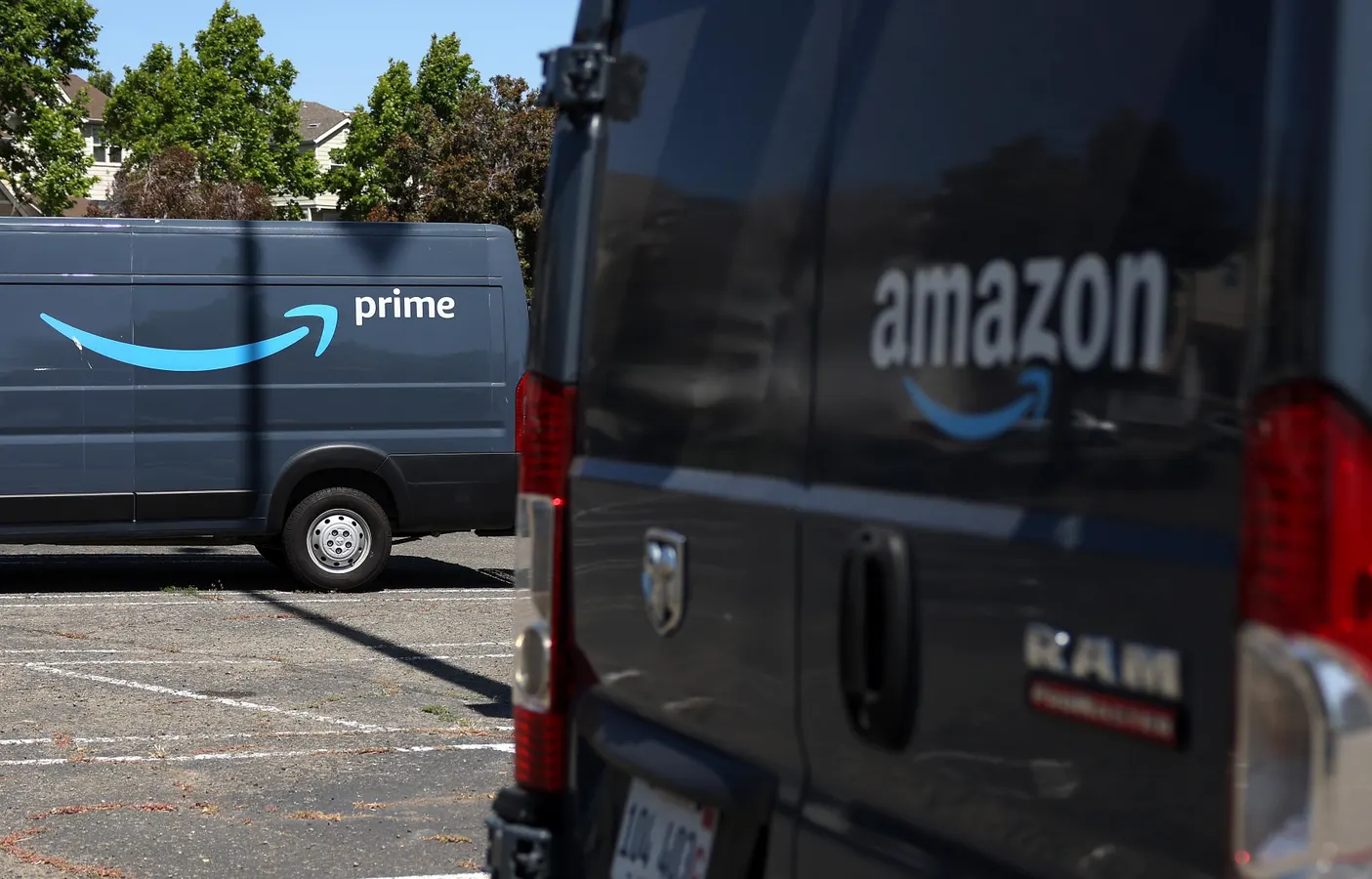

RICHMOND, CALIFORNIA – JUNE 21: The Amazon Prime logo is displayed on the side of an Amazon delivery truck on June 21, 2023 in Richmond, California. The Federal Trade Commission (FTC) sued Amazon alleging that company has deceived millions of customers into signing up for Prime subscription services and intentionally complicated the cancellation process. (Photo by Justin Sullivan/Getty Images)
Getty Images
If you bought $10,000 worth of Amazon shares in 2006, your investment would be worth over $1.4 million today. You can stop reading now, or maybe not.
Wayne Duggan at U.S. News & World Report calculated the above stat. For some it’s the source of awe. For others it’s the source of glee. But for exponentially more, it’s the stuff of heartache. If only they’d held on.
Which is of course the point. Implied in a $10,000 investment increasing in value to $1.4 million is that no one saw it coming.
While wise minds can debate just how efficient stock markets are, there’s no debating the truth that stock markets are a look ahead. Which means they price the future in the present.
Thought of through the prism of Amazon’s presumed future in 2006, the markets decidedly did not see it becoming Amazon. If so, $10,000 invested in Amazon in 2006 would be worth roughly $10,000 today. Get it?
The staggering returns in Amazon shares over the last twenty years raises a basic question: why does Amazon continue to face substantial antitrust scrutiny? How could it face antitrust scrutiny in consideration of where it came from?
Amazon presently endures an FTC antitrust suit, among other political attacks. The suit alleges that the Seattle giant enjoys an illegal monopoly through “interlocking anticompetitive and unfair strategies.” Supposed Amazon “suppresses competition” by penalizing third-party sellers who offer lower prices elsewhere, plus it’s said to bias searches in favor of its own, private-label products.
Let’s start with first allegation. Absurd is the adjective that keeps coming up. To see why, contemplate why Amazon is one of the world’s most valuable companies today. It can lay claim to the status precisely because shoppers visit Amazon.com more than any other locale. Translated, Amazon offers third-party vendors volume that they couldn’t get elsewhere. Which means its demand that vendors offer the lowest prices on its site in return for profits born of remarkable volume is a blinding glimpse of the obvious.
Amazon is quite logically looking out for its customers. Of course, what’s good for its customers is great for third-party vendors. Volume of sales at Amazon more than makes up for price per sale.
As for Amazon favoring its own private-label products in searches, it would be shooting fish in a crowded barrel to observe that this is what all manner of businesses do, including grocery stores. But this opinion piece won’t shoot fish.
Instead, it will be said yet again that Amazon is one of the world’s most valuable companies. The latter is a signal that customers of Amazon very much revere the brand. Which means it wouldn’t just be harmful to Amazon for it to not prominently feature its private-label products, it would also be masochistic.
From there, it’s useful to return to the amazing, 20-year return in Amazon’s shares to see the abject folly of the FTC’s antitrust suit. As those returns yet again indicate, no one knew what Amazon was going to become. In business, the future is opaque.
Which means it’s similarly hard, if not impossible for investors, let alone government, to see what competition awaits Amazon, and where it’s coming from. Rest assured that it’s coming, however.
See Amazon’s shares. They’re all the evidence one needs of abundant competition ahead, which is why the antitrust distractions must cease so that Amazon can compete instead of dealing with backwards-looking ankle-biters from the FTC.












Leave a comment