


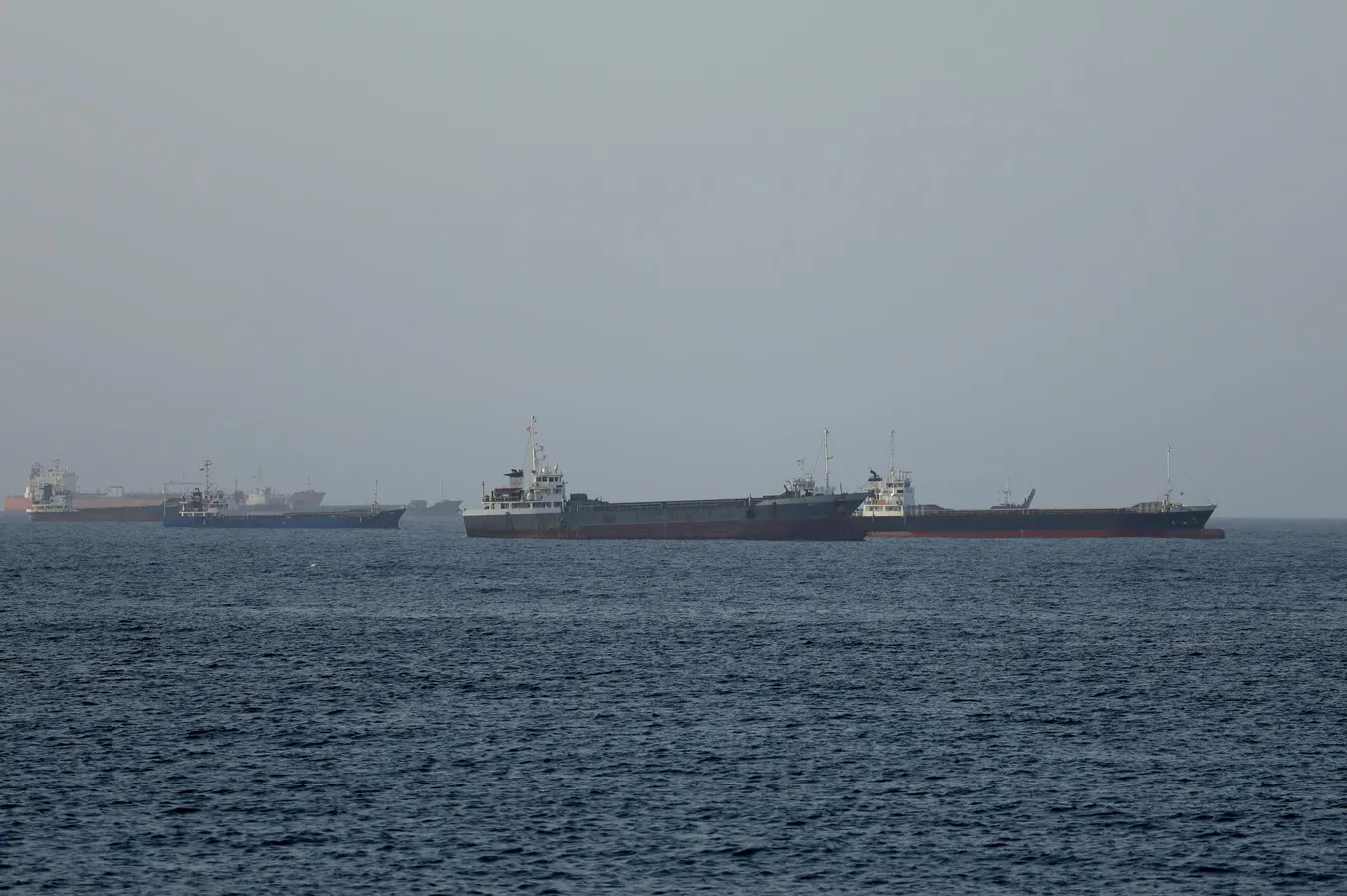

Commercial vessels and oil tankers preparing to transit through the Strait of Hormuz, one of the most critical strategic waterways for global trade flows, maintain their wait in the Gulf of Oman, on June 17, 2026. (Photo: Shady Alassar)
Anadolu via Getty Images
Oil prices fell to three-month lows on Thursday after the U.S. and Iran signalled that a long awaited deal to end hostilities in Middle East had been signed.
At 15:15pm EDT on Thursday, the Brent and West Texas Intermediate front-month futures contracts traded below $80 per barrel, around lows not scene since early March.
Brent traded at $79.53 with the West Texas at $76.81. In Brent’s case the decline equated to 11% on the week, 24.24% on the month and 26.12% on a three-month basis. In WTI’s case, the decline on week came in at 11.11% on the week, 21.61% on the month, and 19.31% on a three-monthly basis.
That’s after the U.S. and Iran signed a memorandum of understanding that is expected to ease disruption in the Strait of Hormuz – a key maritime artery through which a fifth of the world’s oil and gas supplies pass.
The MoU gives negotiators up to 60 days to reach an agreement on the status of Iran’s nuclear program, and set up a $300 billion reconstruction fund for the country among other financial incentives.
U.S. vice president JD Vance, who will lead the U.S. delegation, said Washington will also seek to limit Tehran’s long-range missiles.
Tankers On The Move
Iran started disrupting cargo transits through the Strait soon after the start of the war on February 28. Subsequently, citing the lack of movement on Iran’s part following a ceasefire, U.S. president Donald Trump ordered a blockade of Iranian ports in April severely crippling Tehran’s own oil shipments.
But oil tankers are now on the move, according to reports and the development is dragging oil prices lower. However, it will be some months, even early 2027, before the market normalizes with tankers out of place and many Middle Eastern production hubs suffering outages.
However, the International Energy Agency believes this could result in a significant surplus in 2027. In its monthly oil market report, the think-tank said global supply will now likely surge by 8 million barrels per day while demand may rise by a mere fourth of that.
Such a large supply surplus in 2027 could “provide a welcome respite to the market and an opportunity to replenish depleted inventories, or to build new strategic reserves, as countries review their energy strategies and policies in response to the crisis,” the IEA noted.
Wall Street banks and market forecasters are also scrambling to lower their oil price expectations for 2027 with Citi being the latest to do so, according to a Reuters report published earlier this week.
Citi revised its Brent crude forecast to $75 a barrel for the third quarter of this year, $70 for the fourth quarter, and around $65 in 2027.
Previously, Citi had lifted its Brent base-case forecast to $110 for the second quarter, $95 and $80 for the third and fourth quarters respectively, based on the assumption of Strait of Hormuz disruptions lasting longer.
The bank’s new forecast effectively cuts third and fourth quarter projections by $20 and $10 a barrel respectively – a high revision by all accounts. Expect more of the same as the market works its way around unwinding the risk premium and oil prices ultimately stabilize near pre-war levels.
Disclaimer: The above commentary is meant to stimulate discussion based on the author’s opinion and analysis offered in a personal capacity. It is not solicitation, recommendation or investment advice to trade oil stocks, futures, options or products. Oil markets can be highly volatile and opinions in the sector may change instantaneously and without notice.













Leave a comment