


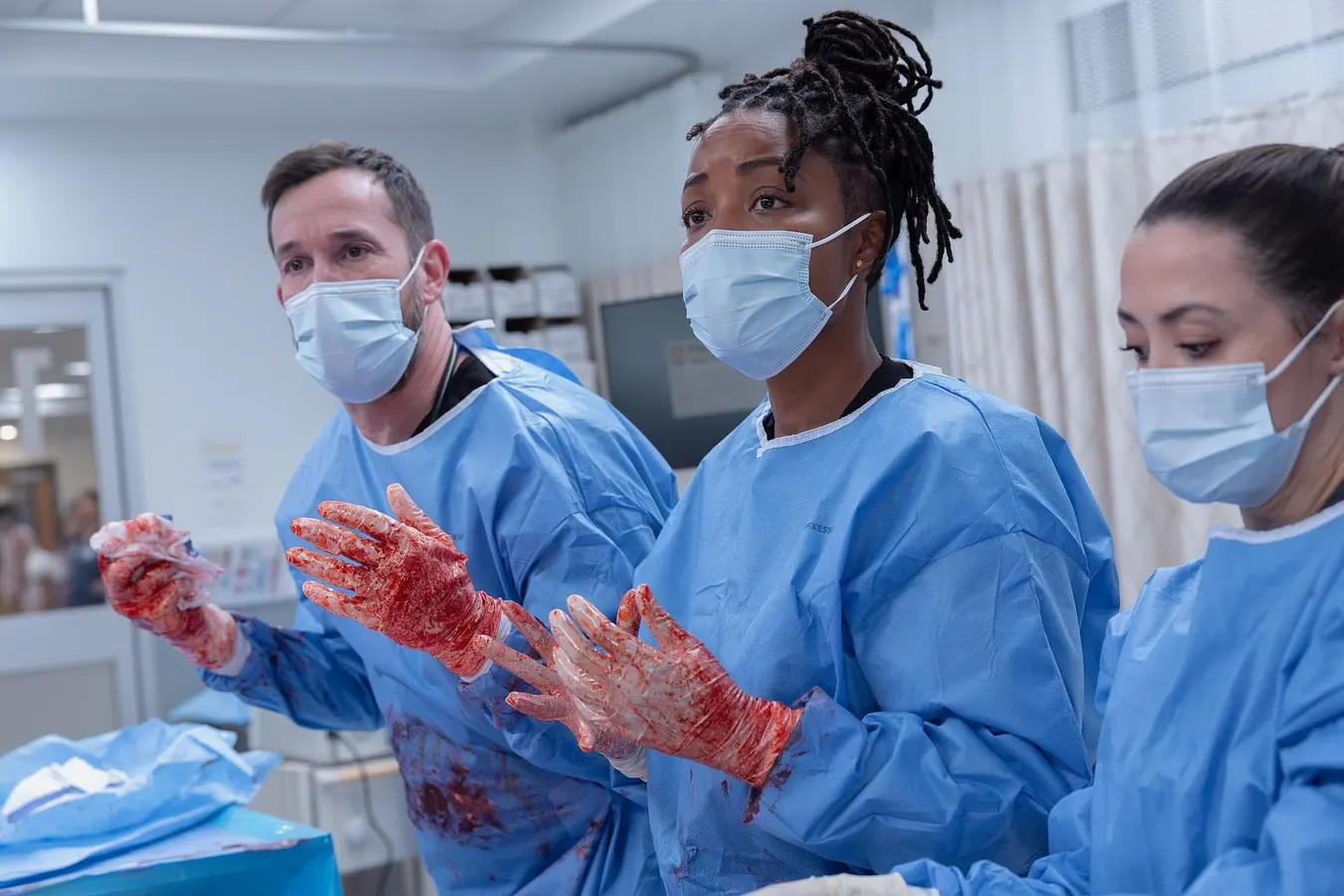
HBO Max’s exceptional hit series The Pitt enters Emmy season with strong momentum, and Emmy-winning executive producer and writer Simran Baidwan helped shape its socially aware, character-driven medical storytelling. I sat down for an extended interview with Baidwan, discussing what makes the show so realistic and immediately relevant for today’s audiences.
The Pitt – The Interview
MARK HUGHES: I want to talk first about systems under pressure, because you’ve talked about how that’s kind of the show, it’s people within these systems that are put under pressure, and how they have to work together to overcome that, and the ER kind of is a human-scale map of that, right? And patients come in with the medical emergencies, but then there’s insurance, poverty, housing, immigration, all of these larger forces converging in one room. And in real time, [with] the format forcing people to observe it. You can’t walk away from it. You can’t just cut away from it. So first, I want to just discuss the idea of an ER dramatizing society bursting at the seams. Was that part of your perception and conception of this out the gate?
SIMRAN BAIDWAN: Yeah, I think it was really important. This all came about really during COVID, when Noah Wyle was getting inundated with a lot of people saying we need some hope and we need some humanity, and how do we bring this back? And he’s been getting fan mail for decades, based on his previous experiences in television, and it was from not just healthcare workers, but just people in general, and I think people were really striving for connectivity, for human connectivity, right? We were all isolated. We were put in our homes.
So I think that was part of the seed that sparked, hey, maybe there’s more medical stories to tell, and we could tell it in a slightly different light. And that’s how he started chatting with John [Wells], and then they both started chatting with Scott Gemmill, our creator, and it just started percolating from that idea of, let’s go someplace that’s not shiny and sexy like New York City or Los Angeles or Chicago. But let’s get into the heart of America. Let’s go to Pittsburgh. Let’s just open the doors to a regular trauma center in there with a cross section of society, as an ER does. It doesn’t care about your socioeconomics, it doesn’t care about race or culture. You know, it really cares about, well, you’re sick. What are you sick for?
And quite honestly, people who are coming through those doors… it’s probably the worst day of their lives, or one of the worst days of their lives. So you’re really seeing a cross section of humanity coming through that. And by showing a cross section of humanity, you are going to have a cross section of these humanitarian issues, whether it’s food insecurity, it’s people who are unhoused, climate change, mental health, all those kinds of things. So it’s kind of baked into the inherent structure of what an emergency department does and who they treat.
MH: It is amazing how well it captures that. My sister is a nurse and worked in emergency rooms, and–
SB: Wow, well please thank her, from us!
MH: I sure will. And she loved the show, and I’ve unfortunately spent enough time in emergency rooms myself to know that it’s exactly that. And when you’re in an emergency room, it’s like the great equalizer. And it is a cross section of humanity and also of trauma and of crises. But what I love about the show is that care does it as well, and that kindness does it, they compound too. And The Pitt and Clean Slate both understand, I think, how trauma compounds, and that’s why we need care to compound as well. There’s not always a perfect cure, and it gets that across, and there’s not always a perfect apology, and there’s not always a clean healing, but with support it’s survivable and it can be less painful. And that seems like a theme you return to in your work. I’m fascinated, because I know you have a background as a prosecutor, and that’s what I went to college for originally, actually–
SB: Oh wow.
MH: And life didn’t turn out that way, but that was originally my intent. And so that’s what I came to see in my own life: that trauma compounds and crises compound, but care compounds, and we reach out for each other, and there are hands there to reach back if you do that.
SB: Absolutely, absolutely. I mean, as far as writing, I’m always interested in complex characters. You know, it’s the most intriguing part for me. Like, really peeling back the layers of the onion, where we are multi-dimensional, multifaceted, multi-experiential human beings. And I always say that, even though I grew up in the same house as my brother and sister, with the same parents, we each had a different set of parents. You know, we each had different experiences in that household. So, we’re not a monolith.
And I think that’s really important as far as character development and what you’re trying to see. And I think the more specific you can be about characters, in a weird way, they become more universal. People find the threads and be like, oh, okay, I may not like this character, but I understand them. Or okay, you know, there’s complexity in that… and that we’re always growing. We’re always learning. I feel that way. You know, if I’m not learning and growing, then what am I doing here? But yeah, so I think let’s show that. Let’s show a mirror of what’s possible: that if you know better, you can do better and be better. And I think that there’s always an opportunity to have that in any kind of writing.
MH: Yeah, it’s really good at conveying– I mean, I see so many different characters in the show who are people I know, people in my life, people I have known, friends, family. And “survival infrastructure” is the phrase that comes to mind… It’s not just emotional comfort, but there’s also survival infrastructure inside that system, we care and we want to help each other. It’s emotional support, but there’s also that very literal keeping each other alive, whether it’s the literalism in the ER, or in Clean Slate. I think about the communities under stress, and how the communities respond to that in different ways. And a lot of the times, you are kind of keeping one another alive, and sometimes it is just on your faith in each other, and faith that there is a light at the end of this tunnel.
SB: Yeah, I think both of them have similar themes in restoring hope and faith in humanity, in your fellow human being, whether that comes from your born family, your chosen family, your work family, which all probably have many forms of dysfunction as well in them. But, you know, at the end of the day, just trying to find that little sliver of hope, that sliver of we are really learning, we are trying to be a better society and a better community. I think that people really gravitate towards that, especially during difficult times. I mean, there’s so much tumultuous, difficult stuff going on in our country right now and around the world. And so it helps if you can turn to your entertainment, which hopefully restores a little bit of [sense of] okay, there is good in the world… we can do some good things, and it doesn’t have to be perfect, but at least it’s moving in the right direction.
MH: It provides a really great model for people to see… because you’re taking these bigger issues that so many people are living directly in their lives, and it’s closer and closer to their own front door. But for a lot of people, for most of the 320 or 330 million people in this country, it’s not right outside the window. And because of that, I think it feels so much larger than life… and it feels impossible to get control from one moment to the other.
And this is where I think the brilliance of your choice to do it in real time. There’s not going to be a cutaway, a commercial break doesn’t save you. The characters.. have to stay with it. And that means we as viewers don’t get out. However uncomfortable it is, those ICE agents are still in that hall for the duration, and we have to live with that the way the characters do. And that gets [to something] I think you said, [that] you didn’t want characters making speeches to make points. I think that’s why your show works, because we have a bazillion people talking and giving speeches on podcasts, politics, news, everywhere, and it’s not changing anything. People taking action is what’s happening, and what’s changing things, and what matters. And now I’m speechifying myself too much.
SB: No, thank you. Thank you for those very kind words. And that 15 hours, one-day structure, that comes from the brilliant mind of Scott Gemmill. That was how he really pitched and formulated the show. The very first meeting I had with him about the show, it was with him and Noah. And there was no script yet… but they came in and they were like, hey, this is basically the logline. And, you know, they had the rough structure of a few of the characters. And then we really were able to break the series and the season of season one together, before we went and pitched it to HBO Max.
And it was really wonderful to be on the ground floor with these really, really lovely storytellers and creators and minds, who just wanted to be out there telling authentic stories, telling something that was a reflection of what these healthcare workers are going through. They are such unheralded heroes, you know. And especially in those emergency rooms, in those hospitals… like I said, they’re seeing, you know, the world’s worst ills coming through the door, day in and day out, and they do it every day, you know? So, yes, ours is an exaggerated 15-hour shift, and sometimes we have a lot more traumas and things than might be on a normal shift, but the reality is everything that we show on our series has happened in real life. We talk to hundreds of experts and doctors and residents and nurses who share their stories, and share their stories not just about the patients they see, but what they’re feeling, how they are feeling, and what is being thrust upon them, both mentally and physically.
And that’s the greatest response we’ve had, honestly… from the healthcare workers, saying that they felt heard and seen, and now that is something that has helped them to share with their own families and friends. Like, yes, this really is what I go through on a daily basis. And so you have a little bit more grace for people in your lives, and hopefully not just the healthcare workers, but everybody in your life. And then I think it’s really been helpful when we talk about these mental health issues… that, again, not just the people walking into the door who are patients, but people who are actually working in those environments. To have people give us that feedback, saying it’s really made me shine a light on my own life, and maybe go see a therapist, or talk to somebody, or really open up to my partner… that means the world. I mean, that is all gravy.
MH: I lived in LA through the initial [outbreak]… and I got COVID right out the gate, in February of that first year… I remember going to Kaiser at the height of it, and they had tents outside, and people were in full protective gear and everything. … And people screaming at [healthcare workers], people throwing things… There was such panic, I think everybody kind of felt like the world was falling apart. And in that moment, when nobody was doing anything that needed to get done, the healthcare workers were. They were the only ones who were showing up. And I really think the healthcare system kind of held this whole country together at that time. And I think you’re right, we can’t thank them enough, because I do believe to the extent society bent but didn’t break, and cracked but didn’t fall apart, the healthcare workers probably were the final decisive factor in that.
I don’t think people realize right now how important this show has been. When we look back on it in 10 years or 20 years from now, it’s going to be noted how significant it was. I think The Pitt is having a political effect on the public. I think it’s one of many factors. It’s so overwhelming, and I think it’s reminding people, in these conditions, in these situations, that we have to do that again: remembering compassion, and that we have to help each other.
SB: A hundred percent. I think it’s important for us that we are reflective of what’s really happening in emergency departments across the country. I think part of it is, yes, that’s the show we want to create, but I also think it would be irresponsible and a disservice not to be doing that. And when we’re talking about different topics, it’s because that’s happening, you know? Yes, some people were saying it feels very prescient. I said, no, actually, we’re just listening to the stories about what’s really happening. I mean, when we did the measles story, we were listening to doctors saying people are still anti-vaccine, things are happening, and there’s going to be resurgences of stuff. And we wrote that episode, shot that episode, and I think maybe even around the time it aired is when all these measles spikes started happening. So, again, it was just listening to the local community and the local doctors saying, these are the things we’re seeing. They’re not getting national headlines, but that’s going to have a ripple effect.
And the same thing with immigration. We were seeing it in small neighborhoods. We were seeing it everywhere. We were hearing about it in clinics and other places in Los Angeles. And so when we told that story… we shot that and wrapped that a month before everything happened in Minneapolis. So again, it was just reflective of what we had seen and heard percolating within the community, within these emergency departments, and it just wasn’t getting the attention. So if we can help bring light to some things that need attention like vaccinations, and the fact vaccinations work and they protect people, then so be it. That’s a wonderful thing for us to be able to say.
I know that there was– I feel like Hollywood, Health & Society from the Norman Lear Center had some kind of a study, and I’m going to probably misquote it, but it was about organ donation, and how they talked about the episode we did. Or episodes, I should say, because it was a very long arc. And we chose to do the arc in that fashion because it is such a sensitive topic, because it’s not a rash decision, because how do you speak to a family that’s trying to mourn their child? Like, it’s a surprise, their child’s death, so then you’re saying by the way, I know your child is technically breathing, but they’re technically dead, can we have their vital organs? And we did a lot of research, and a lot of thought went into telling that story. But going back to the Norman Lear Center, they said they had an influx of people who started doing research and signing up for organ donation, who said oh my gosh, we didn’t know about these things. It made us very cognizant of the fact that we can help save lives. And something like that is just wild, in the best way wild.
MH: Segueing a bit, I’d like to talk about representation as story infrastructure. You’ve said how much the diversity behind the camera [helps shape perspectives from which stories are told]– you’ve talked about that before, that matters. And, I mean, writing about healthcare and immigration and trans identity, can you talk about how the composition of the writers’ room changes what the show can see, sort of?
SB: I think, for me… again, this is a testament to Scott Gemmill. I mean, he’s been a successful writer for decades, and he could have very easily filled the writers’ room with a bunch of friends and people that he had worked with previously, but he chose not to. And what he did was, he assembled a group of people, other than Scott and Dr. Joe Sachs and Noah who had worked together before, all people who had never worked together before, never worked with him before, never worked with one another. And we came from a variety of backgrounds. I am a child of East Indian immigrants. Cynthia Adarkwa is a child of immigrants from Ghana. Valerie Chu is of Chinese-Taiwanese descent, also first generation. You know, we have Kirsten Pierre-Geyfman, and she is of Trinidadian, you know, descent, and also first generation. So these are just four people in my writers’ room. There’s many more who come from different life experiences.
But I will say that the majority of our room comes from what we would traditionally recognize as marginalized communities. And by having people with such vastly different lived experiences, I think you get to pull on and pull from those different cultural, social, and emotional kinds of stories, and infuse that into a show like this. I always talk about how I might be able to share a story that is very specific about my family or my upbringing, and infuse a story. What you end up finding out is that, oh, this is more than just a story about a South Indian girl and her overbearing mom. What you’re showing is a relationship between a parent and a child. And what you’re showing is that sometimes it’s a tough dynamic.
And I think that was also reflective, honestly, with Clean Slate, where we had a very specific story of this proud trans woman who came back to her father’s house, and, you know, into this community that is traditionally not very accepting. And you’re like, okay, that’s very specific. But what you’re really talking about is, you’re having a rekindling of a relationship. It’s a little bit of an odd couple: how do we get back under the same house, and how do we rekindle our relationship, and learn from one another, and grow from that? When you have the intention in setting up a room, a writers’ room, with people with diverse voices and different lived experiences, you’re going to get such a rich tapestry of storylines.
MH: You mentioned Clean Slate… I know to a lot of people, it might seem incongruent, but I totally get it. I get how whoever was behind this is behind that too. Because there aren’t many shows as good as these two shows are at addressing the point that sometimes healing is incomplete, and that’s okay. Sometimes what matters is that the connection is still there, and you’re still holding hands, even if the full healing hasn’t fully come, everything’s not where you wanted it, and it didn’t work out how you thought or hoped or imagined. And that’s one of the things– Laverne Cox and George Wallace, the warmth that they bring to it. And again, loving George Wallace, the integrity he brings to it, and the dignity they both bring to their characters. There’s the estrangement, the regret, and you can see it in those old family wounds, and how raw it is. Because nobody can hurt you like someone who loves you, you know? And also, no one can heal you like somebody who loves you. And I think where they come at it differently is, we get the sense in Clean Slate it’s about family and community, and I think in The Pitt, it’s a little more about found community, and even (I know it’s a loaded phrase, but I don’t care) intentional community. Because in that moment in the ER, when ICE is right there, what are you going to do? You know, you have to make your choice about what you do in those moments.
SB: Yeah.
MH: And sometimes that’s where community forms, even if it’s just temporary communities for emotional support and for survival. Or just trying keeping Noah Wyle’s character alive through the end of the day. We watched it hour by hour, knowing that clock was ticking down to whether he’s going to be alive or not at the end, you know?
SB: Absolutely. And, you know, I really applaud Noah for leaning in and wanting to tell these complicated stories and vulnerable stories, that sometimes we aren’t our best selves, sometimes we do make mistakes. Even our heroes are fallible. Because, again, we’re human, right? That’s the whole point. Perfect people are boring. They’re boring to write. And same thing with Clean Slate. Like, George’s character is complicated, and he says some vicious things, and he tries to take them back, but you can’t unring a bell. And it’s about growth, and it’s about learning, and it’s like, okay, I’m really screwing this up, but I’m trying, teach me. Or just even a simple statement, just to know that you are wanted, to know that you are loved. And I’m sorry if there’s going to be some bumps and scrapes along the way, but I promise I’m doing my best, and I need you to keep with me, and keep calling me out, and keep me honest. Because when you know better, you can do better.
And I think the same thing is reflected in The Pitt with these characters. You can try to compartmentalize as much as possible, to separate church and state, your personal life from your professional life. But we’re not robots, none of us, not even these highly trained technicians who are supposed to keep things very taut. I think that it’s just not honest to [think we can] do that. So, if we can just lead with a little bit more empathy in all of these universes, and just show the difficulty with which life can consume all of us, and just be a little graceful with it, if we can have that grace for these characters on television, maybe we can have some grace for our own neighbors.
MH: This is a big issue for me. After the release of Wonder Woman 1984, I wrote a whole long article about the issue of grace, and that it’s okay not to be perfect, and what you’re talking about… you know, you’re not a robot, you’re not a machine, you’re under this constant strain. But people feel like they have to be, because they get in that mindset of, every decision I make [is life or death]. And your show accentuates it with something as simple as “I thought she just had a rash on her leg,” and suddenly in one moment and one mistake, lives get destroyed. I get the sense that you have to have, simultaneously, a god complex to be a doctor, but also a tremendous sense of obligation, that you can’t afford to be terrified about your family at home in the middle of COVID when you’re working there, you have to suppress that. And I think Noah gets that point across, how everyone around him is falling apart and he’s worried about them, and they all lean on him because they know he lets them. That’s who he is. It’s how he avoids confronting his own issues, he fills up with everyone else’s problems so there’s no room or time for his own, until he can’t take it anymore. And, you know, a lot of us have been there. And it’s just very resonant.
SB: Yeah, and that was intentional in that story, just making sure that he’s having a terrible, horrible, very bad day. But, it’s much more than that, because it’s the mental strain, to your point. You’re trying to keep the lid on that pressure cooker, and what it starts doing is, it starts having you lashing out at those around you. You start lashing out in different ways. And then, when you’re finally able to at least say, “I have to get out of here, because I think this place is killing me,” it is so raw and so honest and so brutal. And so I think, again, in that world, he’s made mistakes during the day. He’s been unkind sometimes. He’s said some snarky or biting remarks. But then, when you get to see what’s percolating underneath, that’s where you’re like, oh, you poor soul, I’m sorry for what you’re going through. It doesn’t make what you did right, but it allows you to understand.
And going back to the very beginning of our conversation… complex characters are so rich in that way. I really love peeling back the layers of the onion of different characters. You know, one of my favorites… I love Wicked, and the Wicked Witch, and you’re like, oh, she wasn’t always the Wicked Witch? What was Elphaba’s story? So I call it the Elphaba effect. Let’s peel back the layers of the onion and figure out, was she born this way, or did society make her this way? You know, the things that we tell ourselves. How are we built? How are we evolving and changing as people? So I think that, hopefully, what we’re able to do with The Pitt is show an evolution of all of these characters. Dr. Robby, obviously, at the forefront, but all of them, like Nurse Dana. And when you’re talking about Whitaker, starting as a med student and now he’s an intern. And all of them, and how this place changes them, and how do they change the place, you know? Sometimes for the better, and sometimes not.
MH: Well, I think I have time for one more question, and I wish I’d asked this earlier, so you had time to talk about it. And this segues into what you were just saying. You’re a former prosecutor, so you’ve experienced people caught inside the legal system, and a lot of that same thing, where the villain has a story, and they’re not evil, it’s just their perspective. These aren’t abstractions to you. Can you talk about how that informed where you are now, as a storyteller, about systems and what happens to humans trapped in those?
SB: Sure. When I was a prosecutor, I think I went into it very naively. Like thinking, there’s the law, and then there’s people: you broke the law, you didn’t break the law, that it was very black and white. And it’s not, as we know. We all live in the gray, and there are different circumstances, and different realities, and different situations that provoke behaviors, oftentimes good and bad. And so it was very eye-opening, in seeing a cross section of society. Whether you were a victim of a crime, whether you were a defendant, whether you’re a police officer, whether you’re a judge, all of these things. There’s a lot of human examination going on when you’re working in that environment. And I think being an observer and a listener helps you to also be able to draw on those experiences as a writer, and then infuse characters with that same kind of multivariable sense of what the world is like.
MH: And you’ve done an absolutely outstanding job with it, it’s a wonderful show. Thank you so much for taking time to talk to me, and thank you for both of the shows, The Pitt and Clean Slate.
SB: Thanks, Mark. And please thank your sister for her work as a nurse.
MH: I will tell her. Thank you, Simran.
Thanks again to Simran Baidwan for speaking with me about her work on The Pitt.
















Leave a comment