


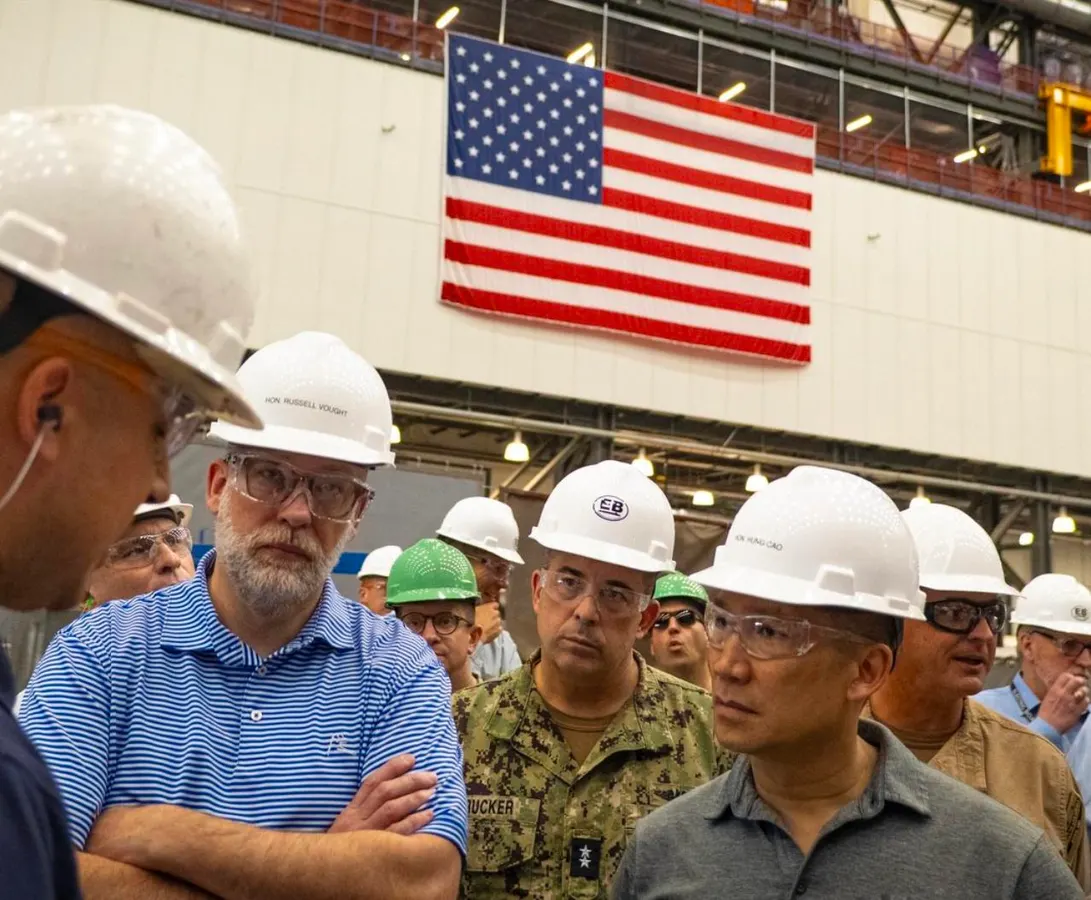

Acting SECNAV Hung Cao (right) joins the powerful OMB Director Russell Vought (left) at a U.S. Submarine factory.
US Navy
After almost two years of pointless front-office intrigue, executive dysfunction and bureaucratic knife-fighting, Acting Secretary of the Navy Hung Cao and William “Bill” Toti, now “Performing the Duties of Undersecretary of the Navy,” are busy preparing the Navy for a welcome era of rational, attentive front-office management.
With the disastrous Navy Secretary John Phelan gone, Cao, the “Acting SECNAV”, is on quite a roll. Cao obviously wants to do well by the Navy, and, by putting his heart into the job, even some democrats are urging the Administration to fast-track Cao’s nomination. He’s doing well. Aside from doing everything right in engaging the fleet, he’s not just chasing ceremonial activities. Rather than chase the President, Cao is quietly establishing himself throughout government, reaching out to key budget stakeholders. In mid June, he toured a submarine factory with the Trump Administration’s budget boss, Russell Vought, the powerful, maritime-focused Director of the Office of Management and Budget.
Acting Secretary Cao is doing more than just enjoying the pomp and circumstance of his new post. He isn’t converting his proximity to power into profit or over-indulging in cultural warfare toxicity. Instead, he is sweating the small stuff, quietly assembling a new team while handling the delicate business of moving competent legacy Phelan appointees to positions of authority just a tiny bit farther away from the Navy Secretary’s immediate office—maintaining leadership continuity while building his own loyal set of Navy leaders. He’ll need everyone. As taxpayer money arrives and America’s waterfront starts to move, Cao will leverage all the front office help he can get.
Chief of Naval Operations Admiral Daryl Caudle and acting Secretary of the Navy Hung Cao chat with members of Congress
Getty Images
Hung Cao Can Chalk Up Some Backroom Wins:
Aside from re-invigorating the Navy and the challenge of managing several festering maritime conflicts, Hung Cao and Bill Toti’s newly-invigorated staff must now show it can do the work of growing the Navy.
Cao can pursue some easy Navy wins.
First, the Acting SECNAV can recruit the White House to test the Navy’s new Portfolio Acquisition Executive (PAE) organizational structure. One good test would be to create a national Navy Battle Depot, directing the new PAEs to immediately procure and maintain a full ship set of spares for every major type and variant of vessel in service today, using advanced manufacturing (additive manufacturing and 3D printing) where possible.
This might be a mundane task, but the Navy’s brand-new PAE program requires this sort of immediate, cross-cutting “taskings” to break up the old Navy procurement bureaucracy. Filling a National Battle Depot with spare parts (or even spare modules–like a few spare bows or bow domes for Virginia Class submarines) will force the PAEs to really exercise their new authorities. And, of course, America’s fully-engaged Navy needs to refresh their spare parts lockers anyway; the Service’s parts inventory accuracy last year veered between 83 percent and 95 percent, well underneath the target goal of 98 percent. A force that wants to be battle-ready must do better.
Cao can also earn immediate kudos by ripping apart the sludgy, slow-moving, “we’ll study anything into the ground at great cost” culture at the Naval Facilities Engineering Systems Command, or NAVFAC. Without an immediate push for sustained and rational management, NAVFAC will stop any big Navy infrastructure refresh before it even gets started.
A bloated enterprise at best, NAVFAC is awash in billions of dollars for military construction, operations and maintenance, and specialized command construction budgets. As an often-overlooked command, of little interest to “Big Boat Navy” leaders in the fleet, NAVFAC has sprawled to become an almost unmanageable contracting shop. Today, the organization is notorious for ignoring infrastructure maintenance in favor of massive building projects. For those, NAVFAC loves to issue sprawling “Indefinite Delivery, Indefinite Quantity” contracts that, in the end, look suspiciously like cozy “Cost-Plus” arrangements for giant global construction contractors.
The lack of Navy interest in managing NAVFAC leads, at best, to a leisurely approach to getting anything done. It gets silly. On 20 May, NAVFAC’s press team celebrated the start of construction of a dog kennel in the Pacific Northwest’s Naval Base Kitsap. The facility, “a modern, single-story reinforced masonry structure,”built to support 17 military dogs and their handlers, will hopefully be delivered by March 2027.
For a military stung by a damning 2026 IG investigation into treatment of military working dogs, this sort of investment is quite welcome, but a deeper glance at the contract tells another story. The project is, obviously, expensive, costing taxpayers at least $7.4 million. Even more distressing is that the Navy is already apparently a year behind schedule. The contract was awarded in April 2024 with an original end-date of June 2026. It begs the simple question—how does the Navy need three years to build a simple dog kennel? And why are military dogs getting, in essence, $435,294 homes? America houses entire military families for less.
Comparable government projects raise additional questions about NAVFACs management. Government kennels are expensive, and certainly nobody wants to short-change the government’s cadre of working dogs. But the Department of Homeland Security—an organization not otherwise known for their penny-pinching nature— somehow managed to build the Transportation Security Administration’s Canine Training Center at Joint Base San Antonio-Lackland for $12 million. And that facility is 25,000 square feet, built to accommodate at least 95 employees and 250 dogs. In 2019, the Secret Service commissioned a 20,500 square foot James J. Maloney Training Center in Maryland. For “less than $10 million,” the two-building facility “houses 100 canines” along with training, veterinary and other support spaces.
A SECNAV that brings NAVFAC to heel would be celebrated throughout the Navy for generations.
If a wholesale rip-out and reinvention of NAVFAC is impossible, Cao can try another route, supercharging the Navy’s behind-schedule and over-budget SIOP by moving forward on West Coast shipbuilding and a 5th Naval shipyard (something I have publicly advocated for since 2019). By sidelining NAVFAC and using lean firm/fixed-price contracts to build a new shipyard, the SECNAV can generate an “apples-to-apples” comparison of unfettered private-sector performance with NAVFAC’s dubious cost, schedule and quality record.
By leaning into the little things—a new national battle depot, the long-term challenge of building nuclear-ready shipyard and establishing a new taxpayer-owned ship repair center on the West Coast—Cao can provide the White House, the Navy, the U.S. Coast Guard some great wins. A new shipyard, built in direct competition with NAVFAC, will both help control NAVFAC and government maintenance costs on the West Coast. Even if Cao leaves office in two years, he’ll be guaranteeing a solid future for the growing submarine fleet and future nuclear-powered surface combatants. It will be a job well done.
These are tough tasks for any SECNAV, but Hung Cao is the right person to get it done. He obviously wants to do the job more than he wants the position. And he has ample incentive to his best. By pushing hard to resolve hard problems today, Cao’s old Navy colleagues and every sailor and Marine in the future–including Cao’s son–will benefit. And who knows? With vigorous action and strong support from an empowered Secretariat staff, Cao might, one day, end up leading the whole show as Secretary of Defense.















Leave a comment