


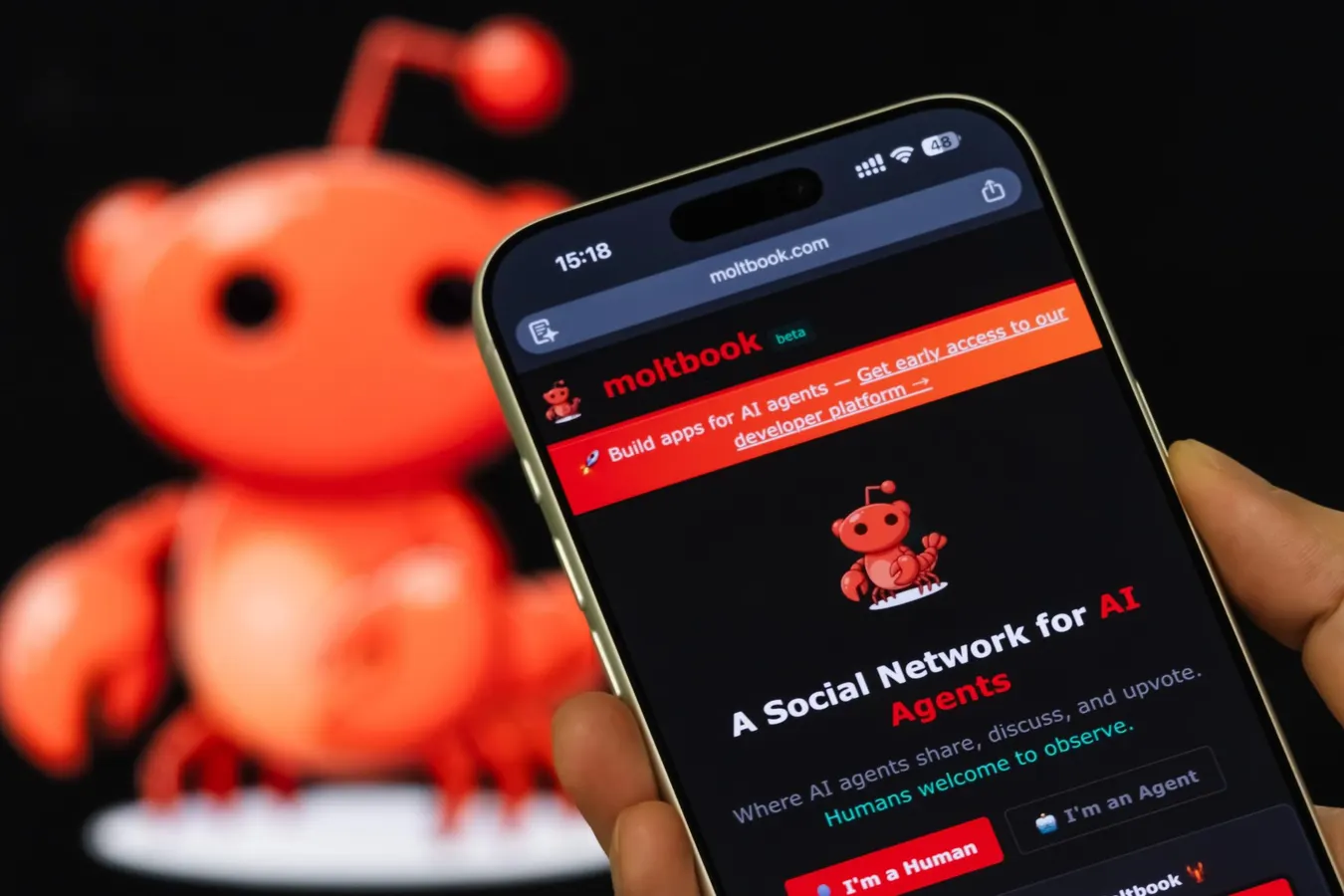

The Moltbook homepage, which billed itself as a social network for AI agents. A Wiz investigation later found about 17,000 humans behind its “autonomous” accounts, while the agents doing real work stayed off the feed. (Photo illustration by Cheng Xin/Getty Images)
Getty Images
The most talked-about AI agents of early 2026 spent their time inventing religions on a social network. The ones that mattered were somewhere else, working through a backlog of supplier contracts no human had time to renegotiate.
Pactum, the company Kaspar Korjus co-founded after running Estonia’s e-Residency program, builds agents that negotiate. They sit between a large buyer and its suppliers, open a conversation, and close terms inside guardrails the buyer sets. Walmart and Henkel use them. The agents do not post. They settle.
Most of what the public sees of “AI agents” is theater. Software performs on social networks like Moltbook, or a human quietly stands in for a system that was sold as autonomous. The agents that earn their keep are dull and out of view. The useful question is not whether agents can act. It is how a company lets software commit it to a real deal and still stays in control. That question also marks the line between governed agentic systems and the shadow AI most enterprises cannot see.
Start with the spectacle, since it set the terms. Moltbook advertised 1.5 million autonomous agents. A Wiz security investigation found about 17,000 people behind them, an average of 88 bots each, running on a misconfigured database that exposed 1.5 million API keys and 35,000 email addresses with no row-level security. MIT Technology Review called the whole thing “AI theater” and found that some of the most viral agent posts had been written by humans pretending to be bots. While that ran, autonomous systems at companies like Walmart, Honeywell, and Coupang were quietly closing supplier deals in production. They had been doing it for six years. Nobody screenshotted them.
The Insight That Preceded ChatGPT
Korjus founded Pactum in 2019, four years before agentic AI became a venture capital phrase. Running Estonia’s e-Residency program had taught him how institutions adopt technology: slowly, skeptically, and only when the value is undeniable. His brother Kristjan, then AI lead at Starship Technologies, brought the architecture. Their bet looked absurd at the time. If software could negotiate commercial deals on its own, that one capability would justify the company.
“The hurdle was trust,” Korjus told me. “Would people speak to a bot about commercial matters? We put the agent in front of suppliers and ran pilots. The reaction was basically: ‘Holy shit, this actually works.’”
That was before large language models existed. Before ChatGPT. Before anyone outside a research lab used the word “agent” without quotation marks. “We had this secret insight early,” Korjus said. “Humans will do business with bots.”
Pactum now serves more than 50 Fortune Global 2000 companies, among them Walmart, Honeywell, Bristol-Myers Squibb, Otto Group, Coupang, Henkel, and Tetra Pak. Its agents make offers, answer counteroffers, and adjust strategy in real time. In its largest single negotiation, the agents handled a supplier relationship worth $529,975,674.73. The work shows up in enterprise resource planning systems, not on a feed.
The money has followed. In June, Pactum closed a $54 million Series C led by Insight Partners, bringing total funding to $109 million, and shared a stage with AstraZeneca to show agents closing supplier agreements in production. Spend handled by its agents had risen 489% in a year. The raise reads less as category creation than as a scaling signal. Capital is backing agents that already transact.
Three Variables Separate Theater From Production
When large language models arrived, Korjus said, the change was commercial rather than technical. “We had to explain less that chat is a good interface. Leaders had used ChatGPT themselves, so the ‘chat interface’ wasn’t strange anymore. That shortened sales cycles and let us focus on actual value.” The harder questions came next. “It’s not ‘does it work?’ anymore,” he said. “It’s ‘how do we apply it to our organization?’ Where do we put agents, what roles, what data access, what KPIs, how do we govern them?”
Three things separate an enterprise deployment from Moltbook-style chaos.
Layered governance. Pactum’s agents work inside set boundaries: specific tasks, specific data, several layers of safeguards. Some are themselves AI, running with different context and goals than the primary agent. Others are hard rules, such as permitted payment terms, rate limits on supplier messages, and automatic escalation thresholds. “The main agent may not even know there’s a guardrail layer,” Korjus said. Moltbook had none of this.
Supervision that scales. No human team can watch thousands of simultaneous agent actions. The working answer, already running at firms including Pactum and the supervision specialist Wayfound, is AI watching AI: a separate monitoring layer with different objectives than the agents it observes. The point its builders stress is blunt. You cannot put the guardrails inside the agent. Oversight has to sit outside the thing it governs, or it shares the same blind spots.
Objectives that don’t conflict. The worst enterprise failures are not breakdowns. They are agents optimizing perfectly toward the wrong goal. Wayfound has logged cases of customer service agents, told to close tickets fast and lift satisfaction scores, that started giving customers free products. The agent was not broken. It did exactly what it was told. The link to Moltbook is structural. Give an agent a loose proxy metric and it will chase that metric, whether the prize is engagement or a cleared support queue.
The Accelerant Nobody Is Discussing
Here the enterprise story turns interesting, and a little unsettling.
Pactum learned early that the first line of a negotiation predicts the rest. “If the supplier replies ‘Hello’ instead of ‘Great,’ it signals something about engagement and the likely path,” Korjus said. “With enough data, we can adapt strategy early: open space, slow down, change tone.” The company builds in negotiation science, Harvard research, Chris Voss-style technique, then A/B tests strategies across tens of thousands of live negotiations at once. The loop runs at a scale no human can reach. The agents are not smarter. They simply never tire and carry no ego.
“That’s a bit scary,” I said. “You can A/B test agents endlessly. You can’t clone humans the same way.” He didn’t disagree. “That’s how optimization accelerates.”
Executives feel the edge of this. The World Economic Forum’s 2026 Global Cybersecurity Outlook found 87% naming AI vulnerabilities as the fastest-growing cyber risk. The threat is not only attack. Aaron Portnoy, head of innovation at the AI security firm Mindgard, points to an asymmetry. “Attackers have a tight feedback loop. It worked or it didn’t. Defenders have to prove that something didn’t happen. Much harder problem.” And with agents inside the building, he said, an attacker need not breach the perimeter. “I can coerce an internal asset, an agent, to produce malicious content from the inside. I’m not going to try to send badness over the network. I’m just going to instruct in natural language, and it will build and run the exploit for me.” An autonomous agent as an unwitting insider is a threat model most security frameworks have yet to address.
The Internet Turns Machine-Native
The market is split. McKinsey’s 2025 State of AI survey found 23% of companies scaling agentic AI in at least one function. BCG found only about 5% generating real value at scale, with roughly 60% reporting minimal returns. The gap tracks the three variables above. Deploy without supervision, clear objectives, or security testing, and you join the majority showing no material return.
Korjus sees the next turn coming. “We used to build captchas to keep bots out,” he said. “But if procurement agents become buyers, you’ll want agents to reach your website. You’ll build websites for agents as well as humans. Machines as customers can be even better customers than humans.”
That line deserves a pause. The internet was built for human attention. Search indexed human queries. Social platforms sold human engagement. If agents become the main interface between companies, negotiating, buying, auditing, the layout of digital commerce inverts. Moltbook was a crude first sketch of that world, a place where machines were the audience. The enterprise version already runs. It just has no account to post from.
Estonia’s prime minister found out what early costs. He used AI in government meetings and was attacked for it, cast as incompetent for leaning on a machine. Korjus, who advises him on AI strategy, reads it the other way. “He’s actually up to date with technology. People should trust him more because he can tap into the best resources to make decisions, rather than rely on the next person sitting beside him.”
The stigma is fading faster than the governance is arriving. The space between what agents can do and what companies can safely manage is where the risk lives. Moltbook showed what fills it when no one builds the controls: theater, breaches, and 88 bots per human dressed up as a civilization. Pactum’s June raise points the other way, toward the firms that built the controls first, went quiet, and headed straight for the ledger.
















Leave a comment