


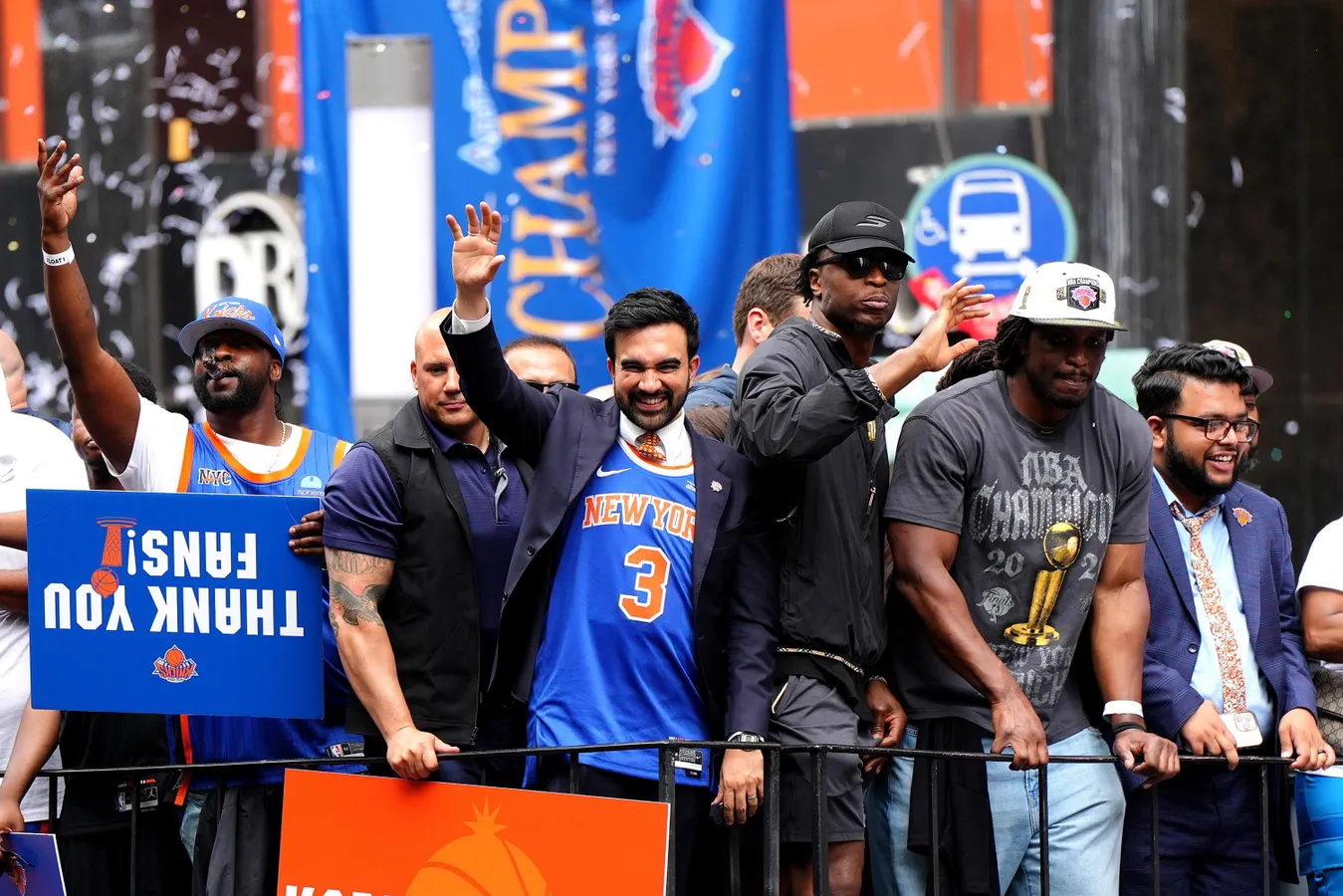

NEW YORK, NEW YORK – JUNE 18: Zohran Mamdani, New York City Mayor and OG Anunoby of the New York Knicks are seen on a float during the New York Knicks Championship ticker tape parade and victory rally celebrating winning the 2026 NBA Finals on June 18, 2026 in New York City. The New York Knicks defeated the San Antonio Spurs in five games to win their first NBA Championship in 53 years. (Photo by Angelina Katsanis/Getty Images)
Getty Images
New York has recently been quite the city to be in, as the N.Y. New Jersey region will host a series of FIFA World Cup games, culminating in the final at MetLife Stadium in mid-July.
In the meantime, the city’s attention has been focused on one of its basketball teams, the New York Knicks, which has just won its first N.B.A. championship since 1973.
This drew an estimated two million people onto the streets of Manhattan as the victorious team took part in a celebratory parade, which culminated in the city’s mayor, Zohra Mamdani, delivering what some people have described as the most memorable speech they have ever witnessed.
The N.Y.C. mayor’s office doubled down on the speech’s sentiment by releasing a video reminiscent of Adidas’ “Backyard Legends” World Cup film – cool, stylish, engaging.
Its carefully crafted production is underpinned by the messaging that New York has a heart, which sustains the dreams and drive of thousands of people, no matter what obstacles they face.
Sporting success and place branding
Sporting success has long played an important role in helping elected officials build political capital and contribute to a sense of local identity and social cohesion, though it also has economic dimensions.
Winning helps create an economic bounce, whilst hosting a mega event can deliver economic benefits, although there’s been considerable debate about the extent of the windfall this summer’s World Cup will deliver.
But New York officials evidently realise that whether it’s the Knicks or the World Cup final, sport offers an opportunity to project an image and a set of accompanying values, commonly known as place branding.
This is the process of creating and managing a unique identity for a specific location, shaping how the world perceives that place, what it stands for, and the emotional connection people have to it.
Kansas City – the centre of world soccer?
Right now, other cities in the U.S. are also playing the game – for instance, Miami and Kansas City – as each battles for our attention.
Miami has rapidly transformed itself into a premier global sports and place brand, driven by marquee events like the F1 Miami Race Weekend and the international star power of Inter Miami.
It has also become a hub and an ecosystem for both major franchises and high-growth athletic brands, including the apparel brand On, and now hosts FIFA offices following the football governing body’s decision to relocate some departments from Switzerland to Florida.
One observer has noted that Kansas City has hit World Cup pay dirt, as it hosted four national team training camps – Algeria, Argentina, England, and the Netherlands – and several World Cup games.
The City’s place-branding tagline is “From the Heart”, which reflects its geographic position and the hospitality it promises, leading one commentator to propose that Kansas is now the soccer capital of the world.
Yet the place-branding game is not just being played domestically; even national teams and nations are competing.
Oasis, The Beatles and Brand England
The England national team has been working hard to cultivate a particular brand image that simultaneously engages its fans and projects a globally appealing set of qualities and values.
Its use of a Beatles motif during the country’s squad announcement is now being supplemented by an Oasis track played at the end of matches.
The Manchester band has sold more than 100 million albums worldwide and is adding credibility and cool to the brand of a country that is struggling to maintain its global standing.
English people, domestically, may be afflicted by self-loathing, yet the enduring appeal of the country’s popular culture continues to serve as a basis for engaging audiences worldwide.
Sponsors as place branding proxies
Sponsors, too, are getting in on things, often serving as proxies for states’ broader ambitions.
For instance, China’s Wuliangye has a licensing agreement with FIFA, which has seen the state-owned company’s alcohol products being marketed in conjunction with the tournament.
Wuliangye produces Moutai, a premium Chinese alcoholic beverage often branded as the embodiment of Chinese diplomatic and philosophical values, which the company imbues with principles such as harmony and beauty.
The activation of its partnership with FIFA is striking for the way it uses place and traditions in its branding efforts, which seem to put cultural understanding rather than driving sales at the forefront of consumer engagement.
It has previously been noted how the Wuliangye brand serves China’s national interests.
In a cluttered world where countries, cities, and other places are battling for our attention, having a clear identity, laden with distinctive values communicated through sport, means that place branding has become increasingly important.
Sporting success helps in this regard, as Zohran Mamdani will no doubt attest.
However, links to music, fashion, or cultural elements mean that even those who have been underperforming during this sporting summer have achieved cut-through in their messaging.













Leave a comment