


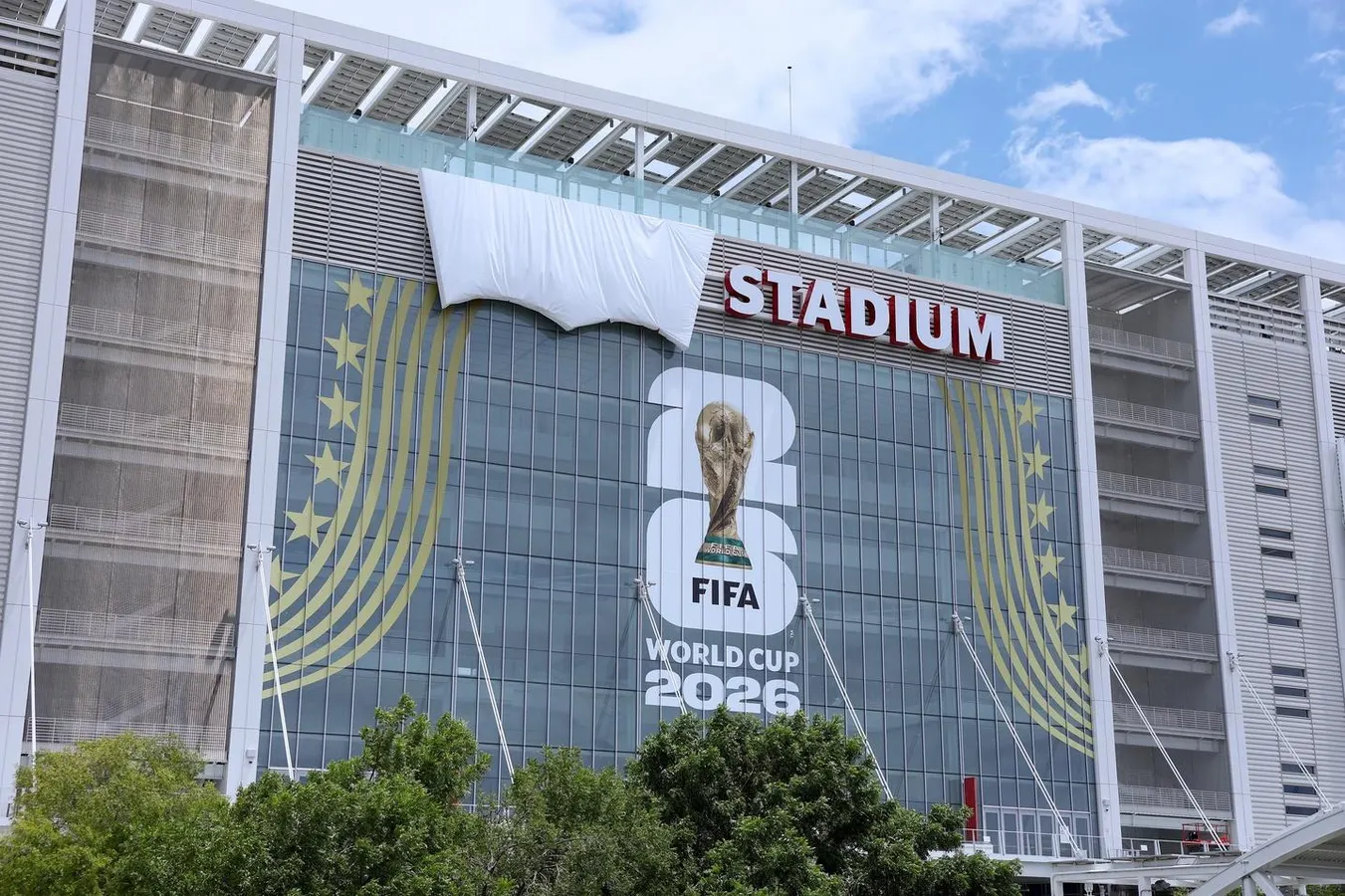

SANTA CLARA, CALIFORNIA – MAY 29: A general view of Levi’s Stadium, which for the FIFA World Cup 2026 will be called San Francisco Bay Area Stadium, on May 29, 2026, in Santa Clara, California. The stadium will host six matches for the FIFA World Cup 2026. (Photo by Ezra Shaw/Getty Images)
Getty Images
The covering up of a Levi’s sign atop the World Cup stadium in San Francisco has been met with a mixture of bewilderment, humour and admiration since the tournament began.
Initially signed in 2013, the clothing brand’s $220 million stadium naming rights deal with the San Francisco 49ers was supposed to last 20 years, though it was extended in 2024 by another ten years (to 2043) following the signing of an additional $170 million deal.
Levi’s logo ruse
For those who have either seen or visited the venue, Levi’s iconic “batwing” logo has therefore long been visible, and during preparations for the tournament, it posed a problem for FIFA.
Soccer’s global governing body operates a “clean stadium” policy, which means only the names, logos, and taglines of its official, multimillion-dollar corporate partners are visible at tournament venues.
Accordingly, the venue in Santa Clara has been officially stripped of its corporate moniker and renamed “San Francisco Bay Area Stadium”.
Some deft creative thinking by local officials nevertheless ensured that the clothing brand’s logo remained recognizable even when covered up, with Levi’s leaning into the situation by changing its official Instagram profile picture to a white, sheet-shrouded version of its logo.
The same fate has befallen Procter & Gamble via its Gillette brand, which holds the official naming rights deal to the New England Patriots’ stadium in Foxborough.
In this instance, creatives decided to block out their logo using shaving foam, a specific reference to the male grooming products with which Gillette is normally associated.
Once more, with clever use of social media, the brand has been able to divert attention from official tournament sponsors at very little cost to the likes of Procter & Gamble.
An ambush marketing tournament
Such tactics have become a staple of the mega-event sponsorship landscape, as companies and brands that have no legal right of association seek to muscle in on the action by drawing attention away from official partners.
This is commonly referred to as ambush marketing, which involves a brand intentionally trying to appear to be an official sponsor or directly attacking a competitor that has paid for a legal right to associate with an event.
Alternatively, ambushing can be indirect, taking the form of coat-tailing, with brands using creative imagery, themes, or social media wit to connect themselves to the event without ever using trademarked names or logos (such as the words “World Cup”).
At this World Cup, ambushers have been out in force, not just in the U.S., but all over the world.
Ahead of his national team’s game against Curaçao, German international Jamal Musiala was asked to tape over the Beats logo on his headphones, an opportunity the brand then seized by placing tape over the logos on its various social media accounts.
The consumer audio products and accessories manufacturer already has an ambushing track record; for instance, at the 2012 Olympic Games, it deliberately sent British team members special versions of the Beats range, branded with union flag colours, a gesture that athletes responded to on social media.
Again, the intention was clear: to distract and draw attention towards the ambusher, who, at low cost, derived the same kind of benefits that official sponsors have otherwise paid hundreds of millions to achieve.
Distraction is cognitive-behavioural in nature, shaping our perceptions and attitudes, leading us – fans, consumers and others – to behave in ways we perhaps didn’t anticipate.
The sports washing game
Yet this is not just a battle of brands; countries are also playing a game of distraction, and nobody more so than the U.S.
In his book, “Red Card: The 2026 World Cup, Sportswashing, and the FIFA Greed Machine”, Jules Boykoff argues that the Trump administration has been using the tournament to distract from controversies surrounding migration, various armed conflicts in which the U.S. is involved, and domestic gun crime.
We’ve been here before; ahead of the 2018 World Cup in Russia, many people feared how they would be treated if they attended. In the end, there was a consensus that Russia was hospitable, well organised, modern, bending over backwards to help, and ready to party.
This was quite the assessment, given that Russia had already annexed Crimea, been poisoning overseas dissidents, and was agitating for an invasion of Ukraine.
Similarly, Qatar’s organisation of the 2022 edition of FIFA’s showcase was beset by human rights controversies, although observers ultimately highlighted the tournament’s warm reception, hospitality, and tolerance, with Gianni Infantino – FIFA’s president – describing the event as “the best World Cup ever”.
No surprise then that Andrew Giuliani, executive director of the White House’s World Cup Task Force, is already claiming that the world is seeing a side of America that is often hidden behind contentious headlines – a free and diverse nation, highly adept in staging great shows.
Yet this is the distracting power of soccer’s World Cup: whatever the political truths or commercial realities of a nation, people can be led to think about the world in ways that may not accurately reflect reality.









Leave a comment