



Jacob Anderson as Louis de Pointe du Lac and Delainey Hayles as Regina in The Vampire Lestat
AMC
Major spoilers ahead for The Vampire Lestat episode 4
Grief and an aching desperation to right wrongs that can never be fixed sit at the heart of Louis’ (Jacob Anderson) story in The Vampire Lestat. His true seasonal arc begins not with Bruce’s (Damon Daunno) death but rather in the Brick & Bacon, a New York City diner where a 20something waitress named Regina (Delainey Hayles) works shifts that don’t get her any closer to making ends meet.
In episode 4, “The Devil’s Road,” sandwiched in-between Lestat’s (Sam Reid) worsening mental breakdown in the wake of Gabriella’s (Jennifer Ehle) departure and Daniel’s (Eric Bogosian) explosive reunion with Armand (Assad Zaman), lies a quiet storm of bad decisions and an emotionally ruinous agreement. There is a tender toxicity to the bond Louis forges with Regina that speaks to the overwhelming heartbreak from which its born.
But these stolen moments remain in the same conversation as the rest of Interview with the Vampire’s third outing. One that explores parenthood, transactional relationships, and what it looks like to hide in the possibility of someone else instead of facing yourself.
Jacob Anderson as Louis de Pointe du Lac in The Vampire Lestat
AMC
When Louis Met Regina
Lestat sets the scene for Louis’ ill-advised observations of Regina. Poignantly and pointedly, he says, “Louis du Lac, or Thomas Pitt or he who licenses and franchises the night, was more feared than wanted now and he could do his business wherever he wanted. And being in the same space with her was satisfying in a way the destruction of the vampire Bruce was not.”
Louis had lit Bruce on fire with Claudia’s (Delainey Hayles) diary entry as a punishment for raping her. Though he’d told Lemuel (Moses Sumney) that he’d found what he was searching for, he’d lied. What he wanted was Claudia, but her death made that impossible. So he went to what he could have. A table at a diner with a waitress whose section he could sit in just to hear her speak in an accent his daughter did not have though she has a face exactly like hers.
He’s drawn to Regina like a moth to a flame, however, her appearance isn’t the sole reason he returns nightly to the Brick & Bacon ordering food he’s not going to eat. Regina has a similar temperament to Claudia. She’s quick-witted, sharp tongued, and highly observant. But make no mistake, Louis’ hunting her. He presents himself as soft, approachable, and non-threatening.
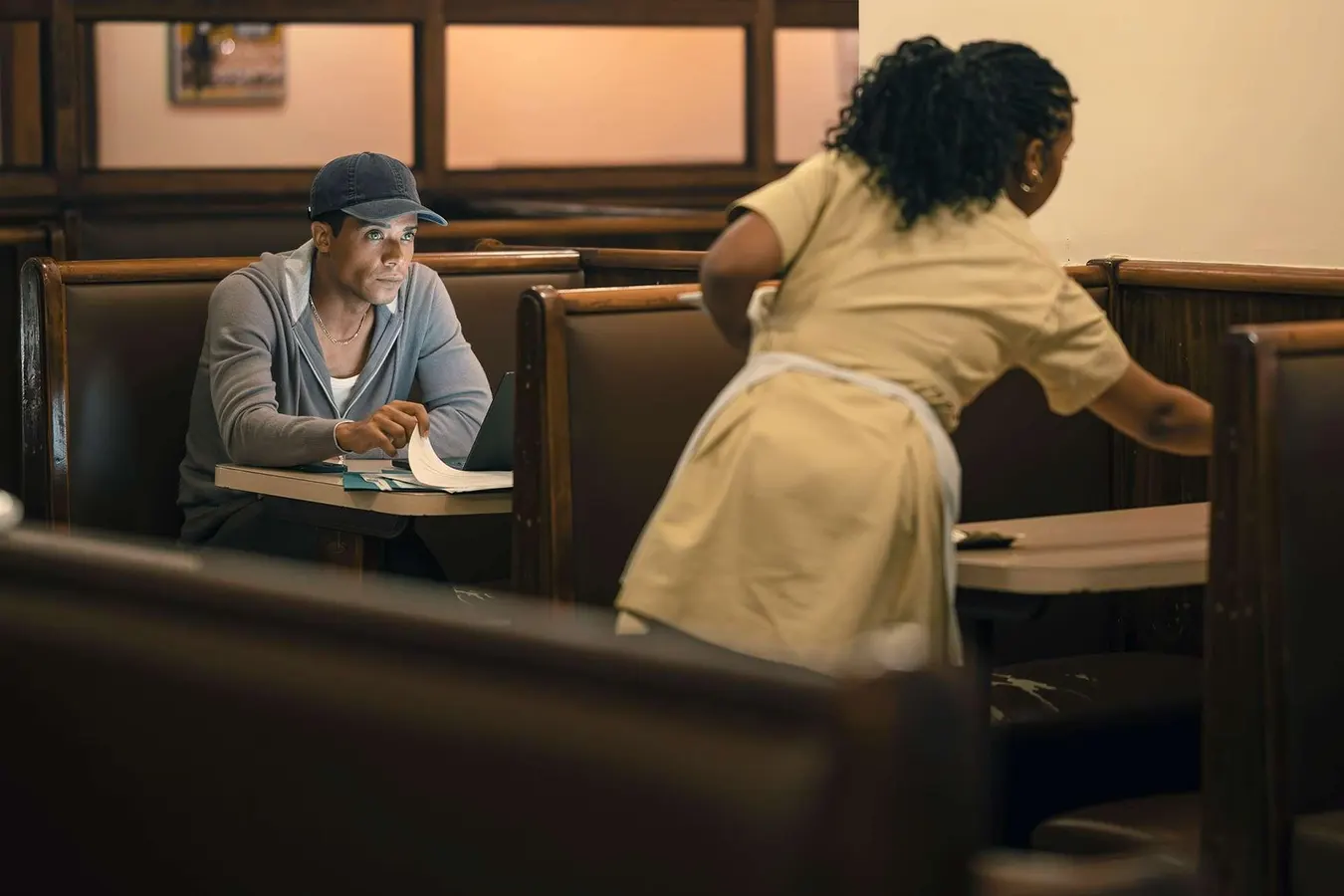
Their first conversation that’s more than pleasantries happens when Louis’ decked in the only bland outfit we’ll see him in all season. A grey sweatsuit and a nondescript, blue ball cap. He’s going for low-key and not flashy, just a man in a diner booth doing business while conversing with a young waitress, nothing to see here.
Louis attempts to get to know Regina by guessing where she might be from in London. He shares that he has a place in Marylebone. That’s the West End. All the places he guesses she’s from are on the East. She calls him posh and then gets to the root of why she believes he’s been in her section three out of the five nights she’s worked. Attraction.
Regina tells Louis that’s she’s not on the menu, but she costs so he needs to tip better, he can afford it. She knows because Marylebone is affluent and Louis’ sweatsuit is cashmere. His version of blending in ignores that being rich has a tell and it’s usually the quality of the clothes someone is wearing. Though it’s unclear if it was Louis’ intent to initially hide his wealth or if he meant to subtly flex it with a quietly luxurious sartorial choice, there’s an immediate visual dichotomy that’s established between the two rooted in their disparate socioeconomic statuses and supported by the way they relate to one another.
Notably, Louis lowers Regina’s guard by immediately dissuading her of the impression that he is interested in her sexually or romantically. He asserts he’s gay and shows Regina the picture he has of him and Lemuel (Moses Sumney) on his phone, stating that he’s “spoken for.” Surprised, she puts together the pieces of him that she knows and finds herself coming up empty. To her, Thomas Pitt is a mystery.
At first, that’s entirely the point for Louis. He can sit at the diner counter and chat with Regina. He can pretend that the baggage he’s tucked his trauma and heartbreak into doesn’t sit in the seat beside him even as he scrolls social media looking at Lestat performing “The Loneliness” while he floats in the air. But just like Claudia, Regina is not keen on letting him live in a fantasy for long.
She tells Louis that she looked him up. She knows he’s a very rich man and, though it’s playful, she draws a distinct line between their circumstances. The juxtaposition of Louis being smiley and coy about his diversified portfolio and Regina’s cramped living situation with multiple roommates in an apartment where mice are falling from the ceiling is jarring. It’s meant to be as is her ability to pluck him from the clouds and pin him to the table with her directness.
Regina asks point blank why Louis keeps coming to see her, and Louis’ honest. He shares that she caught him in a lonely hour and that she’s been helping him. While he says that he doesn’t want to put what’s going on with him onto Regina, she nips that statement in the bud. She knows he does, it’s why he’s here. She says it’s in his jaw as if he’s been biting back what he really wants to tell her.
Louis’ uncomfortable when Regina asks him if she reminds him of his sister. He deflects back to the mice problem she told him about as he leaves her a $500 tip. Then in a morbid guess, she asks Louis whether she reminds him of his Year 3 teacher who he’d found hanging at his school. Regina’s macabre but sincere approach cracks the door open for Louis as he gives into his desire to let her into his real life not the persona of Thomas Pitt that he’s created.
Interestingly, it’s still somewhat of a facade because he shows her Interview with the Vampire, which Regina’s vaguely familiar with. She calls it a horror book, he says it’s true. We know it’s true to an extent and filled with misremembered moments, a devastating misunderstanding about the real orchestrator of Claudia’s death, and actual falsehoods. But the biography is an approximation of the truth and it will suffice.
Louis tells Regina there’s a girl in it, referring to his daughter. But he can’t answer Regina’s question on what happened to her. It’s overwhelming and he leaves with an apology. The damage, however, is already done.
Delainey Hayles as Regina in The Vampire Lestat
AMC
Louis’ Failure In ‘The Vampire Lestat’
Like with Lestat, there is a moment in the Brick & Bacon narrative when Louis could have walked away. He could have stayed gone after he showed Regina the book. Instead, he returns and he waits for her with increased worry as she misses shifts. Then one night, she arrives so late to work that it’s close to sunrise.
Louis listens in as she’s chewed out by her boss. His concern is palpable. It is both about her situation working a low paying job with little thanks and clientele she doesn’t want to be around as well as the insight into his life that he gave her. Louis wants to explain, but she understands. Regina likely missed work processing the book and her likeness to Claudia. She calls it mental and tells Louis that what she knows now is a lot.
Regina tries to dismiss Louis by saying she’s got to switch the diner to breakfast. But he can’t stay anyway because night is nearly over. His subtle confirmation of being a vampire puts Regina on edge and the awkwardness and discomfort she has around him in this moment shifts into fear when Louis stands. But his care for her, stating that he’s been at the diner since 1:30 a.m. and that he just wanted to know she’s okay and then handing her a wad of cash, evaporates some of that fear and swiftly transforms it into anger as soon as they step out of the diner’s door.
She questions him about the money, and Louis says she could have a different life. Regina knows she doesn’t need Louis for that and says as much, but he reveals that he looked her up just like she did him. Except his wealth allows him to dig deeper. While she did a simple Google search, he scoured the Internet, found her OnlyFans, criminal record, and evidence of her bouncing all around Europe before landing in America.
Regina accuses Louis of “full stalking,” but he’s been stalking her this entire time. He’s never been just a lonely man in a booth trying to find some solace in her presence a night at a time. Louis wants to take care of her, but he calls it “helping.” He wants to wipe her record clean, set her up in a nice apartment, and provide for her.
As she’s done the entirety of “The Devil’s Road,” Regina lays bare what it is that Louis truly wants. What he’s not saying. She makes it crass, telling him that he wants her to put on a yellow dress, sit in his lap, and pretend to be his dead daughter. The transactional nature of it, the direct call out of non-sexual intimacy not being some kind of safeguard against obsession and an unhealthy attachment to your child, and the role play aspect of what Louis won’t admit he wants is confronting.
It’s so confronting that Louis runs away from Regina yet again as she yells about having enough going on in her life and that she doesn’t need what he’s just put on her on top of it. But Louis still comes back another night, sitting in the very Escalade she scornfully lumped into her dressing down of him, and he still walks in when she catches him and waves him into the diner.
Their interest in being around one another is mutual. Regina genuinely likes Louis, is regretful about getting loud with him, and after learning about Claudia feels sorry for him. But not sorry enough to turn him away or keep their relation to one another as a waitress to a frequent customer she’s friendly with. As she told him during their first real conversation, time with her costs.
Louis has already proven giving Regina hundreds of dollars is nothing to him. She knows $1,000 is like bus fare, so she asks what isn’t. When he responds $100,000, she says that she wants five times that. His nod prompts Regina to pull Louis over the line he was trying not cross. She puts on a NOLA accent and asks him, “What now, Daddy Louis,” effectively dropping us into an unsettling cheapening of Louis and Claudia’s relationship that centers her as a child and not the woman she grew into by the time of her murder.
It is here we uncover one of the roots of Louis’ grief. He failed at the most intimate responsibility of his life, that of a father’s duty to care for and protect his daughter. A job he did not excel at when Claudia was alive and that he was subsequently divorced from by her when she became an adult. She called herself his sister, he very much still sees her as his child.
Murdering Bruce decades late didn’t quell his need to right how he’d wronged Claudia. But in service to his compulsion to assuage his guilt, Louis repeats a pattern that he never could escape from with his daughter. In the end, his actions, his choices, are rarely about her. They are about him, just like the night she was made and just like Regina stepping into the shoes Louis has laid out for her.
Louis has made a Claudia not revived the Claudia he loves and misses to his ruination and sickness. But in his loneliness he will take what he can get.
New episodes of The Vampire Lestat air Sundays at 9 p.m. ET on AMC and are available to stream on AMC+. Follow Sabrina Reed on Forbes for weekly coverage of the season and news about the business of TV.
















Leave a comment