


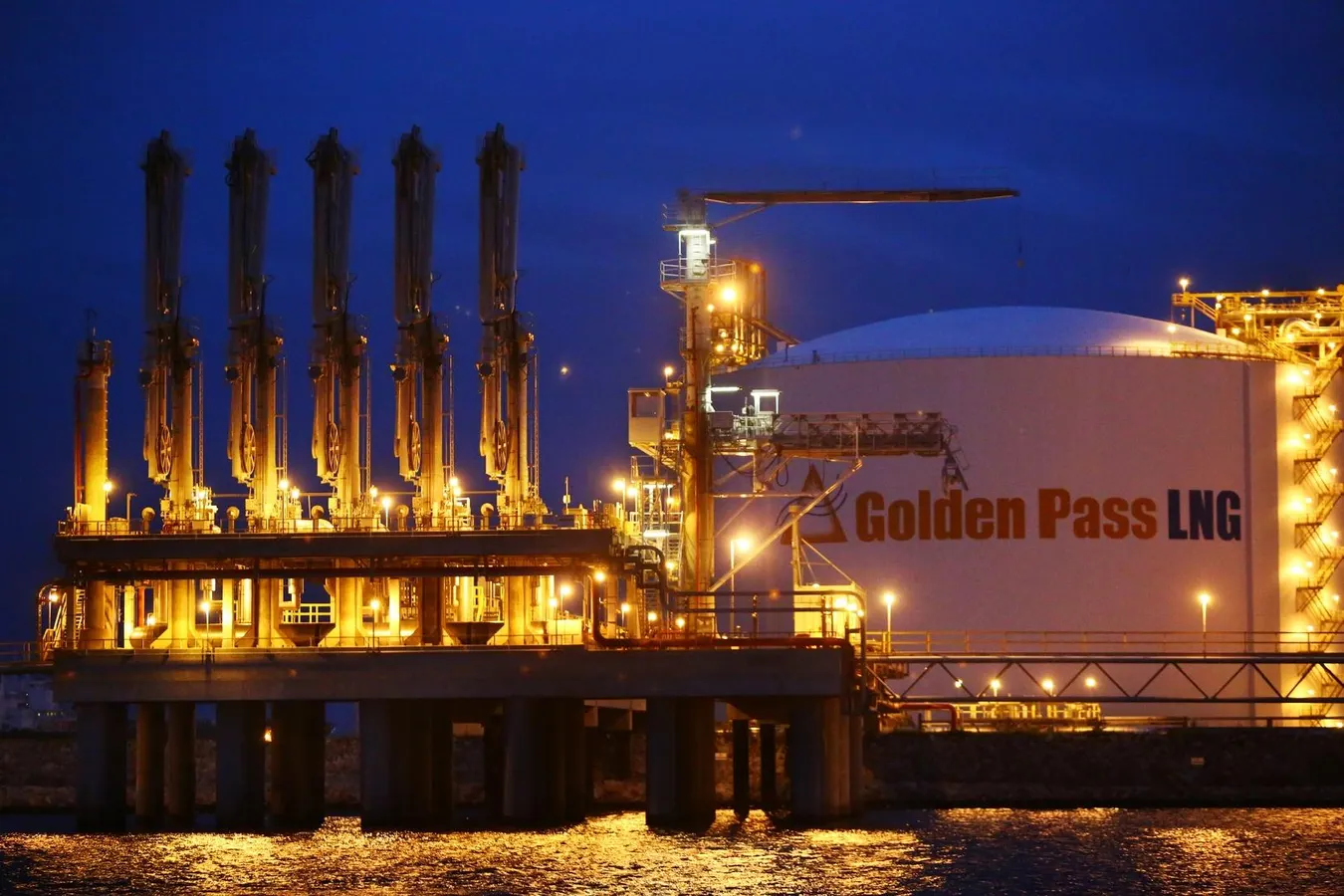

Golden Pass LNG storage tanks and cargo transfer arms at Port Arthur, Texas, U.S. (Photo: Marie D. De Jesus)
Houston Chronicle via Getty Imag
The war in the Middle East may have clouded the near-term outlook for the global liquified natural gas market, but few can call into question the demand trajectory of LNG driven by the power sector.
An anticipated increase in global energy demand from artificial intelligence and hyperscale data centers, that simply cannot be serviced by renewable energy alone, augurs well not just for the LNG trade but for all advocates of the natural gas market.
That’s particularly significant for one producer and exporter at the heart of it all – the United States. It is world’s most prolific builder of data centers and accounts for the largest number of hyperscale data centers worldwide. California’s Silicon Valley and Ashburn, Virginia are major hubs for a country that boasts of nearly 5,500 data centers and counting.
The U.S. also happens to the world’s largest exporter of LNG, having overtaken Qatar in the first quarter of 2024, and its largest natural gas producer by volume turning out 110 billion cubic feet per day. That’s more than a fourth of the world’s supply.
The industry exists in a climate of rapid realization that expanding nuclear and renewable energy solutions are unlikely to keep up with the pace of data center expansion – not just stateside but worldwide.
As it appears, multibillion dollar investments in data centers are proceeding in near tandem with multibillion dollar investments in natural gas infrastructure and LNG, as the U.S. embarks on its largest energy buildout in a generation.
Examining The Figures
That energy buildout could be worth $2 trillion over the next decade, with a substantial portion of it likely heading toward LNG and wider natural gas investments for good reason.
Last year, the U.S. nearly tripled its gas-fired capacity in development totaling just over 252 gigawatts in projects in announced, pre-construction, and construction phases. By 2030, the country’s rapidly expanding AI-driven data center industry could consume over 10% of U.S. electricity, up from 4% today, according to ING Research.
Such projections may give ample confidence to invest domestically in natural gas and boost the export oriented LNG industry too as its feedgas. Afterall, since its establishment in 2016, the U.S. LNG industry has been taking over 10% to 15% of all natural gas produced in the country in any given year.
It equated to 110.74 million tons of LNG exports from the U.S. last year to high demand regions like Asia Pacific and Europe that imported 168.7 million tons and 126.2 million tons respectively from the global market, according to the International Gas Union’s latest World LNG Report.
Overall, the U.S. added around 12.7 bcf/d of LNG export capacity between 2016 and 2024, and remains on track to add a further 13.3 bcf/d by 2030, going by U.S. Energy Information Administration data.
Depending on capacity, investment towards an LNG project is typically in the range of $8 billion to $15 billion, creating opportunities aplenty for engineering, construction, industrial solutions and automation vendors.
“The U.S. is one of the most important (and growing) energy infrastructure investment markets in the world right now. What makes it exciting are the growth opportunities across all energy segments, but the commitments and scale of LNG projects unquestionably stands out,” said Hany Fouda, senior vice president, process, discrete and hybrid automation, at Schneider Electric.
It’s a welcome development for importers having to contend with disruptions caused by the war in the Middle East to Qatar’s output which may take years to return to pre-war levels.
Investors Queue Up Stateside
Eyeing the wider market dynamic, a veritable who’s-who of the energy world is either investing in or signing offtake agreements to partake in U.S. LNG plays.
This issue looks set to occupy a sizeable chunk of the narrative at Gastech, the natural gas industry’s largest annual global gathering being held in Bangkok, Thailand, in September.
Industry would be heading to event in the heart of Asia knowing that nearly 80% of peak export capacity from currently operational U.S. LNG export facilities is either financed or backed foreign equity investors.
Senior U.S. officials from the Departments of Energy and The Interior are expected to be in attendance making the case for the country’s LNG industry including energy secretary Chris Wright and secretary of the interior Doug Burgum.
Chris Wright, U.S. energy secretary, at Golden Pass LNG in Sabine Pass, Texas, U.S., on May 15, 2026. With investments for additional export capacity, US LNG exports are set to more than double from current levels by the early 2030s, according to Department of Energy projections. (Photo: Mark Felix)
© 2026 Bloomberg Finance LP
Earlier this year, secretary Wright said: “U.S. LNG partnerships are bringing more jobs, more opportunity, and more investment. The future is extremely bright for the nations that join the U.S. in pursuing common sense energy policies that deliver prosperity and security for their respective people.”
Existing foreign investors include Japan’s JERA and JAPEX, Australia’s Woodside Energy, Saudi Aramco, ADNOC, Abu Dhabi’s state-owned energy company, and its investment arm XRG. They’ve all made their presence felt via multi-year supply deals and direct investment commitments for projects.
One of the first overseas entrants was QatarEnergy in 2019. It holds a 70% majority stake in Golden Pass LNG export terminal in Texas in partnership with ExxonMobil. And Thailand’s state-owned energy firm PTT happens to be latest one in talks with U.S. LNG operators as recently as June.
Strong Pricing For U.S. Producers
As investors queue up, the U.S. domestic gas pricing outlook is also looking up for producers. Kristy Kramer, head of LNG strategy and market development at Wood Mackenzie, believes the era $2-$4/mmbtu domestic gas prices benchmarked to the country’s Henry Hub futures would likely become a thing of the past.
In a recent report, Kramer suggested the possibility of an appreciation of at least a dollar to be factored in as demand and supply conditions shift by 2035.
“Rapid play development, near-zero-cost associated gas, and year-on-year productivity gains drove the previous era of cheap, stable prices. Those tail winds have largely run their course. Power sector demand alone is calling for an additional 17 bcf/d by the mid-2030s, and the highest-quality acreage is already in production. Prices will need to rise to grow supply from here,” she added.
A new normal of $5/mmbtu Henry Hub prices by 2035 may hit the margins of LNG exporters. But given that gas sells at several multiples of that in lucrative Asian and European markets, a domestic price uptick is unlikely to be a major concern.
Current forecasts suggest the U.S. will account for more than one-third of global LNG supply in the early 2030s, and demand expansion is expected to continue into the 2040s.
As such, the next ten years may potentially result in a huge LNG investment opportunity that becomes bigger with each passing year of rising foreign and domestic power demand.
Disclaimer: The above commentary is meant to stimulate discussion based on the author’s opinion and analysis offered in a personal capacity. It is not solicitation, recommendation or investment advice to trade oil and gas stocks, futures, options or products. Oil and gas markets can be highly volatile and opinions in the sector may change instantaneously and without notice.
















Leave a comment