


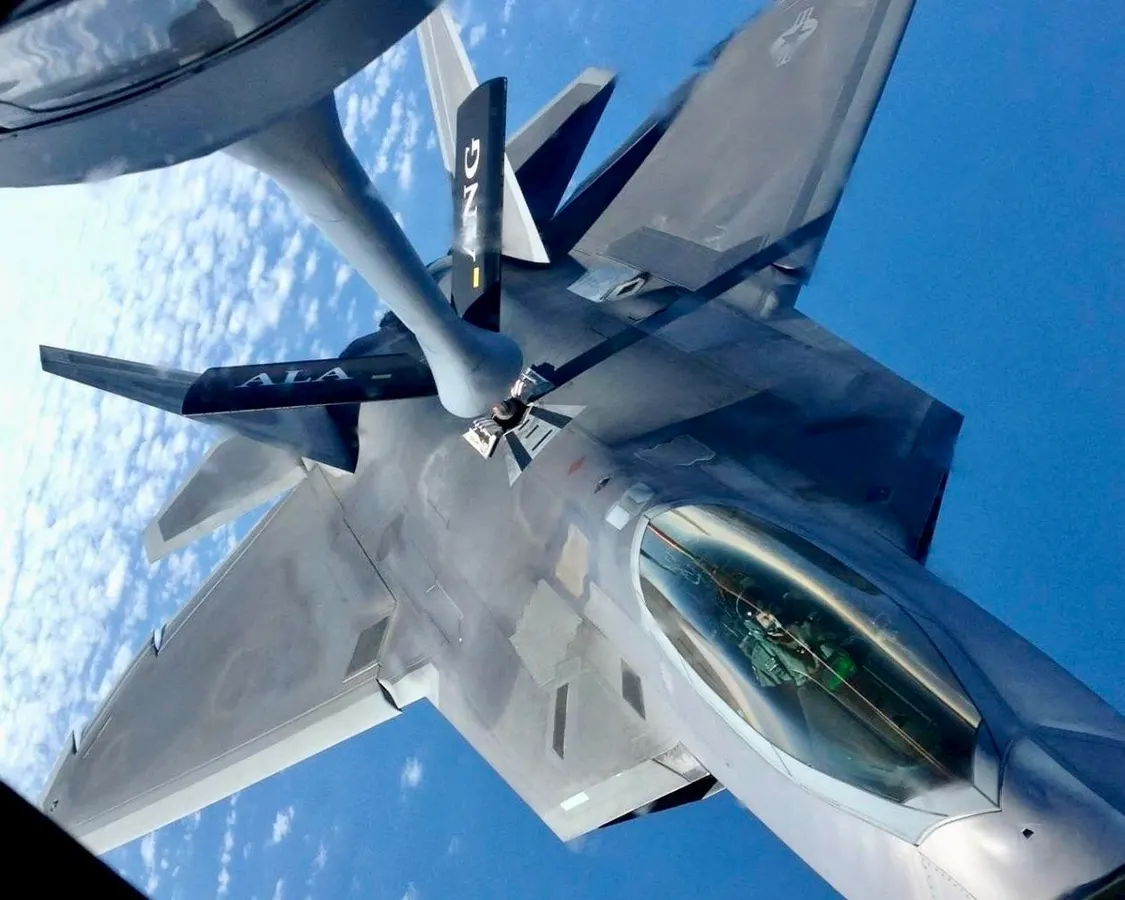

F-22 Refueling with KC-135 Before Engaging
USAF
Every few months, as reliably as bad weather, another commentator announces that “aerial bombing alone cannot win a war”—as though this were a profound strategic revelation. Recent examples include, “America’s Big Mistake in Iran,” which uses that familiar claim to assess the effectiveness of American military operations. Another is, “Air Power Just Failed Its Biggest Test: What the Iran War Proved About Winning Wars,” which categorically asserts that only “land combat decides who wins.” And another, “Airpower Can’t Occupy a Hill: The Enduring Limits of Airpower,” which defines “victory” so narrowly that it only means occupation.
Each of these arguments begins with faulty assumptions and then asks the wrong questions.
No serious modern airpower professional argues that bombing, by itself, can solve every military and political problem. Nor does any competent strategist contend that land, sea, air, space, or cyber capabilities should be employed by themselves, independently of the others. Modern warfare is not a contest to determine which military service can claim supremacy. It is the disciplined application of the military capabilities best suited to achieve clearly defined political objectives.
The useful inquiry is not whether aircraft can independently deliver every conceivable form of victory. It is whether the choice made by military and political leaders is appropriate to the objectives defined by political leaders. That distinction matters because different objectives require fundamentally different military contributions.
A campaign designed to replace Iran’s government and assume responsibility for the country would require a major ground component and a far broader political project. Airpower could not occupy Iran, police its cities, or administer its population. Neither could naval, cyber, or space power. Even a successful ground invasion would not guarantee a satisfactory outcome unless political leaders had a credible plan for the post-invasion governance and order.
The United States learned that lesson painfully after the fall of Baghdad in 2003, when removing an opposing government did not produce the stable political outcome American leaders sought. In this case, Army and Marine ground forces invaded, but their presence could not decide who “won.” Nor could they accomplish the objectives that were achieved without the use of aerospace power.
Any time the aim is to reduce dangerous capabilities, interrupt military operations, shield partners, deny an adversary freedom of action, or generate bargaining leverage, aerospace forces will carry the principal military load. That is the purposeful employment of military power in support of national aims.
Objectives, Not Slogans, Determine Success
These recent commentary arguments collapse every military objective into one crude test: Did the adversary’s government surrender, collapse, or disappear? If not, they seem to believe, the military campaign is a failure.
By that standard, virtually every use of force short of total conquest will be unsuccessful by definition. Such a measure ignores the fact that nations frequently employ military power for limited purposes: deterrence, denial, degradation, disruption, coercion, containment, protection, or to buy time and diplomatic leverage.
These are not lesser or inconsequential objectives. They are often the most politically realistic and strategically responsible options available.
The claim that only ground forces can “win” a war builds the conclusion into the premise. If victory is defined exclusively as seizing territory or overthrowing a government, then ground forces will inevitably appear to be the only force capable of delivering it. But defining success as occupation does not prove that occupation is the appropriate political objective.
Land forces are indispensable when leaders decide that seizure and control of territory, protection of populations, defeat of enemy formations in close combat, or occupation and administration of another country is the necessary course of action. Even as these remain essential military functions, they are not the purpose of every military campaign.
The mission should determine the force—not the other way around.
Lessons from History
History makes clear that the deployment of large ground formations is no guarantee of strategic success. Advocates of land-power primacy frequently invoke T. R. Fehrenbach’s claim that wars are ultimately won “on the ground . . . in the mud.” Yet Fehrenbach drew that lesson from the Korean War—an especially ironic example, given that ground forces did not achieve a conclusive political outcome there. More than seven decades after the fighting ended, the conflict remains formally unresolved because the 1953 armistice did not result in a peace treaty. The continued division of Korea into two antagonistic states underscores the limits of land power.
Armies may seize and defend territory, absorb enormous casualties, and sustain combat for years without producing a durable political settlement. The lessons from Korea should caution us against equating persistence and sacrifice in ground combat with decisive strategic victory. That warning becomes even more persuasive when considered alongside the strategically adverse outcomes produced by extensive land campaigns in Vietnam, Afghanistan, and Iraq. The conclusion is not that ground forces lack value. It is that military capability cannot solve confused political objectives or compensate for an unsound theory of success.
History also demonstrates that aerospace power can produce decisive strategic effects when assigned objectives suited to its capabilities.
In Desert Storm, the short duration of ground operations was made possible by an air campaign that debilitated Iraq’s entire military establishment. Before coalition ground forces ever crossed the line of departure, the air campaign had already shattered Iraqi command and control, severed communications, interdicted reinforcement and resupply, dismantled air defenses, and broken the cohesion and combat effectiveness of Iraqi ground forces across the theater.
Coalition ground forces were absolutely essential to complete the liberation of Kuwait. But they attacked a crushed enemy that could not mount a coherent defense.
Operation Allied Force offers another instructive example. In Kosovo, sustained NATO pressure ultimately persuaded Belgrade to withdraw its forces and accept the alliance’s conditions without an American-led invasion of Serbia. The result emerged from the interaction of military pressure, diplomatic isolation, allied unity, intelligence support, economic strain, and the expectation of continued escalation. Among the military tools applied, aerospace forces carried most of the operational load.
Indigenous Kosovo Liberation Army forces contributed pressure, intelligence, and a ground presence that complicated Serbian operations, but they neither defeated Yugoslav forces nor overthrew Slobodan Milošević. No American armored formation seized Belgrade, and no occupation of Serbia was required to achieve NATO’s stated objective.
The lesson is not that airpower is magical or universally decisive. It is that military effectiveness can be evaluated only in relation to the objective assigned.
Airpower Is More Than Bombing
Discussions of aerospace power are often trapped in outdated images of mass bombing campaigns, attacks against cities, and theories developed during the first half of the 20th century. Or worse yet, referred to as “fires”—a ground warfare term that recognizes airpower as nothing more than artillery from the air.
Modern aerospace power bears little resemblance to those caricatures.
Contemporary aerospace operations combine low-observable aircraft, precision weapons, intelligence and surveillance, electronic attack, mobility, aerial refueling, space support, cyber capabilities, suppression of enemy air defenses, defensive counterair, global strike, and theater-wide command and control.
At their most effective, these capabilities can undermine an adversary’s ability to function as a coherent system by creating specific effects: disabling communications, disrupting logistics, denying access to information, suppressing defensive networks, destroying key military capabilities, isolating forces, and preventing an opponent from achieving strategic aims.
Success should be assessed by the change imposed on the adversary’s behavior and capacity, not by a tally of weapons released or aimpoints hit or “fires” imposed.
Did the campaign prevent the adversary from employing a particular capability? Did it reduce the threat to U.S. forces and allies? Did it delay or destroy a dangerous weapons program? Did it restrict the enemy’s freedom of action? Did it alter the adversary’s calculations? Did it provide political leaders with additional options at acceptable cost?
Those are the questions serious analysis should ask.
Matching Ends and Means
The debate over Iran demonstrates why clearly defined objectives are essential.
If American leaders promised to overthrow the Iranian government, occupy the country, and install a new political system through air strikes alone, criticism would be warranted. Such a strategy would represent a mismatch between political ends and military means.
But where the assigned mission is to reduce Iran’s capacity for nuclear development, missile attack, and regional coercion, continued survival of the government is not a valid test of operational failure. One does not judge a quarterback on his ability to tackle the opposition. Or a goalie on his ability to score goals. These are simply not their jobs.
An air campaign need not resolve every political dispute with an adversary to be considered effective. It can reduce a threat without eliminating the state that created it. It can destroy capabilities without transforming the ideology of the government that possessed them. It can create favorable conditions for diplomacy without guaranteeing that diplomacy will succeed.
Armed force always serves political purpose; it cannot define that purpose on its own.
The United States must therefore decide what it seeks to accomplish in Iran. Is the objective to prevent the acquisition of nuclear weapons? To eliminate ballistic missile capacity? To protect freedom of navigation? To defend regional allies? To deter future attacks? To weaken the regime? Or to overthrow it?
Each objective carries different requirements, risks, timelines, and measures of success. Lumping them together under the undefined category of “winning the war” obscures rather than clarifies strategic choices.
The Iran debate is ultimately about whether national leaders can connect the result they seek with the means, risks, and campaign design required to obtain it.
Jointness Does Not Require Equal Participation
Articles that castigate airpower because it cannot “win wars alone” not only distort its role but display a fundamental misunderstanding of the meaning of joint warfare.
Joint operations do not require artificial symmetry among the services or an identical share of responsibility for each component. Nor must a land force provide the final act in every campaign simply to validate the effort as joint.
Jointness means employing the capabilities most appropriate to the mission in the right quantities at the right places and in the correct sequence.
Sometimes land forces will dominate. Sometimes naval forces will. In other circumstances, airpower will carry the principal load. Cyber and space capabilities may be central to all of them. The optimal combination will vary according to the adversary, geography, political objective, available forces, acceptable risk, and desired end state.
The purpose of joint operations is not to protect service equities. It is to maximize strategic effectiveness.
The appropriate force package is the one that delivers the required result with the least exposure, casualties, and escalation risk.
The Greater Strategic Danger
The problem with repeatedly declaring that “bombing alone cannot win wars” is not simply that the phrase is imprecise. It is that the phrase displaces serious examination with a ready-made conclusion.
It also encourages a competing myth: that threatening or committing ground forces necessarily produces strategic success. Recent American experience in Iraq and Afghanistan should have dispelled that belief.
No military domain possesses an inherent ability to turn tactical accomplishment into political success. Airpower cannot govern a hostile population. Naval power cannot occupy a capital. Land power cannot guarantee political legitimacy. Space and/or Cyber operations cannot by themselves compel every adversary. Even a fully optimized and integrated joint military force cannot rescue an incoherent strategy.
The more productive debate is over the political result being sought, the feasibility of that result, and the combination of diplomatic, economic, informational, and military tools most likely to secure it without disproportionate cost.
Political purpose—not service preference—must govern military campaign design.














Leave a comment