


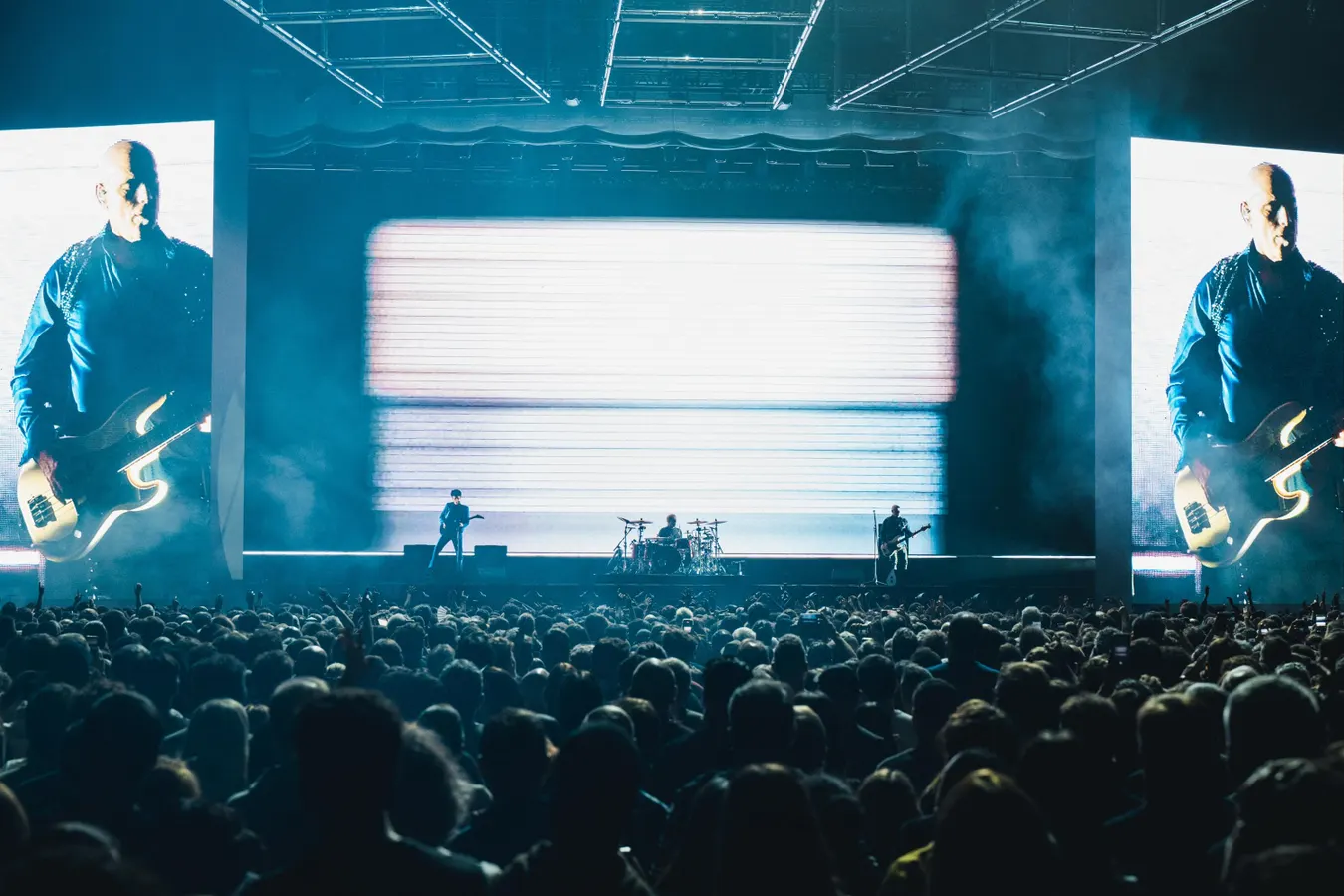

The surviving members of Soda Stereo perform live during their 2026 ECOS tour alongside a digital avatar of late singer Gustavo Cerati (left).
Agustín Dusserre
Stepping into a modern concert venue feels increasingly like entering an immersive media spectacle, one that’s powered by everything from spatial audio to virtual production and next-generation visual design. But if the boundary-pushing new tour from the Argentine rock band Soda Stereo is any indication, an even bigger transformation is fast approaching for the multibillion-dollar live concert industry.
Widely regarded as the Beatles of Latin America, Soda Stereo is in the midst of a global tour built around a futuristic-sounding formula: Live musicians playing in real time alongside a digital frontman. Those musicians are the band’s bassist Zeta Bosio and drummer Charly Alberti, performing onstage with a lifelike avatar of singer Gustavo Cerati, who died in 2014.
The future of live music technology
What makes the ECOS experience unique: Whereas earlier avatar concerts and shows like London’s ABBA Voyage have been hologram projection-based and tied to fixed, purpose-built environments, Soda Stereo’s tour isn’t confined to a single stage. Nor are the shows, strictly speaking, built around a hologram or projection.
Rather, the band’s high-tech rendering of Cerati creates the convincing illusion of a three-dimensional performer actually sharing the physical stage space with his surviving bandmates. An even bigger technological leap is that the setup is fully modular, allowing Cerati’s avatar to travel, move, and interact with crowds in dozens of international venues.
A digital avatar of Soda Stereo’s late singer Gustavo Cerati is shown on stage monitors during the band’s 2026 ECOS tour.
Zeus Leon
“To the best of our knowledge, no production has ever toured with a digital member performing live alongside real musicians in this way,” Nicolás Bernaudo, the creative director of ECOS, told me about the tour that will span 14 countries and almost two dozen cities by the time it wraps. “Finding a way to make that possible was one of our greatest creative challenges, because there’s no established roadmap for a show like this.
“We’ve had to develop our own methods and protocols from scratch.”
That included bypassing AI entirely, along with the use of synthetic vocals and machine-learned movements. The production—named after an early Soda Stereo song, the title of which is Spanish for “echoes”—instead relies on hyperrealistic visual renderings paired with archival audio, to bring to life one of the most iconic figures in Spanish rock.
What audiences see, bathed in stage lighting, is a virtual Cerati materialize almost like a specter that’s just walked through a portal from the great beyond. Throughout each roughly 2-hour show, Soda Stereo’s digitally resurrected singer nods, smiles, makes playful hand gestures, and strums his electric guitar, leading fans in arena-rattling singalongs of the band’s hits like “Persiana Americana” and “Prófugos.”
‘We wanted them to feel…like they were watching Soda Stereo again’
So far, the tour has sold more than 450,000 tickets, and the U.S. leg in September will include stops in San Jose, Los Angeles, Las Vegas, Chicago, New York, and Miami.
“Our direction was never focused on making the technology the star of the show,” Bernaudo said. “The goal was never for people to leave thinking, ‘What incredible technology.’ We wanted them, even if only for a moment, to feel they were watching Soda Stereo again.”
The band’s experiment is also unfolding amid a broader technology revolution reshaping the live music business, examples of which include the futuristic wonderland of the Las Vegas Sphere and Coldplay’s many concert innovations like kinetic dance floors and recyclable LED wristbands.
Concertgoers are also increasingly being greeted with things like synchronized drone shows and object-based spatial audio that can position instruments and vocals anywhere in a venue.
This all comes as revenue from live music ticket sales topped $40 billion globally for the first time in 2025 and will likely hit $50 billion by 2030, per Omdia market data. Concert figures from Pollstar and Live Nation similarly confirm that fans are willing to spend big, so long as an event offers a spectacle beyond the standard concert experience.
The legacy behind Soda Stereo’s ECOS tour
All that said, visual tricks alone don’t sell nearly half a million concert tickets. To understand why ECOS has been resonating with audiences, it’s helpful to grasp the long shadow that Cerati and Soda Stereo cast across the Spanish-speaking world.
Formed in Buenos Aires in 1982, the trio didn’t just top charts; they practically pioneered stadium rock in Latin America, defining the sound of a generation with anthems like “De Música Ligera.”
Soda Stereo also developed a reputation for pushing the technological envelope in the band’s live shows—particularly during the band’s 1997 farewell tour and its reunion tour in 2007. Both outings set new benchmarks for concerts in Latin America, anchored by sophisticated video and light shows.
Now, they’ve done it again, this time with a digital avatar of their late bandmate—in a way that effectively redefines what a concert can be.
“There’s a phrase a friend once told me that I often repeat: ‘If it doesn’t move you, it doesn’t work,’” Bernaudo said. “All of us understood we were creating something that went beyond technology—it felt like we were bringing a shared fantasy to life.”
“I don’t think [ECOS] is here to replace traditional concerts. I see it as opening a new creative language within live performance. Technology alone isn’t enough—what really matters is how it’s used in service of a story, an artistic vision, and above all an emotional experience.”












Leave a comment