


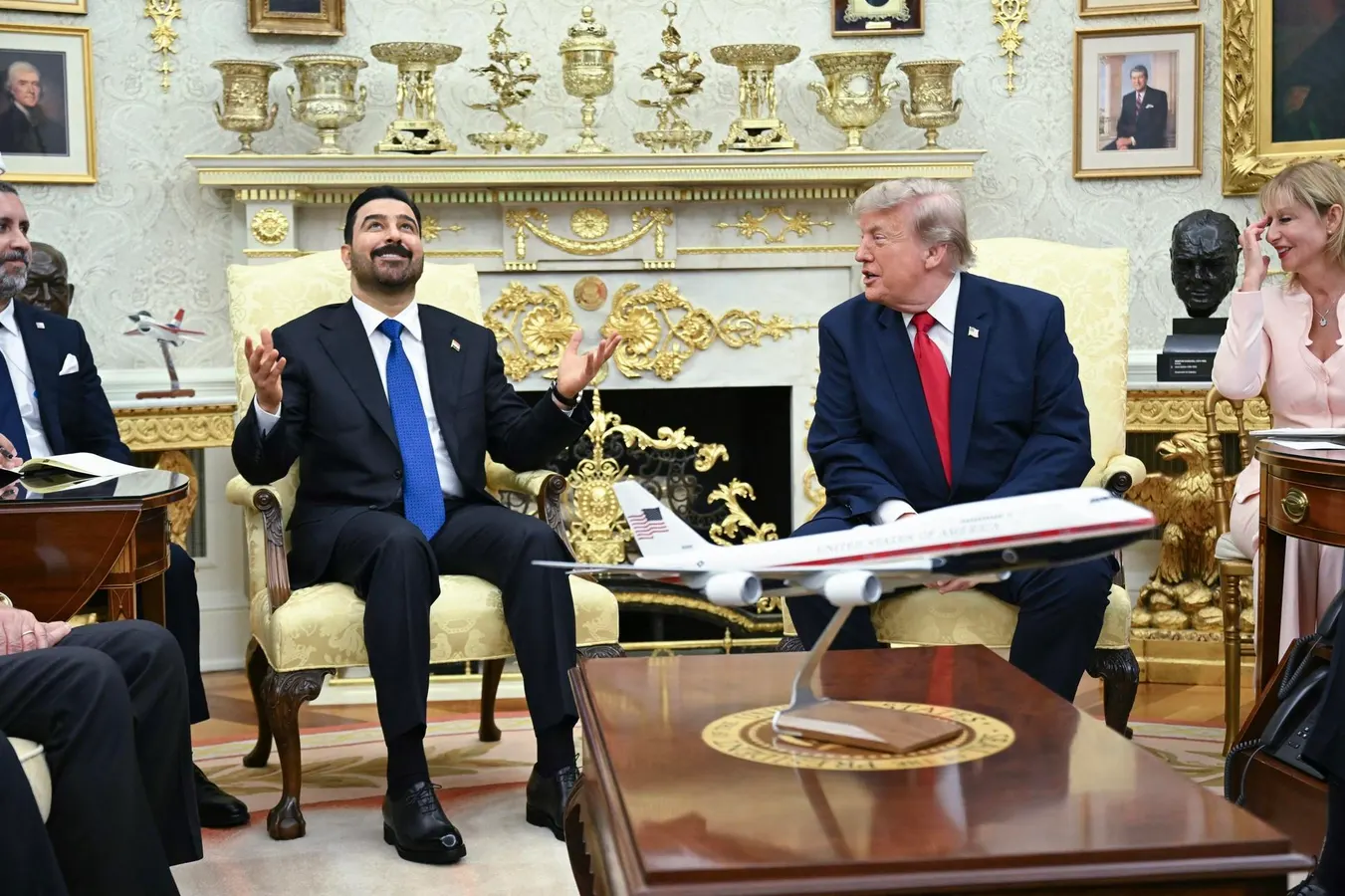

US President Donald Trump meets with Prime Minister of Iraq Ali al-Zaidi (L) in the Oval Office of the White House in Washington, DC, on July 14, 2026. (Photo by SAUL LOEB / AFP via Getty Images)
AFP via Getty Images
On July 14, Donald Trump welcomed Iraq’s new prime minister, Ali al-Zaidi, into the Oval Office and told reporters the two men had “tremendous chemistry.” Two days later, in Houston, al-Zaidi was shaking hands with executives from Halliburton, Shell, Baker Hughes, Weatherford, and GE Vernova.
By the time he flew home, Iraq had signed 48 agreements with American companies and floated a figure—up to $100 billion in foreign direct investment over five years—enough to reshape the country’s oil sector for a generation. Headlines abound. But the more interesting story is how Iraq will balance U.S. pressures with those from Iran and China.
I asked Ahmed Al-Windi about that trip during an interview on Cross Lines, the current-affairs program I co-hosted with Bayraq Faisal Ghazi, on Al-Ahad TV. Al-Windi—vice president of the Ghadan Foundation for Risk Management and executive director of the Baghdad International Energy Forum—addressed whether Iraq can take Washington’s money without breaking with Tehran and Beijing, the two other powers it depends on.
It isn’t a hypothetical. The prime minister holds his job partly because Washington intervened to keep it out of the hands of someone it saw as too close to Iran. Iraq’s dominant parliamentary bloc initially lined up behind Nouri al-Maliki, who the Trump Administration viewed as too close to Iran. Prime Minister Al-Zaidi, a businessman with no prior political career, emerged instead as the compromise candidate—and arrived in Washington already committed to disarming Iran-backed militias by September 30, when U.S. troops are set to leave the country.
Al-Windi frames Washington’s logic this way. “Under the United States’ new national-security approach,” he told me, “American assets and interests abroad are increasingly viewed as part of its national security. For Iraq, a larger American commercial presence could therefore give Washington a stronger interest in the country’s stability.”
That’s the trade Washington is offering Baghdad: let Chevron and ExxonMobil in, and American self-interest becomes a form of protection. It also means Washington acquires a growing stake in deciding who else gets to operate in Iraq, and on what terms. Is this worth it to Iraq?
The Ties Already Baked In
Gas flares at an oil refinery near Iraq’s receding marshes of Hawizeh, which straddle the border with Iran, in the southeastern Missan province on April 25, 2025. (Photo by Asaad NIAZI / AFP) (Photo by ASAAD NIAZI/AFP via Getty Images)
AFP via Getty Images
Notably, Iraq and Iran fought each other for eight years in the 1980s, a war that killed hundreds of thousands — by some estimates close to a million — on both sides. Since the U.S. invasion toppled Saddam Hussein in 2003 and installed Shia-led governments in Baghdad, Iraq has built deep political, religious, and economic ties with the same neighbor it once fought, including a national electricity grid that has run for years on imported Iranian power and gas.
The first Trump administration granted Iraq a waiver to keep buying that Iranian electricity despite sanctions; the second Trump administration let the waiver lapse in March 2025, part of its broader “maximum pressure” campaign on Iran. Iraq’s Ministry of Electricity has warned that losing the parallel gas waiver too would strip out another 30% of the country’s power supply.
China’s position runs just as deep. Somewhere between half and two-thirds of Iraq’s oil production now comes from fields where Chinese companies hold a stake as investors, operators, or field-services contractors, according to the Dutch think tank Clingendael. While the oil belongs to Iraq, it pays foreign firms to develop and run the fields—with Chinese state companies operating many of them.
China has also long been Iraq’s largest single buyer of crude oil, though monthly trade figures have swung sharply over the past year.
Iraq found out this year just how exposed that position leaves it. When the U.S. and Israel struck Iran on February 28, 2026, and Tehran closed the Strait of Hormuz in retaliation, Iraq—unlike Saudi Arabia and the UAE, the only two Gulf producers with pipelines that bypass the Strait—watched its own oil exports collapse from roughly 4.5 million barrels a day to a low of 1.4 million in May. That’s purely a result of being a bystander in someone else’s war.
So Iraq isn’t weighing an abstraction. It has an Iranian relationship running through its power grid, its parliament, and its armed factions and a Chinese connection running through its wellheads and its export contracts. And it is now trying to layer an ambitious new American relationship on top of both—one that Washington’s own doctrine describes as a matter of national security rather than ordinary commerce.
Al-Windi said Iraq doesn’t need to choose a lane. Chinese companies, he argues, “helped maintain Iraqi production at a difficult time and should not now be pushed aside simply because Baghdad is seeking greater Western involvement.” In his eyes, Baghdad has leverage—not potential liabilities.
“China also uses political, economic, and social influence to protect its interests,” he told me. “At the same time, Iraq wants greater participation from American and other Western companies. This will inevitably create competition and some resistance from established Chinese interests.”
Whose Choice Is This, Really?
BAGHDAD, IRAQ – FEBRUARY 22: Iraqi Prime Minister Mohammed Shia al-Sudani (C) and U.S. Special Representative for Syria Tom Barrack (L) attend a signing ceremony for energy agreements between Iraqi government and the US-based company Chevron Corporation for the development of oil fields in the provinces of Basra, Dhi Qar and Saladin, on February 22, 2026. (Photo by Iraqi Prime Ministry Press Office / Handout/Anadolu via Getty Images)
Anadolu via Getty Images
Former Prime Minister al-Maliki’s episode suggests the friction runs deeper than competition over contracts. Washington didn’t simply wait for Iraq to pick a prime minister and then negotiate with whoever won; instead, it has turned up the heat on Iraqi neutrality itself, one waiver, one militia, one candidacy at a time. On this view, the deals signed in Washington and Houston are Iraq’s reward for realigning with the West even before Prime Minister al-Zaidi landed in the U.S.
“Strengthening relations with the United States is widely understood as a national interest” across a political map that agrees on almost nothing else, Al-Windi told me. Indeed, its domestic coalition spans Shiite, Sunni, and Kurdish political blocs.
That’s a broad, durable domestic consensus, not simply an arrangement imposed from outside—even if Washington helped clear the path. And the Chinese relationship long predates the current pressure campaign; it was built when Western majors walked away from Iraq’s oilfields.
The realistic test of Iraq’s position, then, isn’t whether Baghdad formally picks a side. Prime Minister Al-Zaidi’s arrival in office shows how much Washington can shape that choice without Iraq ever officially declaring one. The narrower, more mechanical test is whether the militias actually disarm by September 30, whether the electricity and gas waivers survive in some form, and whether Chinese production contracts get renegotiated or simply continue running alongside the new American ones.
Al-Windi insists that Iraq can walk this tightrope: “Iraq’s strategic advantage lies in careful neutrality,” he said. “Choosing sides too sharply would create obstacles and make it harder for the government to deliver on its economic promises.”
That’s the bet behind Iraq’s strategy: that it can stay useful to Washington, Tehran, and Beijing at once, rather than beneficial to only one of them. Washington’s own doctrine cuts against that hedge: it treats its commercial presence abroad as a national-security asset—and may ask Iraq to choose a team.












Leave a comment