


Current Climate brings you the latest news about the business of sustainability every Monday. Sign up to get it in your inbox.
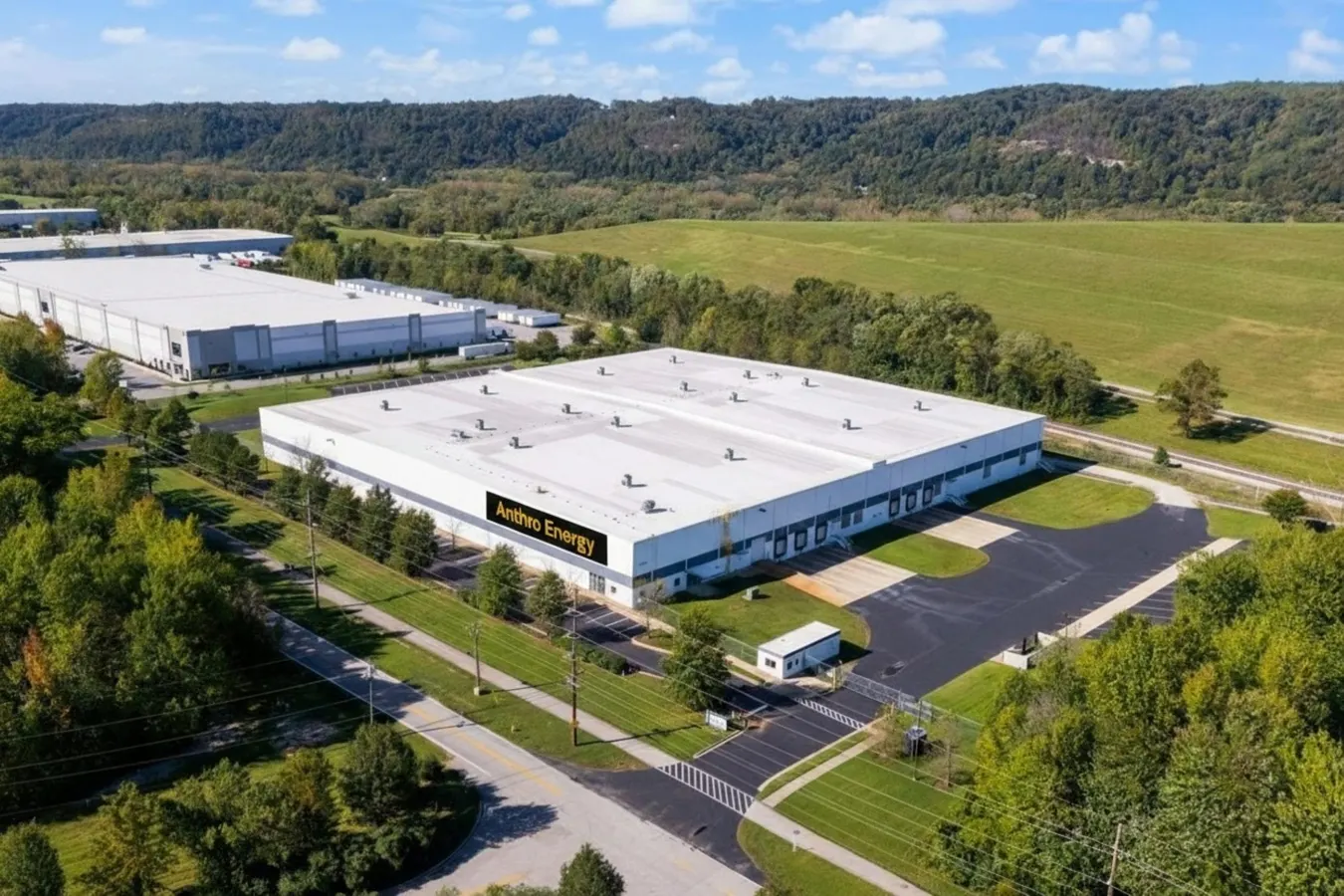
Anthro Energy’s electrolyte factory under construction in Louisville, Kentucky.
Anthro Energy
Welcome back to Current Climate. For years, the U.S. has lacked the domestic infrastructure to make all the key parts of advanced batteries used in EVs, consumer electronics and energy storage, allowing China to reign as the planet’s dominant supplier. But that’s beginning to change.
Last week, Silicon Valley startup Anthro Energy broke ground on a factory in Kentucky that, when it begins operating in 2027, will be the first U.S. owned and operated maker of electrolytes, an essential chemical additive for lithium-ion and other battery chemistries to function. Unlike conventional battery electrolytes, which can be highly flammable, Anthro believes its new liquid polymer electrolyte will bring substantial benefits to safety, power density and usable life for battery cells.
“Today’s batteries are based on liquids that are volatile, flammable, toxic and corrosive. And inside every battery, there’s this kind of continued degradation of the electrolyte that ultimately leads to performance trade-offs,” said CEO David Mackanic. “More energetic materials kind of degrade the electrolyte quicker, and then can cause safety issues.”
That’s led to a push for solid-state electrolytes, which “are great in terms of enabling higher energy density, safer, longer-lasting batteries, but they have a lot of manufacturing challenges,” he said. Anthro’s tech combines elements of both types of electrolyte, but is designed to be a drop-in solution for existing battery cell lines.
“We call it a phase-change electrolyte that combines the best of both worlds. This is a material that gets injected into the battery like a liquid. … And then once it’s inside the battery, we solidify it inside that cell, converting it into this elastomeric material. What that does is it protects all of the interfaces in the batteries so you can remove a lot of this uncontrolled, unwanted degradation. This is important for safety, for cycle life, but it’s particularly important for the next generation of battery materials that have more energy.”
The Alameda, California-based company, spun out of research begun at Stanford University, currently is able to produce about 200 kilograms a day of its electrolyte on a small-scale production line at its headquarters, but the new factory will be a game-changer for Anthro, said CTO Joe Papp.
“We just broke ground on our facility in Louisville, Kentucky, and at full production will be able to produce up to 12,000 metric tons of electrolytes – enough for about 25 gigawatt hours of battery at full production tilt,” Papp said. That would be enough to power 400,000 EVs. “That will be ramping up toward the end of next year and into 2028.”
Locating the factory in Kentucky puts it in the heart of the so-called Battery Belt that stretches from Michigan to Georgia and is home to about a dozen battery factories operated by automakers and electronics companies. The company has “some off-takes contracted” from the new facility that Mackanic declined to identify.
So while it may be years before the U.S. can fully compete with China in battery production, suppliers like Anthro could eliminate some major supply chain gaps.
The Big Read
Illustration by Yunjia Yuan for Forbes; photos by The Washington Post/Getty
DOGE Broke America’s Weather Machine. Now Fishermen, Insurers And Farmers Are Paying For It
When Brian Ritchie takes his 53-foot charter fishing boat into the cold, choppy waters of the Cook Inlet near Homer, Alaska, carrying a dozen or more anglers hoping to catch Pacific halibut, he’s paying extra attention to weather conditions. That’s because an automated National Weather Service station that provided detailed local wind reports is offline and won’t be operational until at least November.
“It’s a long season and we’ve gone half a year without knowing what the wind is doing in a part of the inlet that we fish a lot,” said Ritchie. “That’s pretty important, especially for charter fishing. Because the people that I take out like watching ‘The Deadliest Catch,’ but they don’t like living it.”
Ritchie’s weather station issue, which hasn’t resulted in any disasters so far, isn’t an isolated headache. Nationwide, launches of weather balloons have dropped, decreasing the amount of data on temperature, air pressure, humidity, wind speed and direction that feeds into weather prediction models, fire and marine weather forecasts and aids the aviation industry. Off U.S. coasts, fewer buoys are measuring wave conditions than in 2024. As wildfires rage across western states, there’s a tight supply of specialized meteorologists to provide detailed weather data that helps communities and firefighters make lifesaving, tactical decisions, people familiar with the matter told Forbes. A 20-year-old program that measures arctic ice just got cut, and plans for next-generation weather satellites to replace two critical ones that may begin to fail in the early 2030s have been halted.
This is what happens when the government dismantles the country’s vast environmental intelligence system. Built over decades, NOAA’s sprawling network of satellites, balloons, buoys, radar stations and scientists underpin much of the U.S. economy. Fishermen use it to decide whether waters are safe to sail. Farmers use it to determine when to plant and harvest. Airlines use it to route flights. Insurers and reinsurers use it to assess risk of losses from major events like hurricanes, fires and large-scale accidents. Utilities, builders and emergency officials use it to manage power grids, protect infrastructure and keep people alive.
Hot Topic
Chad Mirkin, director of Northwestern University’s International Institute for Nanotechnology, on using AI to create a “megalibrary” of advanced materials
How are you using AI to help create new, unique materials for things like green hydrogen, batteries and ammonia?
For the last decade, we’ve been developing tools that allow you to synthesize materials faster than has ever been contemplated before. And I mean everything, everything in the periodic table.
The way these tools work is we can take these tiny tips, shrunk down to the nanoscale using lithographic techniques, and create an array of 160,000 tips. Each of those tips can deliver different chemicals to a chip, a two-by-two-centimeter chip. And then each of those can be converted into a different material. We call the generation of these little blobs of material that are put on the surface with this tip nanoreactors.
They’re filled with metal ions–different metal ions of interest and different combinations of metal ions of interest. And in a fraction of a second, you can bring an array of 160,000 tips down onto a surface and generate 160,000 reactors. They can be converted into 160,000 materials. In minutes, you can do millions. In hours, you can do billions. So imagine having a two-by-two-centimeter chip that has hundreds of millions of distinct materials all positionally encoded.
The first thing that allows you to do is to make things faster than man has ever contemplated before. The world collectively, since the beginning of time, has made and characterized about a million new inorganic materials. I tell students in the course of an afternoon, you’re now making more materials than scientists have cumulatively made since the beginning of time. That’s profound observation number one.
The second is when you can do this and mix and match all the different elements from the periodic table; that’s our kind of palette to work with. We can begin to make what we call megalibraries of materials and use them to discover materials that matter. Materials that can be used for displays, materials that can be used for fusion, materials that can be used for any problem of interest, materials that can be used to find new catalysts.
It’s not just a brute force way of finding new materials that matter. It’s a way of generating big data faster than has ever been done before. You have this chip of all these materials, some good, some bad for what you want to use them for, but they’re all collecting data about what you’re interested in. And good and bad data are really important in terms of training AI and machine learning.
You don’t just want the good data. You want to know where the losers are, where the winners are, where the intermediates are. And once you have enough of it, machines then can tell you where to go next. So in a world of AI, the next big frontier is going to be AI for science.
How could this help improve something like producing green hydrogen?
A lot of people want to use iridium for the oxygen evolution reaction – splitting water if you’re trying to generate clean hydrogen. The problem with iridium is there’s not enough iridium in the world to meet the projected demand. And it’s in a bad part of the world from a U.S. perspective, so there’s a geopolitical risk.
That’s a great example of channeling megalibrary technology to solve a major problem. Can I find a combination of elements that work as well as Iridium or better than Iridium and either reduces or eliminates the need for Iridium? And what we did here was eliminate the need for Iridium. We found a catalyst that was as active, actually a little bit more active, and comparably stable. Those are two of the big parameters. You have to know what you’re trying to beat.
We don’t have a dog in the fight in terms of what the winner is. We just know that we can survey very, very rapidly the landscape and look at different shots on goal faster than has ever been done before. Iridium is an interesting example since it’s both rare and extremely expensive.
Is the material you’ve generated going to be used commercially to make green hydrogen?
Oh yeah. We found catalysts that are being commercialized now. … To me, it’s not the most important one, but it was one that was clear cut, where we could really make the point and show the world that we can channel this capability down a path that solves indisputable problems. Many people recognize that it would be great if we had something as good as Iridium that had more earth-abundant elements. That had things with less geopolitical risk, but also performed or behaved at least as well and preferably better.
And what about in terms of cost?
Yes, that lowers cost as well.
Can you estimate how much cheaper this material is relative to Iridium?
I don’t have it on the tip of my head, but we’ve done that before. It can be orders of magnitude less expensive.
What Else We’re Reading
Lawsuit seeks to block closure of top federal climate research center (Inside Climate News)
When climate change hits an aging population: Heat’s threat is underestimated, study says (NBC News)
Becerra reveals ‘power hour’ idea to give California free electricity (USA Today)
















Leave a comment