


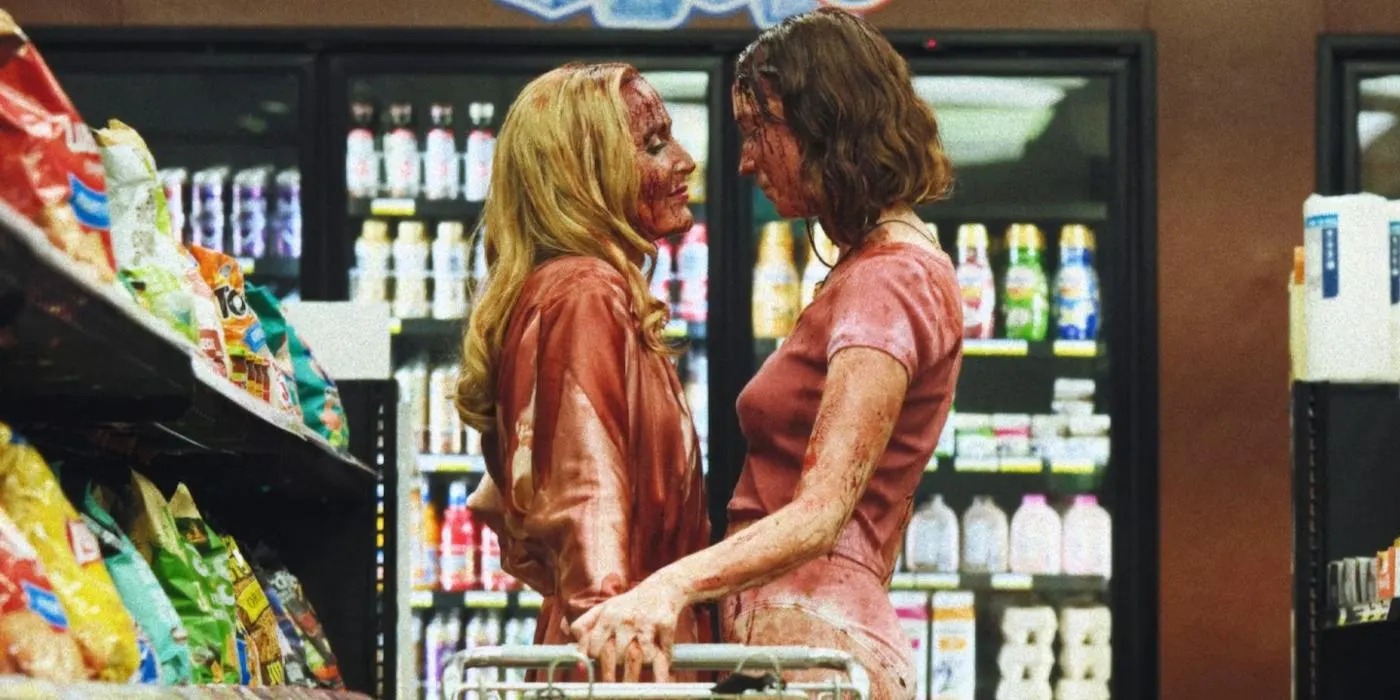
Hannah Einbinder and Gillian Anderson in ‘Teenage Sex and Death at Camp Miasma’
MUBI
Teenage Sex and Death at Camp Miasma takes place in a multi-layered reality, where dreams, sexual fantasies and slasher flicks are just as solid as the real world—maybe more so.
The hit film’s surreal, blood-spattered ending is ambiguous enough to spark debate over whether the surviving characters are happy, depressed or still alive.
What Is The Plot Of ‘Teenage Sex and Death at Camp Miasma’?
Written and directed by Jane Schoenbrun (I Saw The TV Glow), Teenage Sex and Death at Camp Miasma stars Hannah Einbinder (Hacks) as Kris, a queer filmmaker tasked with reviving a dead franchise, Camp Miasma.
For inspiration, Kris seeks the star of the first film, Billy, played by X-Files icon Gillian Anderson.
Curiously, Billy declined the opportunity to star in subsequent Camp Miasma films, but has chosen to live on the grounds of an abandoned summer camp where the original was shot.
Echoing the fate of popular horror franchises, Camp Miasma has been milked to death with increasingly absurd sequels—Kris’s role is to reboot the series back into respectability.
The studio execs want Kris to deliver an “elevated horror” reboot, along with an origin story for the franchise villain, “Little Death” (Jack Haven), a masked killer who always comes back.
One of Kris’s conversations with Billy illuminates her tendency to overthink everything—she is obsessed with the cheesy slashers that defined her childhood, breaking down outdated tropes, deconstructing the problematic genre with pseudo-intellectual polish.
Billy reckons that Kris is missing the point—she views these films as nothing more than visceral depictions of lust and violence.
The truth lies somewhere in the middle, but regardless of artistic merit, the low-budget slasher films have deeply impacted the lives of these two women.
As the two grow closer, Billy repeatedly implies that the events of the Camp Miasma films are real—not just inspired by a grisly local murder, but literally real.
Billy “describes a hole at the bottom of the lake where the movies come from,” the dwelling place of Little Death.
The villain’s name happens to be the literal translation of “la petite mort,” a French phrase used to describe the brain-melting bliss of an orgasm.
Teenage Sex and Death at Camp Miasma is fairly open to interpretation, mulling on identity, self-perception and retreating into fantasy, but mostly, it’s about sex.
Kris is stuck in an unsatisfying polyamorous relationship and tells Billy about her sexual hang-ups that prevent her from reaching orgasm. Kris simply can’t let go and trust her partner enough to lose control.
Kris also admits to using movies and her creative work to escape from reality, but the film is ambivalent on whether or not this is a good thing—it’s not as simple as that.
Healthy coping mechanism or not, Billy seems to understand how Kris feels.
As their sexual relationship intensifies, the two connect over a formative scene from the first Camp Miasma film in which Billy’s character spies Little Death approaching, just as she is about to orgasm for the first time.
Death and orgasm occur simultaneously, and Billy talks about the scene as though she really experienced it, traumatic but strangely liberating.
Little Death is described as an otherworldly being that uses people as a means of entertainment, emerging from the hole in the lake to wreak bloody havoc when he grows bored, slicing the fabric of reality into slasher sequels that can sustain his hunger.
As the film approaches climax, fantasy and reality violently collide, creating a new world.
The Surreal Ending Of ‘Teenage Sex and Death at Camp Miasma,’ Explained
As Kris begins to unravel and enter Billy’s reality, she destroys any hope of a working relationship with the studio—she won’t get to reboot Camp Miasma but it doesn’t matter—she’s living it now.
Little Death emerges from the lake and pursues Kris, who is delighted to be playing the part of the “final girl.”
The villain slashes his way through the unsatisfying figures who connect Kris to the real world—her girlfriend, side-boyfriend and the studio execs are slaughtered by his phallic spear.
Finally, Kris and Billy recreate the murder/sex scene from Camp Miasma, Kris experiencing a kind of transcendence, seeing herself through the eyes of Little Death, who penetrates them with the spear as she orgasms.
The two are seemingly dead, the cabin surrounded by the victims of Little Death. Not to worry—it’s Kris’s old self that has died, along with the relationships weighing her down.
She and Billy have been resurrected, dwelling in dreamland together (complete with beautiful matte painting backdrops). The two enter the store that Kris visited as an outsider at the beginning of the film.
They are both covered in blood, collecting bags of candy to eat at home. Clearly they are damaged, visibly so, but they are happy.
The two inhabit a fantasy world, and perhaps it’s not particularly healthy—staying indoors, eating junk food and watching slasher movies is not a typical depiction of a fulfilling life.
Are they dead inside? Maybe. Whatever they are, they are experiencing it together, in love.
If Teenage Sex and Death at Camp Miasma is about anything, it’s about carving out your place in the world and finding the person who truly accepts you, flaws and all.
Embracing your worst self might be the best thing you ever do.














Leave a comment