


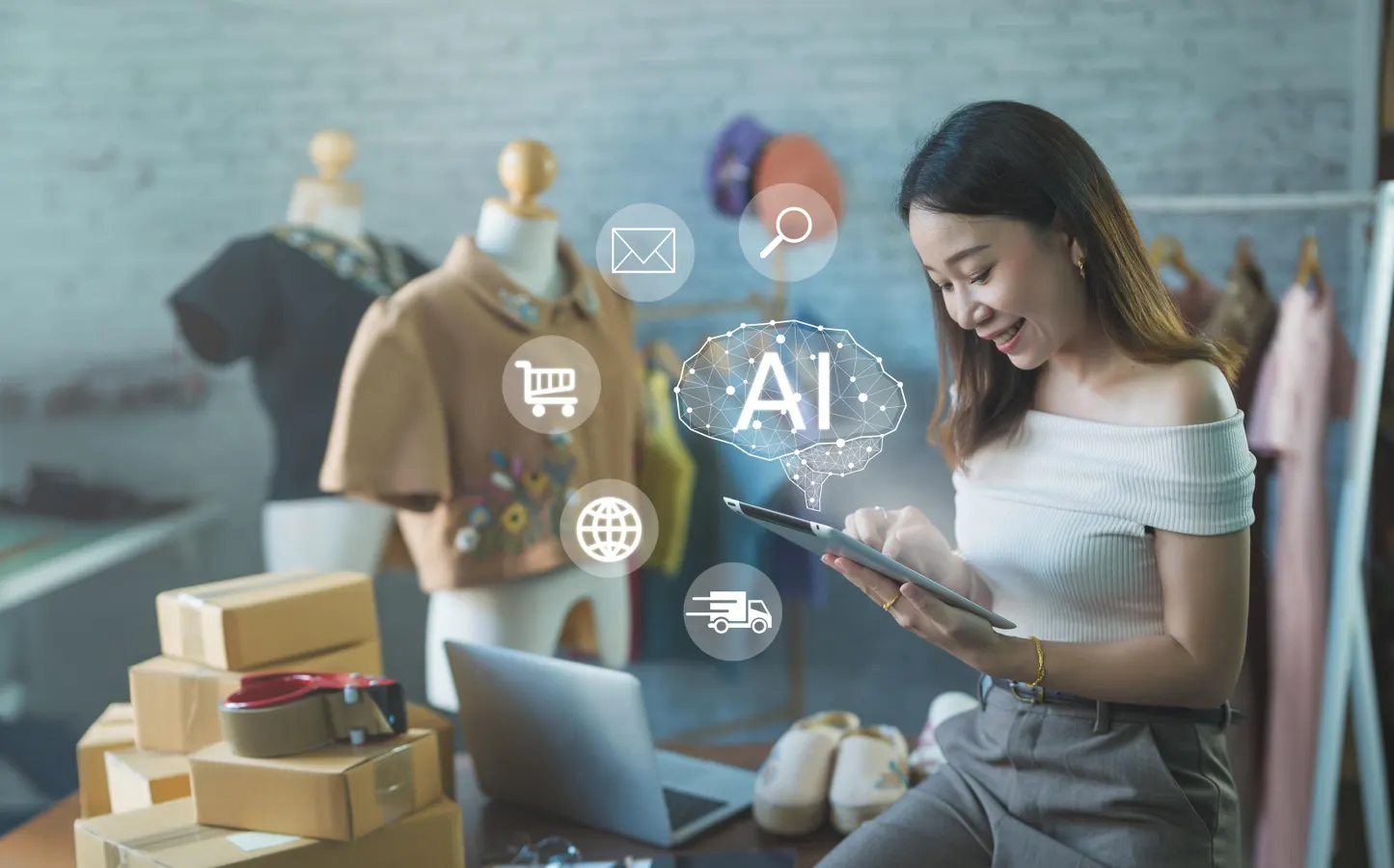

Technology and people concept women use AI to help work
getty
We’re more than halfway through 2026, and retail leaders are confronting a familiar challenge with new urgency: how do you keep moving forward amid persistent uncertainty while proving that investments in AI are delivering real business value?
AI remains at the center of the agenda, but Accenture’s latest Pulse of Change research — based on surveys of 3,000 C-suite leaders and 3,000 employees across 19 industries and 20 countries — reveals a growing tension. Leaders remain committed to AI and its potential to drive productivity, growth and competitive advantage, yet halfway through the year, they feel less prepared to manage disruption. For retailers heading into the critical holiday season, that gap between ambition and readiness is becoming increasingly important.
One reason is the continued volatility of the macroeconomic environment. Globally, 73% of leaders anticipate a surge in inflation and 70% expect a reduction in global economic growth. That outlook is pushing leaders to become more pragmatic — both in how they respond to economic pressures and in how they measure the returns from AI investments.
In retail, we’re seeing this tension play out in real time. Since the start of the year, only 25% of retail leaders expect revenue growth to accelerate, while 43% anticipate it will slow. Yet consumers have proven remarkably resilient: July marked the tenth consecutive month of retail sales gains, with shoppers continuing to spend despite mixed economic signals, according to NRF.
At the same time, Accenture’s latest Macro Foresight analysis shows that U.S. real incomes in June 2026 remained roughly 5% below the pre-pandemic trend — a persistent gap that could leave many households feeling more financially constrained than headline economic indicators suggest. Heading into the holidays, that tension between a willingness to spend and pressure on household budgets will likely shape consumer behavior. Shoppers may still spend, but they will do so more deliberately — prioritizing value, trading down where it makes sense and timing purchases around major promotional events.
That makes the upcoming holiday season an important test. Retailers are still betting big on AI, but the focus is increasingly shifting from investment to impact: Can these technologies deliver value where it matters most — stronger operations, better support for employees and measurable business results?
Here are three questions that are front-of-mind for retailers this holiday season:
Can AI investment deliver measurable value?
Despite continued uncertainty, retail executives remain focused on AI as a pathway to growth and competitive advantage. And there is good reason to move with urgency: consumers are increasingly willing to put AI to work on their behalf. Accenture research found that 74% of consumers would trust a personal AI agent more than their best friend to make a purchase on their behalf. As AI begins to play a greater role in how consumers discover, compare and ultimately choose products, retailers recognize what’s at stake if they fail to keep pace.
But confidence in AI’s potential has yet to translate into widespread business value. While 56% of retail leaders are confident that agentic AI initiatives will deliver quantifiable outcomes within the next 12 months, only 17% say their organization has achieved widespread, sustained business value across the enterprise. That disconnect between AI ambition and measurable return is becoming increasingly important. As my colleague Muqsit Ashraf, Global Lead for Industry and Enterprise at Accenture, notes: “Even amid real uncertainty, leaders remain convinced of AI’s potential. What’s changed is the urgency around results. Securing that return means rethinking how companies operate, compete and grow: integrating AI into core strategy, building the governance to scale it, reinventing how work is done, and reshaping the workforce for the age of AI.”
For retailers, closing that gap requires more than deploying new tools or launching isolated pilots. It means embedding AI into the way the business operates — redesigning workflows, roles and operating models so AI can influence decisions and create value at scale. Target’s recent appointment of its first chief AI officer is one example of that shift, signaling a greater focus on coordinating and integrating AI across the enterprise to improve the shopping experience and give employees better tools to make decisions.
Can retailers keep products moving during continued supply chain disruption?
Retailers have always planned for peak demand around major holiday moments like Black Friday and Cyber Monday. But those peaks are now part of a longer, more fragmented shopping season. With household budgets under pressure, consumers are searching harder for value — shopping earlier, comparing prices across retailers and spreading purchases across multiple promotional events.
That shift creates sustained pressure on supply chains rather than a handful of predictable peaks — leaving retailers with less margin for error. At the same time, external pressures are adding another layer of complexity. In fact, 44% of retail leaders say they are accelerating operational transformation or restructuring in response to energy supply constraints or price volatility.
This is where AI can help retailers move from reacting to disruption to anticipating it. By continuously analyzing demand signals, inventory positions, supplier delays and transportation constraints, AI can identify potential problems earlier and help teams adjust replenishment and fulfillment plans before customers feel the impact. During the holidays, that could mean repositioning inventory as demand shifts, identifying supplier or transportation delays sooner, or dynamically finding the fastest and most cost-effective way to fulfill an order when conditions change.
The opportunity isn’t simply to make the supply chain more efficient. It’s to make it more adaptive — giving retailers the visibility and flexibility to keep products moving even when demand, costs or supply conditions don’t go according to plan.
Can retailers close the AI gap between employees and employers?
Retail employees are already seeing the benefits of AI. Sixty-seven percent say AI tools have increased their productivity, while 57% report higher job satisfaction since those tools were introduced. Yet there is a disconnect between enthusiasm for AI and confidence in how companies are managing the transition. Thirty-five percent of employees believe they would be expected to reskill on their own if their roles were disrupted, and only 31% believe their organization is very prepared to respond to talent disruption.
That gap matters. If employees don’t understand how AI will reshape their roles — or don’t feel equipped and supported to work differently — retailers will struggle to translate AI investment into sustained business value.
Realizing the ROI from AI requires more than simply bringing employees along for the journey. Retailers need to involve them from the start. That means redesigning processes and workflows alongside the technology, investing in new skills and creating a culture where employees understand how AI can augment their work rather than simply automate it.
Middle managers will be especially important. They are the critical link between AI strategy and the frontline experience, translating new capabilities into practical training, redesigned workflows and the day-to-day support employees need to succeed.
Ultimately, the retailers that generate the greatest return from AI may not be those that deploy it the fastest, but those that best prepare their people to use it.
So, what’s next?
As retailers prepare for the holiday season, the conversation around AI is shifting from investment and experimentation to impact. The question is no longer simply whether retailers are using AI, but whether it is delivering meaningful value — for customers, employees and the business.
This holiday season will be an important proving ground. Retailers that use AI to better anticipate what consumers want, respond faster when conditions change and give employees the tools and confidence to work differently will be better positioned not just for the months ahead, but for the next era of retail.
The opportunity is to turn AI from a promising technology into a practical advantage — one that helps retailers navigate uncertainty today while building a more adaptive, resilient business for tomorrow.














Leave a comment