


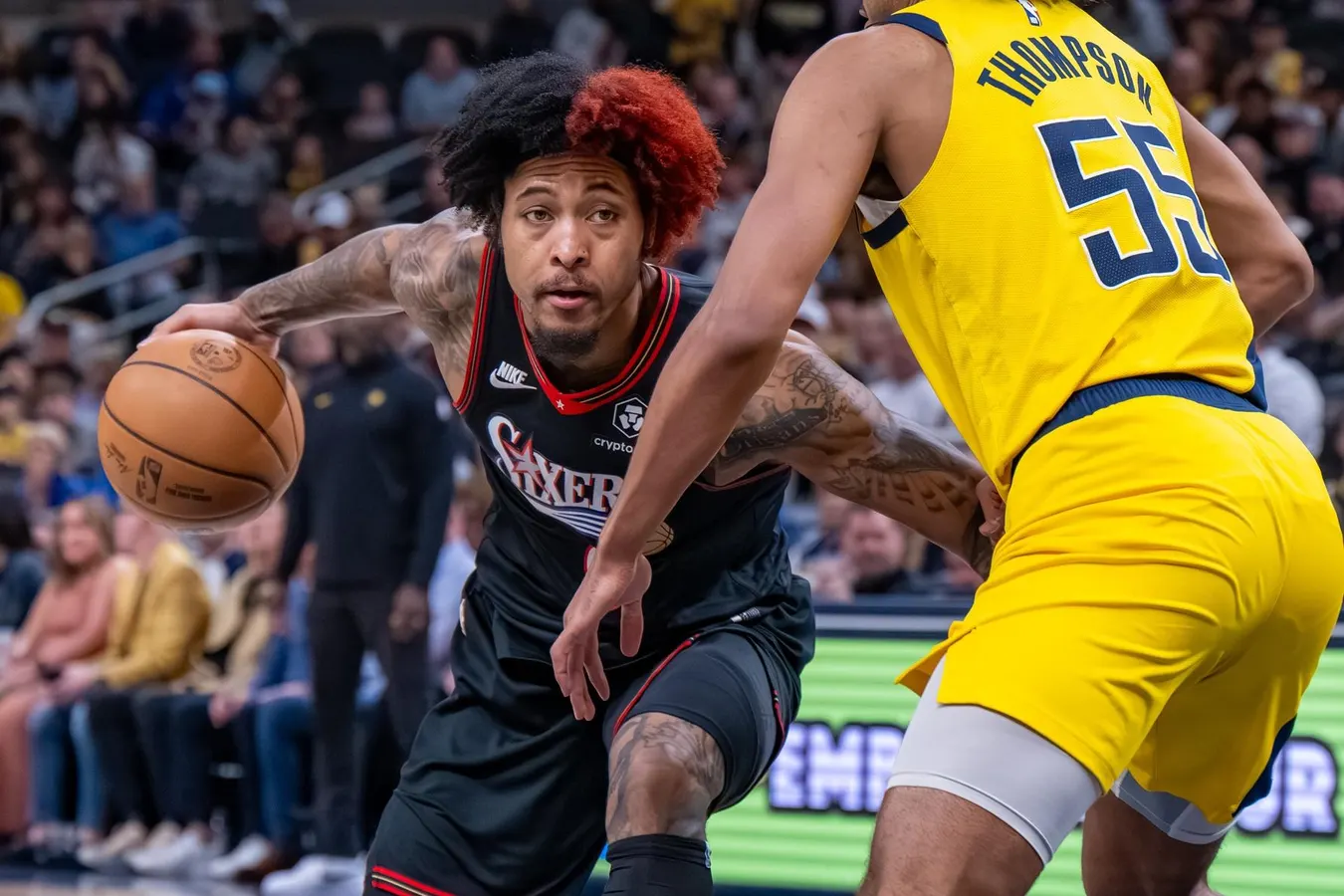

Philadelphia 76ers guard Kelly Oubre Jr. drives into the defense of Indiana Pacers guard Ethan Thompson (55) during the first half of an NBA basketball game in Indianapolis, Friday, April 10, 2026. (AP Photo/Doug McSchooler)
Copyright 2026 The Associated Press. All rights reserved
The Indiana Pacers are hard capped at the first apron for the entire 2026-27 NBA season. That comes with some restrictions, but the Pacers were clearly willing to live with them.
The team signed forward Kelly Oubre to open free agency, kicking off the offseason signing period with a splash. Oubre joined the Pacers on a two-year, $16.5 million contract that is fully guaranteed.
“He’s a guy who has definitely been annoying for me to go against throughout my career, so I’m excited for him to be on our side,” Pacers star guard Tyrese Haliburton said of adding Oubre.
In order to sign Oubre, the Pacers had to use a salary cap exception. Because the first-year salary of Oubre’s contract is above $6.06 million (it’s $8.05 million), that means the team used the Non-Taxpayer Mid-Level Exception (NTMLE) to bring in the 30-year old forward.
It’s a fine price for a productive player. But any front office that uses the Non-Taxpayer MLE to sign a player immediately becomes hard capped at the first apron, and the Pacers will have to deal with those restrictions all season.
What does a first apron hard cap mean for the Pacers?
The NBA has a soft cap system (which was updated to include aprons in the 2023 Collective Bargaining Agreement), meaning teams can go over the established salary cap in a given season. But there are ways that franchises can become hard capped and unable to spend more than a certain dollar amount on their team salary.
That’s true of the Pacers after the Oubre addition. Under no circumstance can Indiana spend more than $209,015,000 on its roster, in terms of salaries plus incentives, this season. That is a true hard cap for Pacers decision makers.
Right now, the Pacers have 14 players signed to guaranteed contracts. Those 14 deals, plus bonuses, total out to about $206.8 million. Without making any other moves, the Pacers can only sign a first or second-year player to a minimum contract before opening night.
INDIANAPOLIS, INDIANA – FEBRUARY 24: Kelly Oubre Jr. #9 of the Philadelphia 76ers takes a shot over Kam Jones #7 of the Indiana Pacers at Gainbridge Fieldhouse on February 24, 2026 in Indianapolis, Indiana. (Photo by Justin Casterline/Getty Images)
Getty Images
Those apron restrictions will last until June 30, 2027. So the Pacers are limited in how much they can add during the coming campaign, and they won’t be able to afford a veteran’s minimum deal for their open roster spot until early November.
That means the Pacers transactional flexibility is reduced for the entire season. They cannot, for any reason, cross the first apron during a transaction – not a trade, not a signing, not a waiver claim, nothing. So most of their moves will have to be cap neutral, or close to it.
That hard cap has already put the Pacers in a tough situation. They couldn’t afford to fill their 15th roster spot with a veteran, and that ended up getting crossed financially with their two-way contract reality. In the end, Ethan Thompson was waived to open up a spot to sign Braden Smith.
The Pacers were hard capped at the first apron last year, too. That happened as a result of using an old trade exception to acquire Jay Huff, then using the Non-Taxpayer MLE on Quenton Jackson. But Indiana was far from the first apron spending limit, so the restrictions didn’t come into play.
This year, they will be a factor in most of the team’s moves. Almost every time the Pacers make any transaction, they will have to think about how much money they are adding – or if adding salary is worth sacrificing flexibility. Any more money put on the Pacers books will make certain other trades or signings impossible since the team would get closer to their hard cap.
Signing Oubre was worth it. He will make the Pacers better as they look to repeat their Eastern Conference success. But they will have to be very careful to make the right moves since they are hard capped at the first apron for all of 2026-27.












Leave a comment