


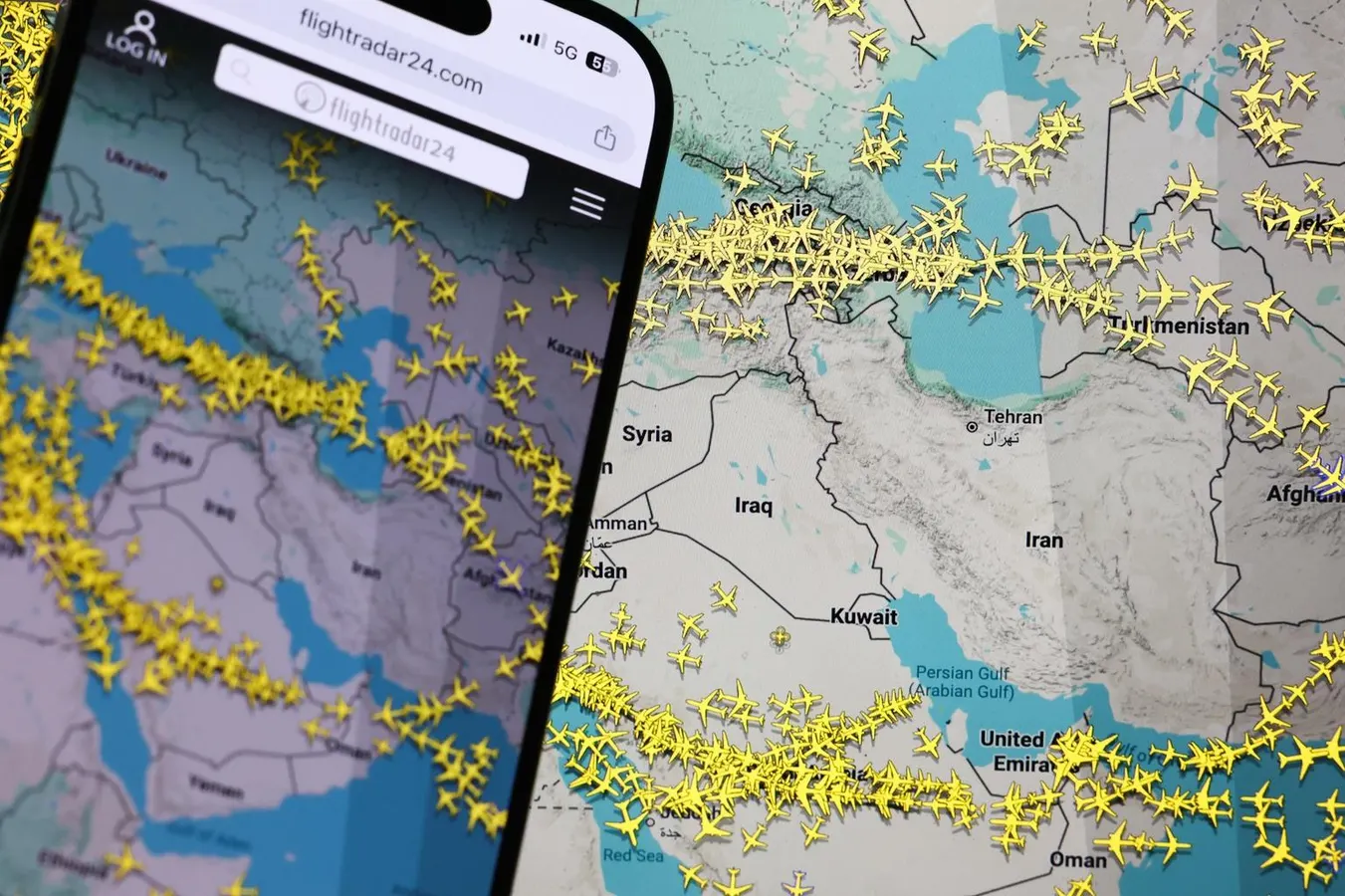

Flightradar24 map showing current air traffic in the Middle East dislplayed on a laptop and a phone screens are seen in this illustration photo taken in Krakow, Poland on March 4, 2026.
NurPhoto via Getty Images
Airlines are spending billions to make flying more efficient, yet geopolitics is pushing long-haul flights in the opposite direction. Conflict zones and other airspace restrictions force aircraft onto longer routes, causing a lasting impact.
Not only are passengers spending more time in the air, but airlines are also burning more fuel and producing more emissions to reach the same destinations.
In this article, I took a closer look at how closed and restricted airspace is making flights longer, increasing costs and worsening aviation’s already significant climate impact.
What Does Closed Airspace Actually Mean?
Airspace can be closed or restricted due to security threats, military exercises, missile or drone activity, political disputes, air traffic control strikes, natural disasters, or severe weather.
But closed airspace does not always mean that every aircraft is prohibited from entering a country’s skies. In Ukraine, the entire airspace is closed to civilian aviation, but in Russia, the airspace is only unavailable to European Union airlines.
A protester holds a banner in favor of closing Ukrainian airspace during a demonstration against the Russian attack on Ukraine organized in front of NATO headquarters.
Getty Images
Aviation authorities, such as the FAA and EASA, can also prohibit or advise carriers against entering. Airlines themselves may also voluntarily avoid airspace based on their own risk assessments.
In Europe, EUROCONTROL’s Flexible Use of Airspace system is designed to release military airspace back to civilian traffic when it is no longer required.
For long-haul travelers, however, the most significant and persistent disruptions are conflicts in strategically located areas that affect an airline’s available route network for months or years.
Closed Airspace Is Adding Hours To Long-Haul Flights
Russian airspace has been unavailable to EU airlines since February 2022.
Back in 2023, the International Civil Aviation Organization (ICAO) already highlighted in its Presentation of Key Trends in Air Transport 2023 that Finnair’s Helsinki–Tokyo route increased from nine hours to 13 hours after the loss of access to Russian airspace. It is a 44% increase.
Finnair also confirmed this in a statement published in April 2026 that its flights to Japan and South Korea can consequently take two to four hours longer than before the closure.
Rusty roadsigns with names of cities Stockholm, Tokyo, Helsinki, Moscow
getty
Following the escalation of hostilities in the Middle East on February 28, 2026, airspace and airport closures across the region forced airlines to establish significant alternative routings.
Finnair noted in the same statement that flights to India, Thailand and Singapore may now take roughly one to two hours longer due to the situation in the Middle East.
The impact has also reached travelers flying directly between Asia and North America. In March 2026, Air India had to route its Europe and North America services westward through available airspace over Oman, Saudi Arabia and Egypt.
Furthermore, India–North America flights have become long enough that aircrafts have to make technical stops in Rome or Vienna before continuing across the Atlantic.
The airline published a statement saying that the detours not only increased flying time but also made operations more complex.
While the Middle East conflict is temporarily closed, Iran, Iraq and Lebanon remain among the areas EASA advises airlines not to overfly.
Passengers Are The Ones Paying For The Detours
Air India moved quickly to pass some of the higher fuel costs on to passengers.
Air India’s Boeing 787 Dreamliner at their hub airport Delhi Indira Gandhi International Airport.
getty
On March 10, 2026, just days after the Middle East conflict escalated, the airline announced the implementation of fuel surcharges. The airline cited a sharp rise in jet fuel prices linked to the geopolitical situation in the Gulf as the reason.
For North America, the airline increased the surcharge from $150 to $200 one-way, then again to $280 in April.
ANA’s first surcharge was announced in April. For Japan–North America and Europe flights, the one-way surcharge was ¥56,000 ($386) for itineraries originating outside Japan, then rose in July–August to ¥65,000 ($485).
As of September 1, 2026, ANA cut it to ¥55,000 ($352), citing Japanese government measures that helped mitigate the fuel-cost increases linked to the situation in the Middle East.
Emirates kept its fuel surcharges unchanged as of September 1, 2026, with Japan–Dubai tickets carrying a ¥48,000 ($306) one-way surcharge and flights from Japan to Europe or the Americas carrying a ¥49,000 ($312) surcharge.
















Leave a comment