


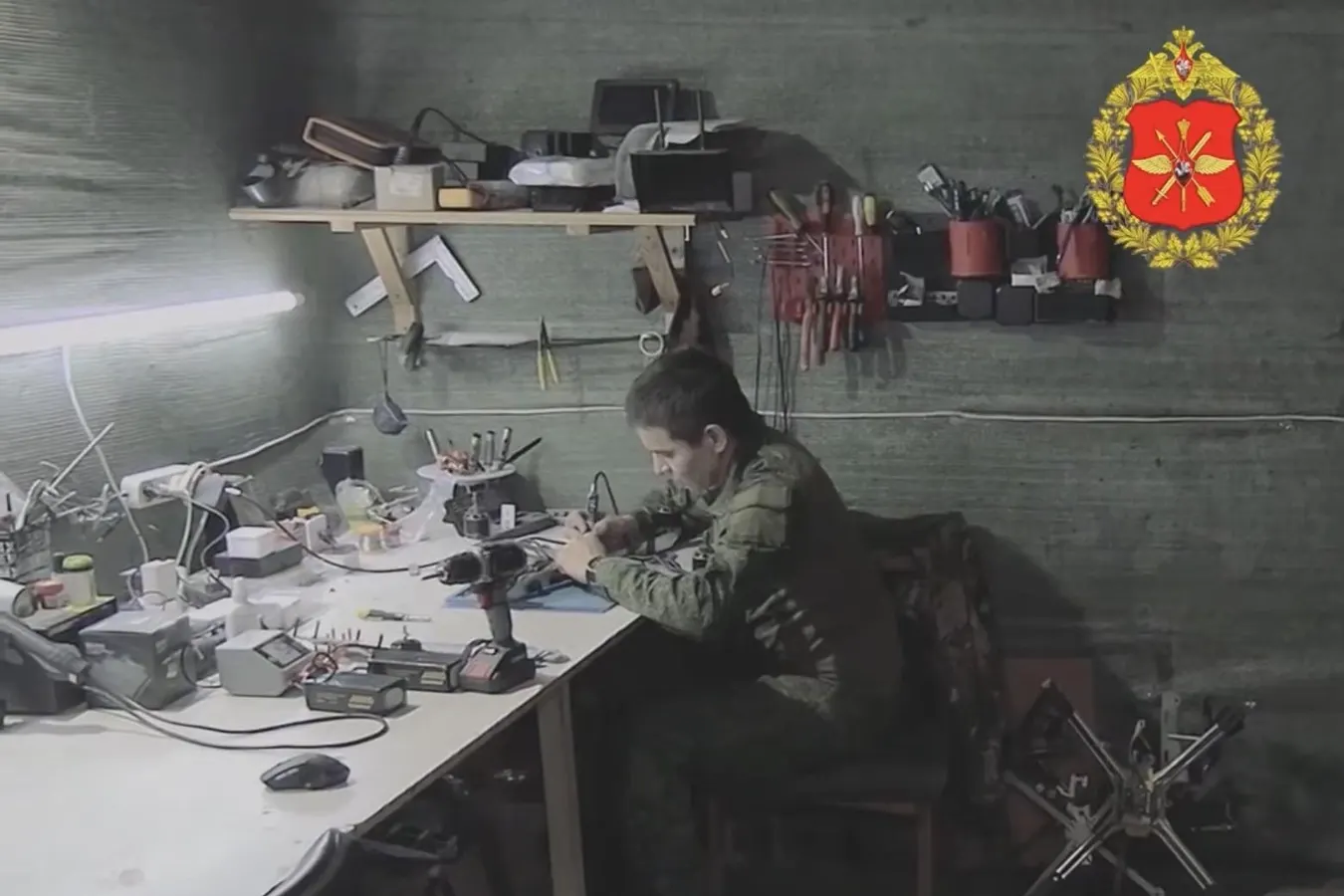

Image captured from a video posted by the Russian Ministry of Defense on Telegram on September 6, 2026. The video showed a maintenance team from the 268th Self-Propelled Artillery Regiment that had been repurposed to restore and upgrade drones.
Social Media Capture
The Russian Ministry of Defense recently posted a video on its Telegram channel featuring soldiers from a maintenance unit in the 268th Self-Propelled Artillery Regiment that has been repurposed to repair and upgrade drones. This shift reflects a broader trend within the Russian military, which is converting some artillery and armor units into drone-enabled assault forces. As demand for traditional artillery and armor maintenance declines, Russia appears to be reallocating maintenance personnel to support drone upgrades closer to the front lines. These drone innovation teams could enable Russian forces to adapt their drones more quickly to evolving battlefield conditions and Ukrainian countermeasures.
The Development Of Drone Innovation Teams
According to the video, the primary purpose of these teams is to accelerate drone innovation at the tactical level. Previously, Russian units that needed modifications to their drones had to rely on the traditional acquisition system or attempt the changes themselves. The first option often took considerable time, while the second depended heavily on the technical expertise and equipment available within the unit. Neither approach was particularly efficient, contributing to a gap between Russia and Ukraine in the pace of tactical drone innovation.
By embedding technical teams alongside frontline drone units, Russia appears to be adopting an approach that Ukraine has successfully employed throughout the war by pushing drone innovation to the tactical edge. Ukrainian drone units have been able to rapidly identify problems, develop solutions, test them in combat, and refine designs based on battlefield results. Russia’s new teams could create a similar feedback loop between drone operators and technical personnel. Effective modifications can then be reported back to Moscow and incorporated into broader production efforts, allowing locally developed solutions to spread across the force.
Image captured from a video posted by the Russian Ministry of Defense on Telegram on September 6, 2026. The video showed a maintenance team from the 268th Self-Propelled Artillery Regiment that had been repurposed to restore and upgrade drones.
Social Media Capture
Russia also has a substantial pool of personnel available to support this new model. The realignment of artillery and armor units provides maintenance and support personnel who can be reassigned to these teams. These soldiers already possess skills in electronics repair, fabrication, diagnostics, and equipment modification, many of which are directly applicable to tactical drones. As a result, employing them in drone support and innovation roles may be a more effective use of their expertise than reassigning them as assault troops or drone operators.
The Capabilities Of Drone Innovation Teams
The video provides insight into how this process works in practice. According to one of the soldiers interviewed, the team remains in constant contact with drone operators in the regiment, allowing it to develop solutions tailored to current battlefield requirements. The team designs and produces new components, provides them to operators for field testing, and then refines the designs based on operator feedback. This process enables modifications to be rapidly tested and improved based on combat experience.
The workshop’s primary capability appears to be 3D printing, with six FlashForge printers reportedly operating continuously. FlashForge is a Chinese manufacturer of desktop 3D printers capable of producing components from thermoplastics such as PLA, ABS, and PETG, while some models can also print carbon-fiber-reinforced materials. The video shows a soldier preparing a design on a computer before sending it to one of the printers. Another soldier is shown handling commercial drone components while discussing the team’s ability to print specialized adapters for different optical systems.
Images captured from a video posted by the Russian Ministry of Defense on Telegram on September 6, 2026. The video showed a maintenance team from the 268th Self-Propelled Artillery Regiment that had been repurposed to restore and upgrade drones. These images show a desktop FlashForge 3D Printer (left) printing out a casing for a fiber optic reel (right).
Social Media Capture
The workshop appears particularly focused on fiber-optic FPV drones. One printer is shown producing what appears to be a casing for a fiber-optic reel, while another section of the facility contains equipment for spooling fiber-optic cable. This setup appears to allow the team to convert existing radio-controlled FPV drones to fiber-optic control. Such a focus reflects the growing importance of fiber-optic drones, which remain effective in environments where electronic warfare systems can disrupt conventional radio-controlled platforms.
However, while the facility is capable of modifying and upgrading drones, it does not appear to have the capacity to manufacture them at scale. Six desktop 3D printers would only produce the components for a limited number of drones per day, which would still need to be assembled with commercial electronics and motors. Consequently, it is unlikely that this workshop would contribute significantly to the large number of drones currently being deployed by Russian forces. Instead, the team appears to rely on prefabricated drones and commercial components as the foundation for its work. The 3D printers allow rapid production of specialized parts and adapters, but the workshop remains dependent on external supplies of drones, electronics, motors, optics, and other critical components.
The Broader Implications Of These Drone Innovation Teams
As Russia continues to expand its reliance on FPV drones, the number of these repair and innovation workshops will likely grow, as will their capabilities. Repurposing existing maintenance units offers a relatively straightforward way to establish such facilities across the front without creating entirely new organizations. A larger network of workshops would mean more teams experimenting with designs and responding to the unique challenges of their sectors. As successful modifications are shared between units and incorporated into broader production efforts, this network could help Russia disseminate drone innovations more rapidly across the force.
Image captured from a video posted by the Russian Ministry of Defense on Telegram on September 6, 2026. The video showed a maintenance team from the 268th Self-Propelled Artillery Regiment that had been repurposed to restore and upgrade drones.
Social Media Capture
However, Russia may struggle to replicate the level of technical innovation achieved by Ukraine. Many Ukrainian drone developers entered the war with backgrounds in software development, engineering, and robotics. This gave Ukraine access to a pool of personnel capable of developing new drone technologies. By contrast, Russia is building its workshops around maintenance personnel repurposed from conventional military units. These soldiers possess valuable technical skills, but they may lack the specialized expertise required to develop more advanced hardware and software. As a result, the Russian workshops are better suited to adapting existing technologies than producing fundamentally new ones.
Regardless, the significance of these workshops extends beyond Russia’s use of tactical drones. Modern warfare has become increasingly characterized by rapid cycles of technological and tactical adaptation, in which new capabilities are quickly countered by emerging technologies or tactics. Therefore, success on the battlefield depends heavily on how quickly militaries can identify problems, develop solutions, and deliver those solutions to soldiers in the field. By pushing drone innovation closer to the front lines, Russia is attempting to build that adaptability directly into its fighting force.














Leave a comment