


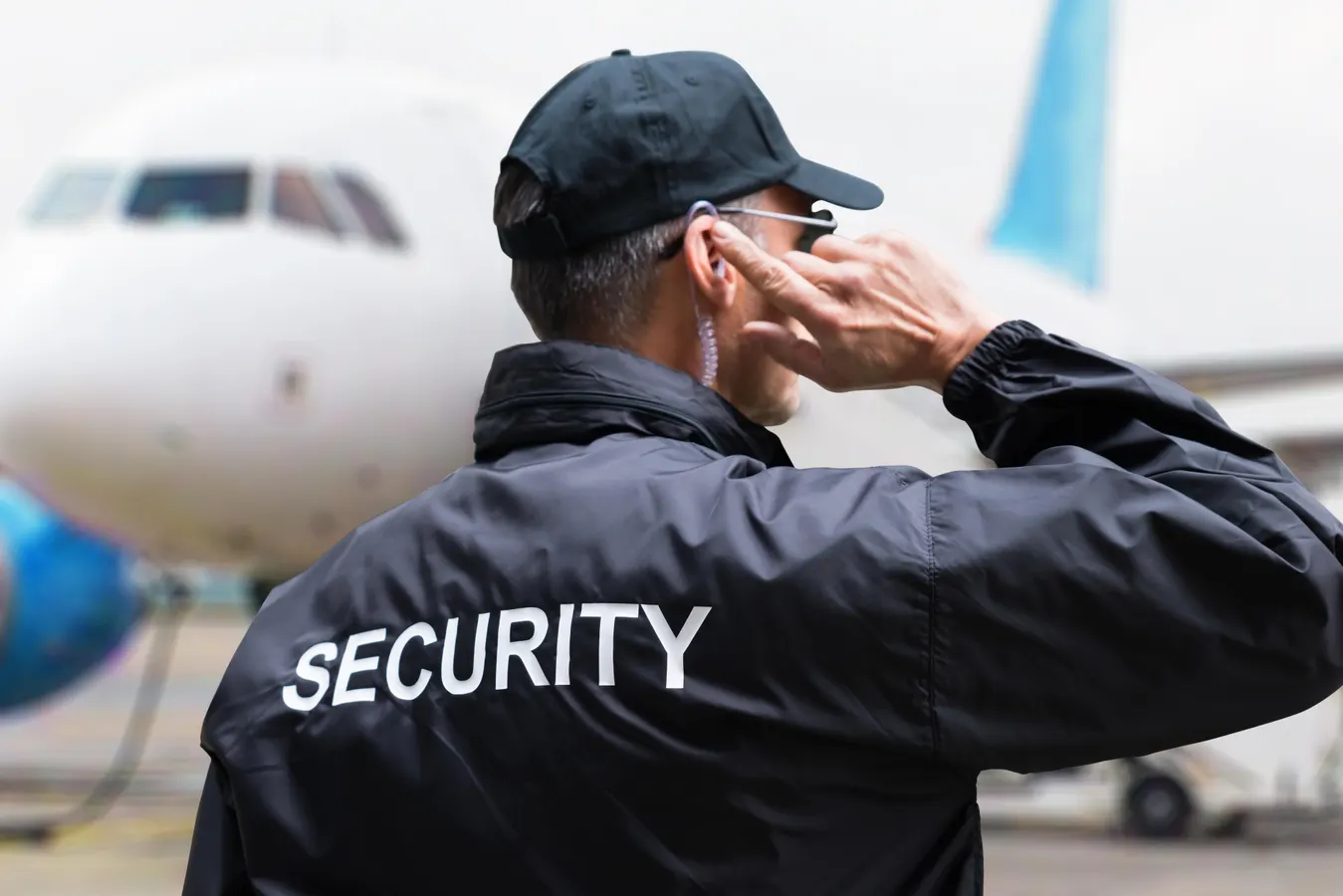

Rear view of a security guard listening to earpiece with an airplane in the background
getty
Twenty-five years ago, travelers could board U.S. flights carrying knives with blades under four inches, while Americans returning from parts of the Western Hemisphere could sometimes establish their citizenship without a passport.
Today, security can begin before passengers reach the airport, with government watchlist checks, biometric screening and other advanced technology extending well beyond the checkpoint.
As the 25th anniversary of the September 11 attacks approaches, I looked at how 9/11 reshaped flying and crossing the U.S. border and which security measures have become so routine that many travelers barely remember a time when they were not around.
Airport Screening Shifted From Airlines To The Federal Government
Back in 2001, the Federal Aviation Administration (FAA) set aviation security rules, but airlines were responsible for implementing passenger checkpoint screening, generally through private contractors.
When the 9/11 Commission’s final report found serious weaknesses across the security system, a change came rapidly. Only about two months later, in November 2001, Congress passed the Aviation and Transportation Security Act and established the Transportation Security Administration (TSA).
The Transportation Security Administration (TSA) logo is displayed on a smartphone screen
SOPA Images/LightRocket via Getty Images
In a 2021 congressional hearing marking TSA’s 20th anniversary, current and former agency leaders described how screening had evolved from a largely one-size-fits-all system centered on metal detectors and X-ray machines to a risk-based approach, passenger vetting through Secure Flight and more advanced detection technology.
Today, security has multiple layers, including federal or federally overseen screeners, explosives specialists, canine teams, intelligence-driven procedures and technology ranging from state-of-the-art imaging to computed tomography scanners.
Security Screening Now Begins Before Travelers Reach The Airport
TSA’s Secure Flight program, implemented after 9/11, compares passenger information with federal government watchlists before travelers reach the security checkpoint. It applies to flights within, into, out of and over the United States.
The contrast with 2001 is substantial. CAPPS, a screening system used pre-9/11, was already attempting to identify potentially higher-risk passengers, but additional scrutiny generally focused on their checked baggage rather than their person or carry-on.
For example, in 2001, FAA guidelines prohibited knives with blades four inches or longer, while the industry checkpoint guide expressly permitted pocket utility knives with blades under four inches.
Even wine and bottle openers that have a small knife are prohibited items that did not make it through TSA checkpoint screenings at Newark Liberty International Airport.
The Washington Post via Getty Images
According to the 9/11 Commission report, the aviation system at the time was more focused on sabotage and explosives than a suicide hijacking.
Investigators found that knives were seen aboard all four hijacked aircraft, while evidence also indicated that these were ‘permitted’ knives with blades under four inches.
The Commission also found that more than half of the 19 hijackers were flagged for further inspection, yet the consequence applied only to their checked luggage and not their carry-on.
Today, knives, with limited exceptions such as plastic or round-bladed butter knives, are prohibited in carry-ons under current TSA rules.
Airport Security Became More Risk-Based, Not Just More Restrictive
Post-9/11 security also created a faster path for travelers considered lower risk.
TSA PreCheck began as a pilot program in 2011, while the application-based program was formally introduced in December 2013.
Travelers walk past a TSA Pre-check application center at Terminal C of the LaGuardia Airport in New York City.
Getty Images
Applicants, U.S. citizens, U.S. nationals and lawful permanent residents, voluntarily provide biographic and biometric information for a security threat assessment before receiving expedited screening eligibility.
For eligible travelers, TSA PreCheck can mean using dedicated security lanes and avoiding some of the procedures associated with standard screening. It is a broader shift from a largely one-size-fits-all checkpoint toward risk-based security.
Americans Could Once Return Home Without A Passport
Perhaps the most surprising change for American travelers happened at the border rather than the airport.
Before the Western Hemisphere Travel Initiative, U.S. and Canadian citizens entering the United States from within the Western Hemisphere faced no standardized documentary requirement.
This meant that pre-9/11 travelers could use numerous forms of documentation or, in some circumstances, an oral declaration of citizenship was sufficient.
Since June 1, 2009, when the land-and-sea requirements of the Western Hemisphere Travel Initiative took effect, U.S. citizens returning by land or sea from destinations such as Canada and Mexico have to present a passport or another approved secure document.
A limited edition U.S. Passport featuring U.S. President Donald Trump, on display at the State Department exhibit on the final day of the Great American State Fair on July 10, 2026 in Washington, DC.
Getty Images
Foreign Visitors Are Now Vetted Before They Fly To The U.S.
The Electronic System for Travel Authorization (ESTA), which became mandatory in 2009, allows the U.S. government to assess travelers in the Visa Waiver Program before boarding any flight bound for the U.S, rather than only when arriving at the U.S. border.
The arrival process has also become increasingly biometric. As of July 17, 2026, U.S. Customs and Border Protection says it uses facial biometric comparison to process travelers entering the country at 238 airports.
Security Is Stricter, But Not All Rules Stay Forever
Before 9/11, passengers did not routinely remove their shoes at U.S. airport security. That changed in the post-9/11 era, after Richard Reid attempted to detonate explosives hidden in his shoes in December 2001.
Since August 2006, TSA has required most passengers to remove their shoes for X-ray screening. It is a rule that remained in place for nearly 19 years before TSA revoked it nationwide in July 2025.
A man is putting his shoes into a tray for airport security check
getty
Identity checks have also become more automated. Instead of relying mainly on an officer to visually inspect an ID and boarding pass, newer TSA systems can electronically authenticate the ID and confirm the passenger’s reservation and screening status.
All liquids and gels were banned in carry-on as of August 10, 2026. While the 3-1-1 liquids rule introduced in September 2006 remains in place today, at airports equipped with CT scanners, passengers may be able to leave laptops and travel-size liquids in their carry-ons.













Leave a comment