


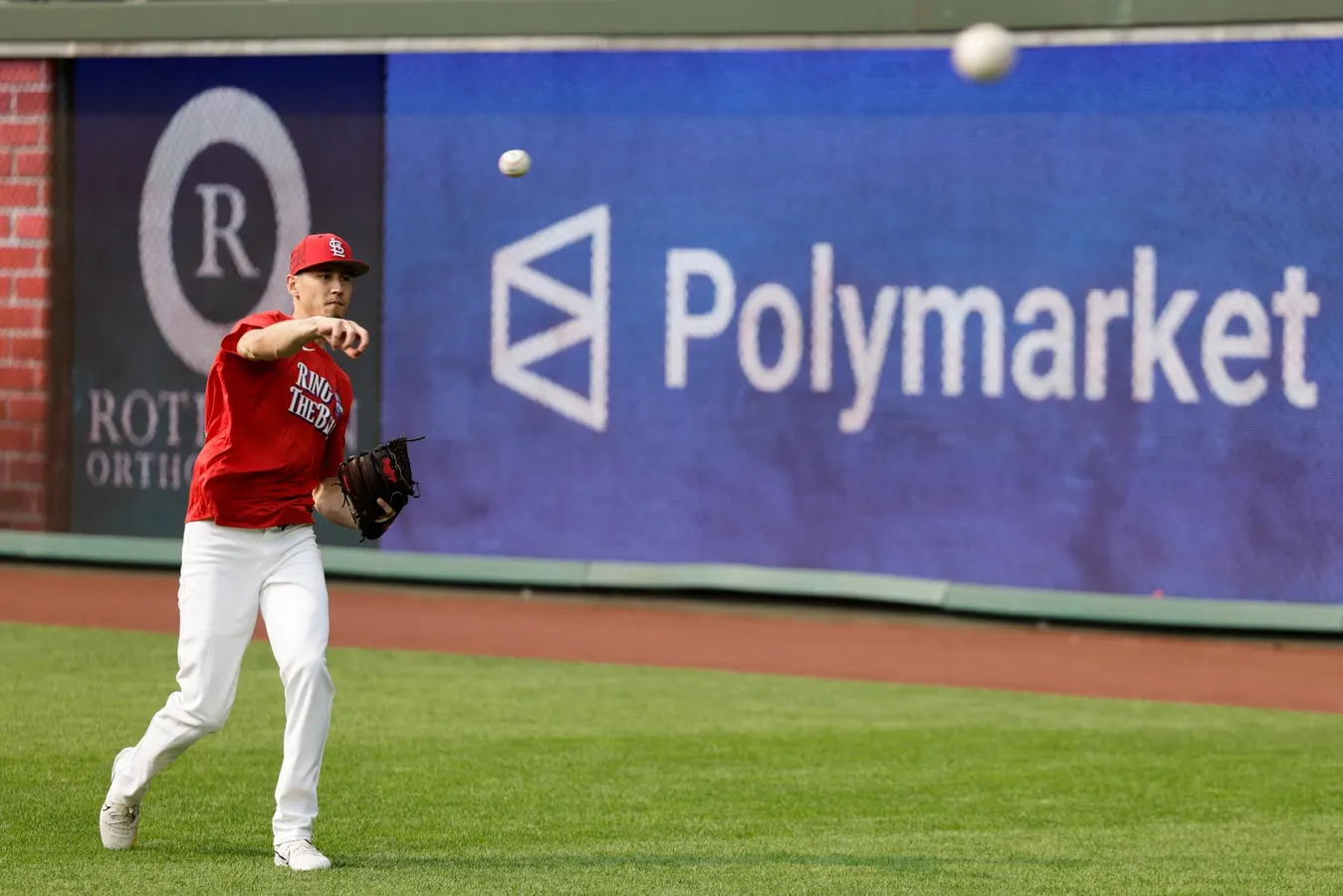

PHILADELPHIA, PA – JULY 14: Riley O’Brien #61 of the St. Louis Cardinals warms up prior to the 96th MLB All-Star Game presented by Mastercard at Citizens Bank Park on Tuesday, July 14, 2026 in Philadelphia, Pennsylvania. (Photo by Steve Boyle/MLB Photos via Getty Images)
MLB Photos via Getty Images
With the 2026 NFL season about to start, a new crop of betting ads also comes with it.
Traditional sportsbooks don’t shut down advertising in the offseason, but football brings new campaigns and an early push to get bettors invested. And increasingly, thanks to the growing popularity of prediction markets, that’s a sales pitch that’s going nationwide.
While online sports betting – through apps like DraftKings and FanDuel – is not yet legal in every state (30 currently allow it), prediction markets currently avoid those laws, because users are making “predictions” against other consumers that could qualify as swaps.
The technicality has spurred a bit of a renewed gold rush around sports betting.
Along with the established giants DraftKings and FanDuel, prediction market brands like Kalshi and Polymarket have pushed increases in sports betting ad spend on national linear TV this year. Through August, sports betting spend is up 39% (in the same timeframe) year-over-year, according to data provided by iSpot. And is already nearing $275 million.
Prediction markets account for about $50 million of this year’s spend so far (18%), but that number is likely to rise as those brands and traditional sports books both blitz NFL games in the early weeks of the 2026 season.
And if prediction market Novig’s new campaign starring Sydney Sweeney is any indication, some of these brands are foregoing subtly in an effort to make a big splash.
SHENZHEN, CHINA – JUNE 16: In this photo illustration, the Apple App Store’s Top Free Apps ranking, featuring World Cup-related and tournament-driven applications including Paramount+, Peacock TV, FOX One, Kalshi, ChatGPT, FWC2026 Mobile Tickets, Netflix Game Controller, FIFA World Cup 2026 and Polymarket, is displayed on a smartphone screen, with the FIFA World Cup trophy and official branding of the 2026 FIFA World Cup shown in the background on June 16, 2026, in Shenzhen, Guangdong Province, China. As the 2026 FIFA World Cup is underway across the United States, Canada and Mexico, streaming platforms, official tournament apps, mobile ticketing services, sports prediction platforms and other football-related digital services have seen increased user interest and downloads during the competition. (Photo illustration by Cheng Xin/Getty Images)
Getty Images
Prediction Market Legality
To-date, Polymarket has official league partnerships with MLB and MLS, along with individual teams like the New York Yankees. Both Kalshi and Polymarket also signed a deal with the NHL last year, and both appear to be in continued talks with the NBA as well.
In recent years, some athletes have also announced partnerships with prediction market brands. Leading into football season, LeBron James announced a new agreement with Polymarket after previously appearing in DraftKings ads. And Giannis Antetokounmpo also joined Kalshi.
On the other hand, though, the NFL has thus far been opposed to prediction markets. Though it remains aligned with traditional online sportsbooks.
The reasons behind the prediction market surge makes sense. For now, they’re expanding inside of a gray area, and are creating another avenue for leagues to profit off betting – especially in states where they haven’t been able to previously.
But that may not always be the case.
In August, the Ninth U.S. Circuit Court of Appeals rejected prediction markets’ requests to offer sporting event-based contracts in Nevada, contradicting an earlier 2026 ruling by the Third U.S. Circuit Court. The split, and complicated decision from the Ninth Circuit, likely sets up a Supreme Court showdown to decide whether these prediction markets are offering sports betting or not.
As Judge Kenneth K. Lee of the Ninth Circuit noted in the August decision, “… the statute does not seem to categorically bar all gaming contracts, despite the text and contextual clues suggesting otherwise. So perhaps some unique sports events can be part of a swap trade if they meet the statutory requirements.”
He continues that neither side of the case emphasized this aspect of the case, since there were drawbacks for both in doing so that undermined parts of their respective arguments, and/or advantages.
Should the prediction markets be found to fall under the same rules as sports betting platforms, Kalshi, Polymarket and others would all be taxed and regulated according to local laws around sports wagering.
DALLAS, TEXAS – MARCH 01: Giannis Antetokounmpo #34 of the Milwaukee Bucks hangs on the rim after dunking during the first half against the Dallas Mavericks at American Airlines Center on March 01, 2025 in Dallas, Texas. NOTE TO USER: User expressly acknowledges and agrees that, by downloading and/or using this photograph, user is consenting to the terms and conditions of the Getty Images License Agreement. (Photo by Sam Hodde/Getty Images)
Getty Images
What’s Working In The Meantime
Prediction markets continue to push the ball forward to their own advantage. Kalshi, for instance, has doubled revenues this year, and Google Trends shows a 600% increase in search volume for the brand going back 12 months.
Part of that comes from their ad approach working, and setting the tone for potential sportsbook changes as well, though.
“Kalshi has effectively utilized TV advertising to spark brand awareness, both among bettors and non-bettors, while avoiding getting lost in deal messaging as the only way to drive outcomes,” Julie Van Ullen, President & CRO at iSpot told Forbes.
“By emphasizing humor and entertainment with creatives, prediction markets are fueling intrigue that avoids preconceived notions about betting and lets audiences discover the brand on their own terms.”
Some of those elements are already being included in new ad creatives coming from the sportsbook space for football season.
DraftKings’ new spot, with Nick Jonas and Kevin Hart, is more interested in brand narrative over offers and courts humor while telling audiences about its 50-state availability (courtesy of similar loopholes prediction markets have utilized).
And though these prediction markets won’t be seen much during NFL games themselves, their ad buys to-date have put a greater emphasis on non-sports programming (and viewers).
Still, even without the NFL, Polymarket and Kalshi partners with other leagues running concurrently to NFL action. During the first full weekend of college football, Kalshi was No. 2 by airings during games among all sportsbooks. That would seem indicative of a strategy to keep their feet on the gas pedal for now.










Leave a comment