


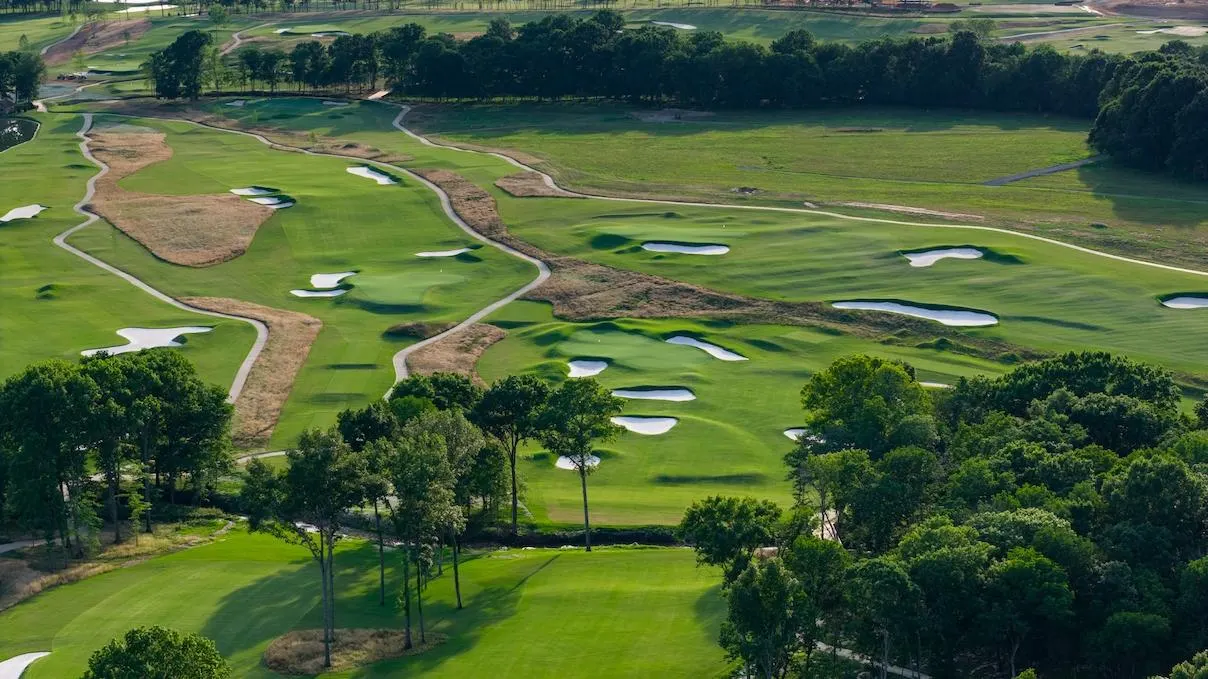

Firefly, a new golf and residential lifestyle community just south of Nashville, features the first original course design from architect Andrew Green.
Austin Peckham | Firefly
Andrew Green has spent years working on some of the most storied golf courses in the game, garnering acclaim for historic renovations and restorations at clubs like Oak Hill in New York, Inverness and Scioto in Ohio, Congressional in Maryland, Interlachen in Minnesota, and East Lake in Atlanta. Through those efforts, he spent an inordinate amount of time thinking about the design process, studying a wide variety of landscapes, shaping endless features, and imagining what he’d do if given the chance to create something truly one of one.
Green finally got the opportunity to do just that at Firefly, a new private club and residential community that just debuted his first original designs about 30 minutes south of Nashville.
“We started with a raw piece of land, a wonderful vision, and a great team, and through the process of designing and building the course, that dream slowly became reality,” Green told me. “The idea that folks are now out there experiencing what we created is incredibly rewarding.
“There is also a little bit of nervousness to it,” Green added. “Throughout the process, Firefly existed in our heads, on paper, and eventually in the dirt. Now it belongs to the golfers. They get to experience it, find their own favorite holes and shots, and hopefully discover things we intentionally built into the course that may not reveal themselves the first time around.”
Green designed an 18-hole championship course as well as a 9-hole short course on the 700-acre property.
Austin Peckham | Firefly
Green’s Opportunity
The recent uptick in U.S. golf development means more new-build opportunities for golf architects like Green, who, while busy with projects at places with championship pedigree, had until recently seen private clubs and resorts gravitate toward names like Tom Doak, Gil Hanse, Tom Fazio, David McLay Kidd and the duo of Bill Coore and Ben Crenshaw – all of whom have extensive experience and expertise in the world of ground-up golf development and design.
There are currently more new golf courses being built in the U.S. than at any time in more than a decade, according to the National Golf Foundation, as recreational golf continues to ride a post-pandemic surge of play and participation. And Nashville has been among the fastest-growing major metro areas in the U.S., with notable population growth and economic expansion. In recent years, home sales of $1 million or more in the region have soared by more than 20%.
Firefly, which is positioned as a high-end, multigenerational golf community, has sold nearly 150 homesites since 2025 and has fewer than 30 remaining across its first two sales phases.
“We have spent the last 15 years fixing the projects that had started before the financial crisis and failed,” said Mark Enderle, a partner in Storied Development, which develops and operates private club communities throughout the continental U.S., Caribbean, Mexico and Hawaii. “Now all of those communities are fully built out and the markets are looking for new opportunities.”
Firefly is the first ground-up project for architect Andrew Green.
Austin Peckham | Firefly
Enderle said that while the location of the property and the quality of the land made for a compelling story at Firefly, the popularity of Green’s design work – much of it at storied clubs that have hosted major championships — provides the project with even greater standing in the market.
In addition to the 18-hole championship course, which can stretch to 7,300 yards, there’s also a 9-hole short course (with holes ranging from 70 to 210 yards), and a practice area with three short-game greens, an 18,000 square foot putting green, and a full-service teaching facility with indoor and outdoor hitting bays. Beyond golf, the luxury amenities at Firefly include a clubhouse, fitness center, family club, adult and family pools, a bowling alley, golf simulators, an interactive game room, a multisport court, a music hall and a racquet club.
Homesites within the 700-acre community are priced from $700,000 to more than $2 million, with home construction expected to begin in 2027. The current real estate offering includes a limited selection of golf course frontage, along with Creekside and green-space homesites.
Freedom and Responsibility
Green said the freedom he had at Firefly was exciting, but it came with an added feeling of responsibility.
“On a restoration, you have history as a guide. At Firefly, every decision was ours. The routing, the scale, the strategy, the contours, where to be bold and where to show restraint,” said Green. “We had the opportunity to create something entirely new, but we wanted it to have the character and authenticity of something that belonged there. That may be the part I’m most proud of.”
Aerial of the course at Firefly, which opened at the start of September 2026.
Austin Peckham | Firefly
Green says his goal at Firefly, first and foremost, was fun. He wants golfers to finish a round and immediately talk about the shots they played, the decisions they made and what they might do differently the next time. But he also focused on incorporating variety – different directions, scales, types of greens and approaches – as well as discovery, with options that become clearer over time.
“You shouldn’t necessarily understand every hole the first time you play it,” said Green. “There should be contours you learn how to use, and places where experience changes the way you see the hole.
“Ultimately, I hope golfers remember how Firefly made them feel,” he adds. “The land is beautiful, the golf has personality, and there is a freedom to the experience. If people walk off 18 smiling, debating their favorite hole, and wanting another chance at a few shots, then I think we accomplished what we set out to do.”
In addition to the championship course, Firefly’s short course (also designed by Green) is meant to offer a fun, engaging and more time-friendly option for families as well as for younger players and those just learning the game.
Firefly opened its championship course and short course in September 2026, with construction to start on homes in the residential community in 2027.
Austin Peckham | Firefly
Green is still immersed in restoration and renovation work but has another new course design, a private, golf-only club named Kawonu, soon set for an unveil in Greenville, South Carolina.
Firefly is, and forever will be, Green’s first new build, however. And it’s a project he’s immensely appreciative of.
“Firefly gave me the opportunity to take all of those lessons and apply them to a piece of land where golf had never existed before,” Green said. “No previous course told us where a green needed to be or where a hole had to go. The land was our starting point, and we had the freedom to find the golf within it.”













Leave a comment