


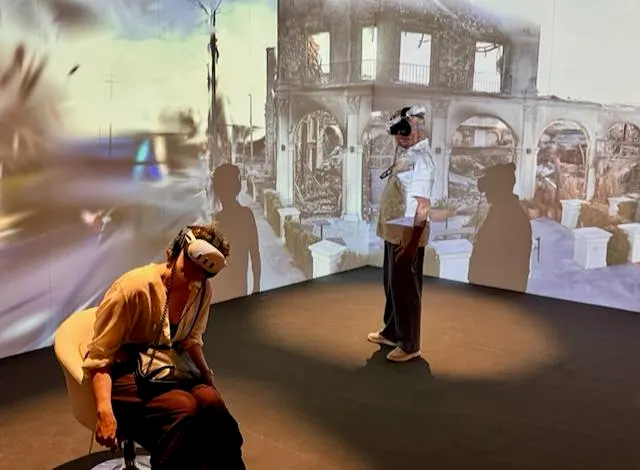

It’s been a rough year in spatial video, though you wouldn’t know it from the dozens of immersive projects on display in a former sailor-quarantine island at the Venice International Film Festival earlier this month.
A wide range of projects were on view, including a notable immersive journalism experience making its world premiere: Out of the Ashes, a you-are-there take on the devastating Pacific Palisades and Eaton Canyon fires of early 2024, telling the emotion-laden stories of loss and rebuilding by people whose cherished homes and keepsakes were immolated in seeming minutes.
The project is directed by Rory Mitchell and Nonny de la Pena, who launched and heads Arizona State University’s narrative and emerging journalism program.
Out of the Ashes was one of 30 immersive experiences in competition at Venice (it won a special jury prize) along with a college competition and collection of Best Of previous experiences showcasing many kinds of uses for spatial video.
For de la Pena, a pioneer in immersive journalism who previously worked at Newsweek and the New York Times, the opportunities for compelling documentary and news stories are significant.
It’s also a source of frustration; after capturing the video used in Out of the Ashes, she offered it to her many contacts in traditional journalism. No one was interested, in part because they didn’t know what to do with spatial video. That’s changing now at a few big news organizations, but it’s a missed chance to put readers in the middle of major news events.
That was one motivation for de la Pena and Mitchell to venture into the fire zones just days after 100-mph winds lashed residential neighborhoods with terrifying walls of flame, destroying 16,000 structures and killing 31.
“So many of our friends lost their homes,” de la Pena said. “So this is a very personal project as well as one that we felt was really important and even more relevant as we have fire after fire after fire. It’s hard to really understand the magnitude and the relevance and the urgency, but we do end with some hope.”
Further sharpening their sensitivities: both de la Pena and Mitchell had previously lost their own homes (Mitchell in the 1994 Northridge earthquake; de la Pena from a bicycle’s electric battery fire in her garage).
De la Pena used spatial cameras to film her own home’s wreckage and debris, then found it useful when arguing with her insurance company about replacing a couch. By happenstance, the footage included the wire frame of the burned couch, enough to prove it existed, and would be covered. That led her to want to capture video of all her friends’ homes, as insurance against reluctant insurers.
So when the Palisades and Eaton Canyon fires hit, de la Pena and Mitchell were ready. Using their press passes (de la Pena’s center is jointly part of ASU’s film and journalism schools), they were among the first allowed back into the fire areas.
“The birds weren’t even back,” de la Pena said. “It was so silent that there weren’t even birds.”
Their team used some clever tricks to work quickly, like mounting a handheld pole (called a flat or corona stick) with four cameras to simultaneously capture video of an object from multiple angles.
The different perspectives thus captured were then fed into an AI-assisted machine-learning system that uses a hot new (technically, newly embraced) technology called Gaussian splats, which extrude strikingly realistic 3D images from 2D footage, particularly the sort captured with the filmmakers’ flat sticks.
Gaussian splats were the talk (alongside the inevitable AI conversations) of the giant SIGGRAPH conference on computer graphics, where Mitchell and de la Pena also presented initial scenes this August.
The result, even in ghostly areas where inadequately captured video is rendered as something closer to smoke, it evokes a ghostly, otherworldly sense of the chaos and loss in the fire zones.
The experience layers that imagery with pieces of surviving family video and photos, and subsequent interviews of survivors, with their affecting stories of what was lost, and what was saved.
Best known of the participants is talk-show host Melissa Rivers, who says among the belongings she grabbed as the fire ripped into her Palisades neighborhood was mother Joan Rivers’ Emmy award, because winning it represented “freedom” and industry recognition at a crucial time in her mother’s life.
As de la Pena noted, the experience is more than just what happened on the ground, grimly and accurately portrayed. It contextualizes the climate-change issues leading to lethal, fast-moving wildfires in places as wide-ranging as Spokane, Bordeaux, northern Canada and southern Australia. And it highlights some of the efforts around the globe to reduce community vulnerability to this new Age of Fire.
The Venice festival remains one of the stalwart supporters of cutting-edge immersive experiences, even among film fests that have, in at least some cases, pulled back. The festival has been spotlighting the best immersive experiences since 2017.
At the same time, two of the biggest companies investing in immersive – Meta and Apple – have pulled back in the past year.
Meta, which spent $80 billion, bought headset maker Oculus and changed its name in its full-throated push for an immersive future, has now turned to AI while laying off hundreds of workers and closing both enterprise and entertainment apps.
Meta is now focused on its Smart Glasses partnership with Essilor Luxottica, which owns storied sunglass brands RayBan and Oakley. Their smart glasses have proven popular, but also enabled, despite various built-in protections, a rash of bad behavior, leading the products to be called “pervert glasses” as they’re used to harass and film (particularly) women without their consent.
Apple is also investigating new approaches beyond headsets. After launching the prodigiously capable and painfully expensive Vision Pro headset in 2024, Apple recently laid off 200 workers in its Vision Pro and Siri teams. It reportedly has cancelled a next version of the $3,499 Vision Pro (though it did update the chip to the powerful M5).
Apple nonetheless is continuing to add spatial-video capabilities across its software, such as Final Cut Pro, and new spatial-video programming, such as of its Friday Night Baseball MLB game telecasts. Its VisionOS operating system also received a modest update this week alongside the release of Apple’s latest OS packages for iPhones, Macs and other devices.
But the real innovation is happening elsewhere, in part driven by yet another big company, Alphabet’s Google division. At Venice, the company’s representatives were seemingly everywhere during the first weekend.
Google, proprietor of the Android XR operating system, backed two major immersive experiences at Venice: Nevatars, co-directed by Andy Serkis and Josh Nelson Youssef, and Galapagos: The Last Eden. Both were created for XReal glasses, a high-quality and lightweight rig that provides lightweight, high-resolution images, but also had problematic virtual controls.
Google and its YouTube unit separately sponsored the Reply AI Film Festival, which ran alongside the Venice festival on the Lido, and is a partner with hot film distributor A24.
“In the past few years, we’ve been particularly thoughtful, we hope, in engaging professional creatives and understanding their broader objectives, both on screen or maybe understanding our technologies or considering how they could be helpful in allowing them to do new, bigger, and bolder things,” Jon Zepp, a Google VP who is the company’s lead interface with entertainment, told me.
Among other projects, Zepp’s team is working with actor Ron Perlman (Hell Boy, Sons of Anarchy) and Perlman’s Asylm Productions partner Willie Mitchell on new immersive experiences after first meeting in Venice’s 2025 iteration, when Perlman was part of the winning immersive project.
A scene from ‘The Pigeon Ring,’ which won the top prize in the Venice International Film Festival’s Immersive competition this month.
(Image courtesy of Venice International Film Festival)
Interestingly, the overall immersive winner at Venice this year was a more artistically inclined project, The Pigeon Ring, out of China.
The display in Venice’s “Immersive Island” for the experience, about memory and loss as a young girl accompanies her grandfather to the family’s former home, incorporated striking, lit-up cubes to create physical armatures for the immersive experience.
“So immersive covers many different formats,” said Liz Rosenthal, co-curator of Venice’s Immersive section. “There are projects that are on single headsets in virtual reality or mixed reality. And then we have projects that are for multiple people that are free roam, location-based experiences where hundreds of people can possibly go for an experience in a day. And then we have projects that aren’t in headsets at all but are using embodiment and space in really interesting ways.”
One such embodiment was Bowie Unseen Unheard. Rather than, say, a virtual-reality video of chameleonic pop star David Bowie, L-Acoustics collaborated with Bowie’s official photographer Denis O’Regan and its own spatial audio to make a unique sound experience paired with O’Regan’s photography of the iconic Bowie.
There are other green shoots for immersive. Emmy voters last weekend awarded a statue to a unique hybrid immersive/live theater experience called Uncanny Valley A New Day, which had its own world premiere at Venice in 2024.
“I see immersive very much in terms of being embodied in space and being present in that space,” Rosenthal said. “We spend so much of our time in life just using our eyes or on screens where we’re kind of disembodied most of the time. And what we’re interested in Venice Immersive is in this fact that it’s kind of using your whole mind and body to experience story and world.”











Leave a comment