


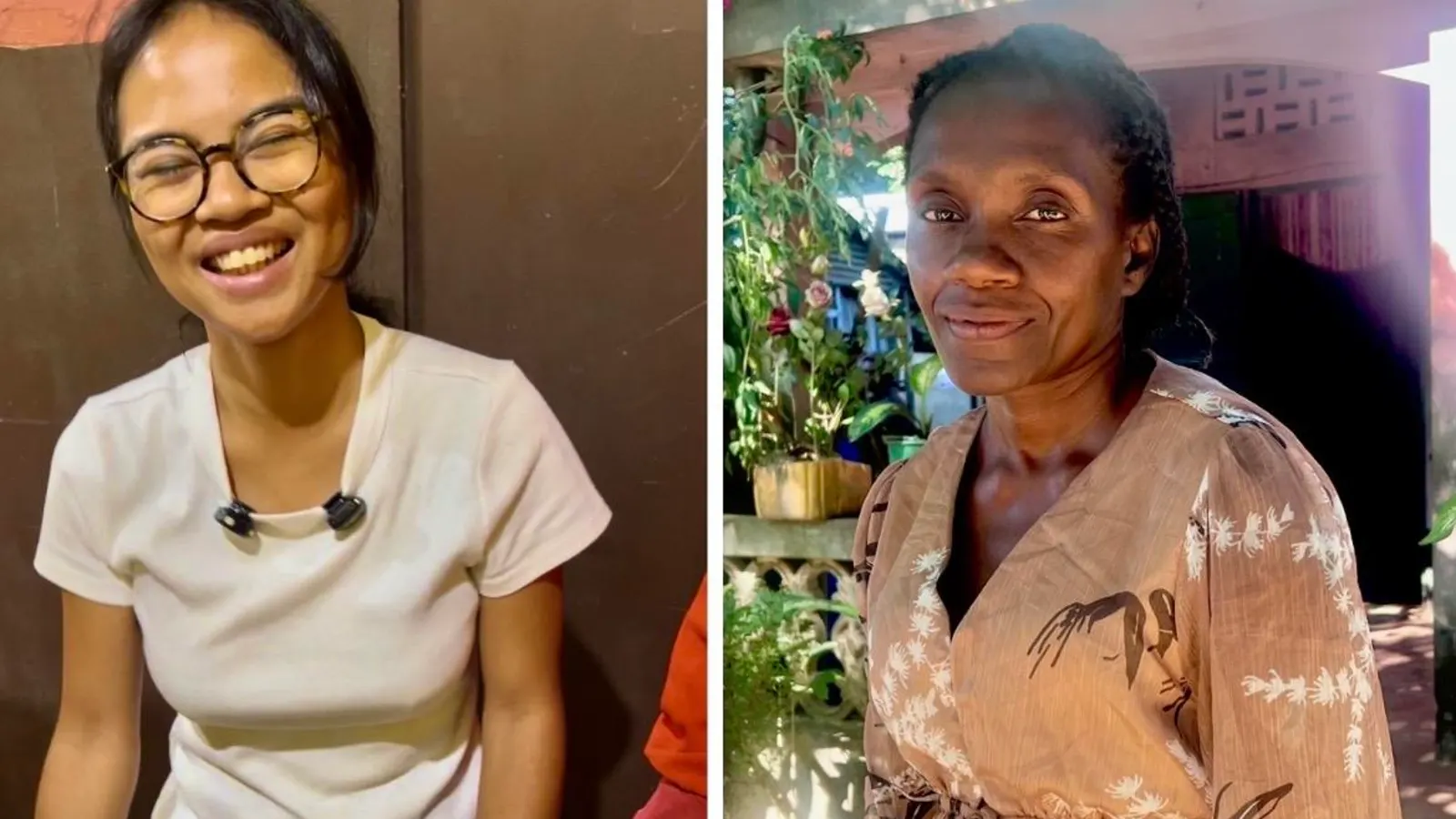

Beyond Good Head Chocolate Maker Sariaka Andrianarivo (left) and CSM Cocoa Cooperative Vice President Latifa Said (right)
photo by author
The US chocolate industry is far removed from the primary ingredient that makes its chocolate what it is: cocoa.
Consumers rarely realize that cocoa is a tropical plant that requires laborious amounts of work to retrieve the fruity beans inside which are eventually processed into chocolate. But perhaps it’s not the consumer’s fault given the companies they are purchasing that chocolate from also rarely know where it comes from.
As the most accessible US chocolate company that makes its chocolate at the source, Beyond Good removes that distance. Its chocolate factory was built near the farms it partners with that grow its cocoa. The cocoa beans are not exported to be made into chocolate somewhere else. The factory and the farms have direct partnerships, making Beyond Good’s chocolate the most traceable chocolate in the country that’s available for average consumers to purchase across the country.
Beyond Good doesn’t just buy cocoa and vanilla. It forms relationships to better the lives of its farmers, and makes better chocolate and vanilla products because of it.
Beyond Good recently released a new line of chocolate called ‘Microbatch,’ its ultra-premium chocolate line, highlighted by the shimmering gold on its packaging, rooted in the work of two Malagasy women who represent a most dignified business model in the shadow of a global chocolate industry often met with corruption.
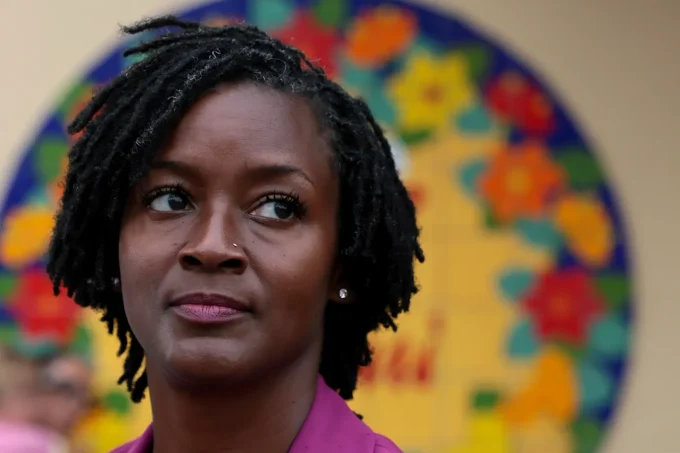
Latifa Said is the Vice President of her cocoa cooperative. Beyond Good founder and CEO Tim McCollum specifically chose Latifa’s cocoa farm to be a main source of cocoa for the company’s Microbatch line. “When we had the idea for Microbatch, we zeroed in on who would be the best cooperative to work with. It was her,” McCollum tells me. “Who would’ve thought that the origin of the world’s best chocolate starts with this woman?”
More than anything, it’s the reliability that makes Latifa’s cocoa so revered. Once her beans are harvested from the pod, fermented and dried, instead of getting shipped to a global cocoa broker as is standard, they are driven on a truck from Northeastern Madagascar to its capital city of Antananarivo.
That’s where the beans meet Sariaka Andrianarivo, Beyond Good’s Head Chocolate Maker. After several years of getting accustomed to many different cocoa farmers, Sariaka knew exactly whose cocoa she wanted to highlight in the Microbatch, eventually forging this stately duo transforming what chocolate can be.
“Traceability is our business model,” McCollum says.
Beyond Good’s Microbatch Line
Beyond Good
Beyond Beyond Good
Beyond Good’s Microbatch launched in 2025 as its most premium offering, intentionally sold only in a select number of curated retailers. The line is a reflection of the company’s commitment to constantly striving to make the highest-quality chocolate possible, rooted in traceability. Each bar bears the number of the batch that it came from, making each bar a true novelty–when it sells out, there will never be an exact iteration of that batch again.
The manufacturing capabilities of the Microbatch are limited, so no matter how tempting it may be for Beyond Good to expand the line, it will always be reigned in to maintain its exclusivity.
“Our north star is that we just want to make the best chocolate we know how to make,” McCollum says. “That’s our Microbatch.”
The line is made, as the name suggests, in small batches in a much slower manner than its standard line. The cocoa beans have a lighter roast that helps the final product achieve a smoother melt and mouthfeel.
Microbatch consists of both Uganda and Madagascar cacao with several different inclusions: Rum Raisin, Vanilla Bean, Candied Ginger and Sea Salt & Nibs.
The Vanilla Bean variety uses Beyond Good’s vanilla caviar–the beans scraped from inside the pod, creating the slightest crunch throughout the smooth chocolate, blending two of Madagascar’s prized crops in one bite. “Typically in craft chocolate, people don’t use vanilla because it has a reputation that it masks imperfections in the cocoa,” McCollum explains. “But we have access to the best vanilla in the world. This brings together the vanilla and chocolate sides of the business in a very special way.”
The Rum Raisin Microbatch is made of cacao from Uganda, which has less fruity tasting and more classic brownie notes than Madagascar, which the Beyond Good team felt would be a better complement to that flavor, an ode to Rum Raisin being the most popular ice cream flavor in Madagascar. The pillowy raisins add a chewy textural moment as the chocolate begins to softly melt in the mouth. Beyond Good is currently building out a new factory in East Africa to make this bar closer to the source too.
But for the other three, when deliberating where to source cacao from for this ultra-premium chocolate line, they knew there was one person whose cocoa they wanted to promote to Microbatch.
Latifa Said
photo by author
Latifa Said, Cocoa Farmer And CSM Cooperative Vice President
Latifa Said has been farming cocoa her whole life. She learned from her grandparents.
“It’s important for me to keep my family’s tradition alive,” she tells me, translated from Malagasy.
She is the Vice President of the CSM cocoa cooperative in a village near Antsiranana, part of Madagascar’s cocoa country, that lives 100% off of subsistence farming.
Beyond Good can rely on the consistency of Latifa’s cooperative, increasing its traceability.
Cocoa drying platform in Latifa’s village
photo by author
“With wet [raw] cocoa, every farmer dumps their cocoa in a scale, there’s no transaction, no paperwork, cash on the spot,”says McCollum. “You lose traceability and you start to lose control of the quality.”
The CSM cooperative is unique because they are not only cocoa farmers, they also process the raw Criollo cocoa to make it ‘dry,’ fully ready for the chocolate making process. Beyond Good puts more responsibility on its farmer partners than most, not through charity, but through opportunity.
“From day one, we always wanted the farmers to do the fermentation and drying…we want people who are cocoa entrepreneurs, not cocoa farmers,” McCollum says. “We want to provide an opportunity for people to go out and earn it themselves.”
Latifa is able to increase the value of her cocoa by processing it from wet to dry. Farmers who work with Latifa’s co-op are required to learn the skills of fermenting and drying cocoa.
“Before the cooperative, I only sold wet cocoa,” Latifa says. “I make more money now that I make a more valuable product with dry cocoa.”
McCollum recounts the so-called ‘Purple Scare’ several years back in Madagascar, which upended the premium cocoa supply.
Latifa’s cocoa storage room that helped her survive the Purple Scare
photo by author
“A few years ago, they had the coldest winter they’ve ever had in the cocoa region, and you couldn’t hit temperatures hot enough to get the fermentation we need to get the flavor we want,” McCollum explains. “Latifa took it upon herself to build an enclosed fermentation box with cement walls off the bottom–the others are all open-air. When we couldn’t get fermentation to the right quality elsewhere, we noticed there was one cooperative and one woman leading it who was nailing the quality. That was Latifa.”
It wasn’t that she was particularly preparing for the Purple Scare, which was an unexpected climate event. This is just how Latifa runs the cooperative, making her business extremely resilient, particularly during such uncertainties.
“Most cultivators and harvesters are male,” Latifa says “As a woman you’re expected to be in the kitchen and stay in the house. I want to encourage those who want to try. I like being the leader of the cooperative because I like to train others and pass on knowledge.“
Latifa has since built more homes for her community and has been able to enroll her young son in private school, which just a few years ago was not possible. Other cocoa farmers have seen the relationship she has formed with Beyond Good, and they have since become partners as well.
“I prefer working with Beyond Good because I like knowing who is buying my cocoa,” Latifa says. “Cocoa has given me wealth.”
Sariaka Andrianarivo
photo by author
Sariaka Andrianarivo, Head Chocolate Maker at Beyond Good
Despite living her whole life in Madagascar, Sariaka Andrianarivo had no relationship with cocoa prior to joining Beyond Good. Cocoa and vanilla are simply exports of Madagascar for people to make money, they are not a significant part of its everyday culture.
As a college student studying chemistry, Sariaka needed a job and was able to land an entry-level position at Beyond Good’s chocolate factory. She didn’t know the first thing about making chocolate.
“I spent months in the factory learning from the people working there how to make chocolate, just by working, by doing, and mostly by tasting every batch.” Sariaka tells me. “We tasted, tasted, tasted until we got it right.”
In just a few years, Sariaka now has the most stripes on her white coat–she is the most senior chocolate maker at Beyond Good.
“From the moment cocoa is harvested until it’s made into chocolate, we’re not just transforming food, there’s a whole science behind it–the fermentation, the roasting, the conching, the way we play with temperature and time,” she explains. “I love it. There’s so much to learn and it’s never boring.”
Roasted cocoa mixed with cocoa butter
photo by author
Sariaka and Latifa work hand-in-hand to produce Beyond Good’s Microbatch to the highest quality it can be–part of that quality stems from traceability. Without knowing your farmers, traceability becomes limited.
“When I first went to meet the farmers, I started making the link between the raw material and the chocolate, and somehow it all made sense…traceability,” Sariaka says. “It makes my life easier to know my farmers. Most people just get the cocoa and it’s either good or bad, and they have to do something with it. They have no choice. I do have the choice, and that’s very precious to me.”
When filmmakers produce a movie, they often say not to rely on post-production if there’s something you can fix during the production process. It’s the same with chocolate, and that’s why Beyond Good’s chocolate tastes different.
“There are only a few leverages we can pull to make differences–the temperature of the roast, the duration,” Sariaka explains. “You have to know your cocoa first–moisture content, the uniformity, the size.”
That is traceability. That is Beyond Good’s superpower.
Beyond Good chocolate bars ready to be packaged
photo by author
Sariaka’s favorite Microbatch bar is the 72% Cocoa Candied Ginger bar, and her favorite part of making chocolate is the roasting process. “That’s when you start to get a sense of how the chocolate is going to turn out,” she says with a smile on her face.
Sariaka traveled to New York for the first time in 2025, watching customers at Whole Foods Market try samples of the chocolate she works to produce every day. “That was the very first time I saw real people, real humans, buying our chocolate and tasting it,” she says. “When I make chocolate, it’s gone once it goes into a container. But when I saw that, I was like, ‘oh, this is for real.’”
Latifa recently took a trip herself to the Beyond Good’s chocolate factory–not only getting the chocolate makers out to the farm, but getting the farmers out to the factory so they can witness what happens to their cocoa once it leaves their possession, making it not just traceable for the final consumer, but traceable for everyone involved in the supply chain.
“We are bringing farmers to the factory so they can actually see what happens with their cocoa. It builds more pride and also a relationship,” McCollum says. “Something very important to us as a company and to the farmer is loyalty.”
Latifa and Sariaka meeting at Beyond Good’s chocolate factory
Beyond Good











Leave a comment