


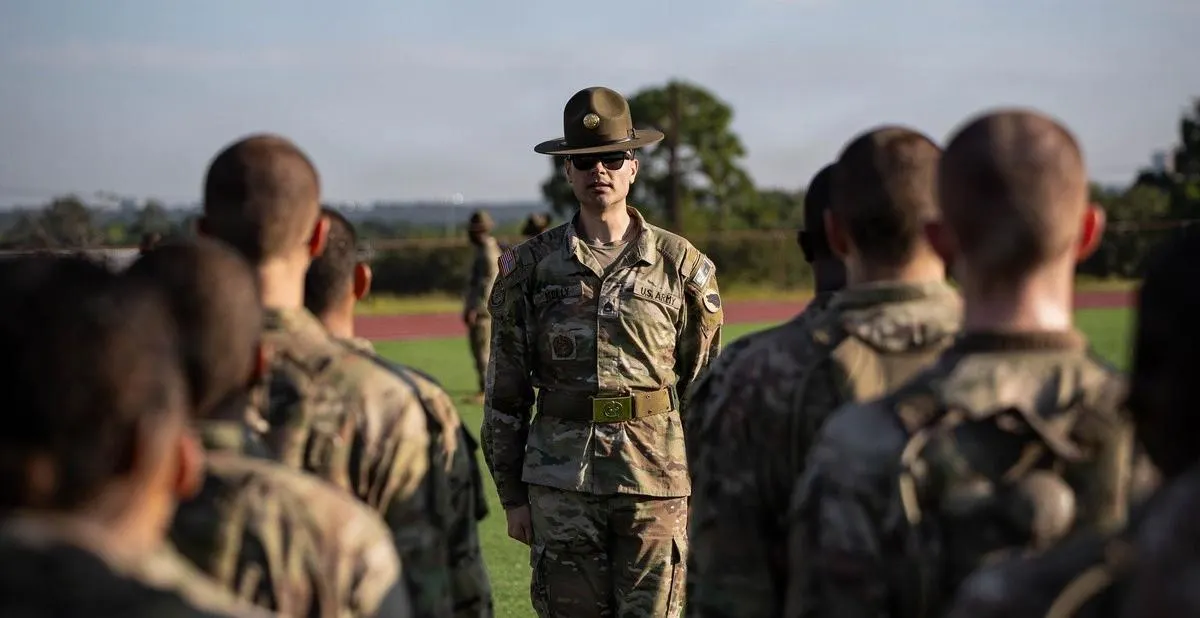

U.S. Army Reserve Staff Sgt. Joseph Kelly, a drill sergeant assigned to the 104th Training Division, instructs trainees on drill and ceremony during the U.S. Army Drill Sergeant of the Year Competition 2026 at Fort Jackson, S.C., Sept. 14, 2026
(U.S. Army Photo by 1st Lt. Jachin Bales)
In the United States Army, a sergeant is a non-commissioned officer who ranks above a corporal and typically leads a small military or police unit. It is a mid-level tier of enlisted personnel acting as a direct first-line leader for junior troops. As an “E-5,” it is also the fifth enlisted pay grade and represents the first official tier of NCOs.
An SGT, who is denoted by the wearing of three chevrons on his/her uniform, is responsible for training soldiers, maintaining discipline, and leading teams or squads in the field.
This month, the U.S. Army initiated a new policy that will see some of its sergeants promoted up a grade to “staff sergeants” upon completion of the Drill Sergeant Course. In addition, sergeants who were currently serving in the drill sergeant position and meet the requirements will also receive the promotion, the service acknowledged.
Promotion Policy
The U.S. Army explained that the new policy is meant to combine the new drill sergeant promotion authority with that of an existing authority where recruiters were promoted from the rank of sergeants to staff sergeants (E-6) upon completion of the Army Recruiting Course. The new policy is meant to promote qualified NCOs, recognizing the “critical role” that these soldiers play in shaping the enlisted force.
“Drill sergeants are the backbone of the force and make a lasting impact on every enlisted Soldier’s career,” said Command Sgt. Maj. Joseph Wilson, U.S. Army Recruiting Command, in a U.S. Army statement on Friday. “Many of us who served for 10, 15, or 20 years or more always remember the drill sergeants who helped us to become ready and lethal members of the U.S. Army.”
The service further acknowledged that drill sergeants maintain immense responsibility, which requires “the utmost maturity and professionalism.” The new policy will further ensure U.S. Army’s newest drill sergeants are expediently promoted to the grade and rank in which they serve. That is meant to “incentivize the best sergeants” in the service to volunteer for one of the service’s greatest and most rewarding leadership challenges, the Army suggested.
Other promotions are also forthcoming.
Earlier this week, the Army announced that it was enabling a “merit-based promotion” of eligible sergeants first class to master sergeants with a follow-on lateral appointment to first sergeant. Battalion Commanders in the Army can formally recommend that sergeants first class (SFC, E-7) are promoted to master sergeant (MSG, E-8).
“We are empowering leaders to endorse high-performing E-7s who stepped up and committed to taking on the hardest working grade plate in the Army: first sergeant,” said Sgt. Maj. of the Army Michael Weimer. “This program is about merit—plain and simple—ensuring qualified, dedicated Soldiers serving in these positions receive the credit and compensation that matches their level of responsibility.”
The Army Human Resources Command’s commanding general will make final promotion decisions.
The Evolving Role Of The Sergeant
The rank of sergeant traces its origin back to the Middle Ages, when sergeants were a servant or military attendant to a knight. The word comes from Anglo-French “sergent” or “serjeant,” which meant “servant” or “attendant,” and was derived from the Latin word “serviens,” meaning “serving.”
Within medieval feudal armies, a sergeant was a professional soldier who ranked just below that of a knight and was considered to have the military value of a knight. They typically fought as heavy or light cavalry or as trained infantry. Within orders such as the Knights Templar, a “sergeant” was also a non-noble member who handled fighting, labor and even equipment maintenance.
During the 16th and 17th centuries, European armies adopted the sergeant as a formal rank for non-commissioned officers, and it was their job to maintain unit discipline and to ensure soldiers executed a captain’s orders. When the Continental Army and Marine Corps were formed in 1775 during the American Revolution, the British sergeant rank structure was adopted, and Prussian General Baron Friedrich Wilhelm von Steuben, who aided in transforming the ragtag Continental Army into a disciplined and professional force, later standardized sergeant duties in the Continental Army.
Over time, the rank of sergeant was expanded into multiple grades – typically E-5 through E-9 in the modern U.S. Army – including specialized positions, such as staff sergeants and drill sergeants. In the 20th century, the U.S. military created the senior enlisted post that included the Sergeant Major of the Army, who represented the enlisted force to military leadership.
A Duty, Not A Rank
Although the term “drill sergeant” is often used, it is actually a duty position and qualification, not a military rank. It is the NCO who transforms civilian volunteers into disciplined, combat-ready soldiers during basic training. Drill sergeants instruct recruits on fundamental skills, including rifle marksmanship, physical fitness, first aid, and military ceremonies.
In addition, a drill sergeant acts as both a coach and mentor to recruits, instilling mental resilience, military bearing, and the core values of the armed forces. In the U.S. Army, soldiers who already hold the rank of sergeant (E-5) can volunteer and attend Drill Sergeant Academy. Under the new policy, qualified sergeants who complete the drill sergeant course are automatically promoted to staff sergeant.
















Leave a comment