


Topline
President Donald Trump on Saturday said he will create an “AI Force” and appoint an “AI Czar” to monitor bad actors in the artificial intelligence sector as fears about the enterprising technology continue to grow in and outside the industry.
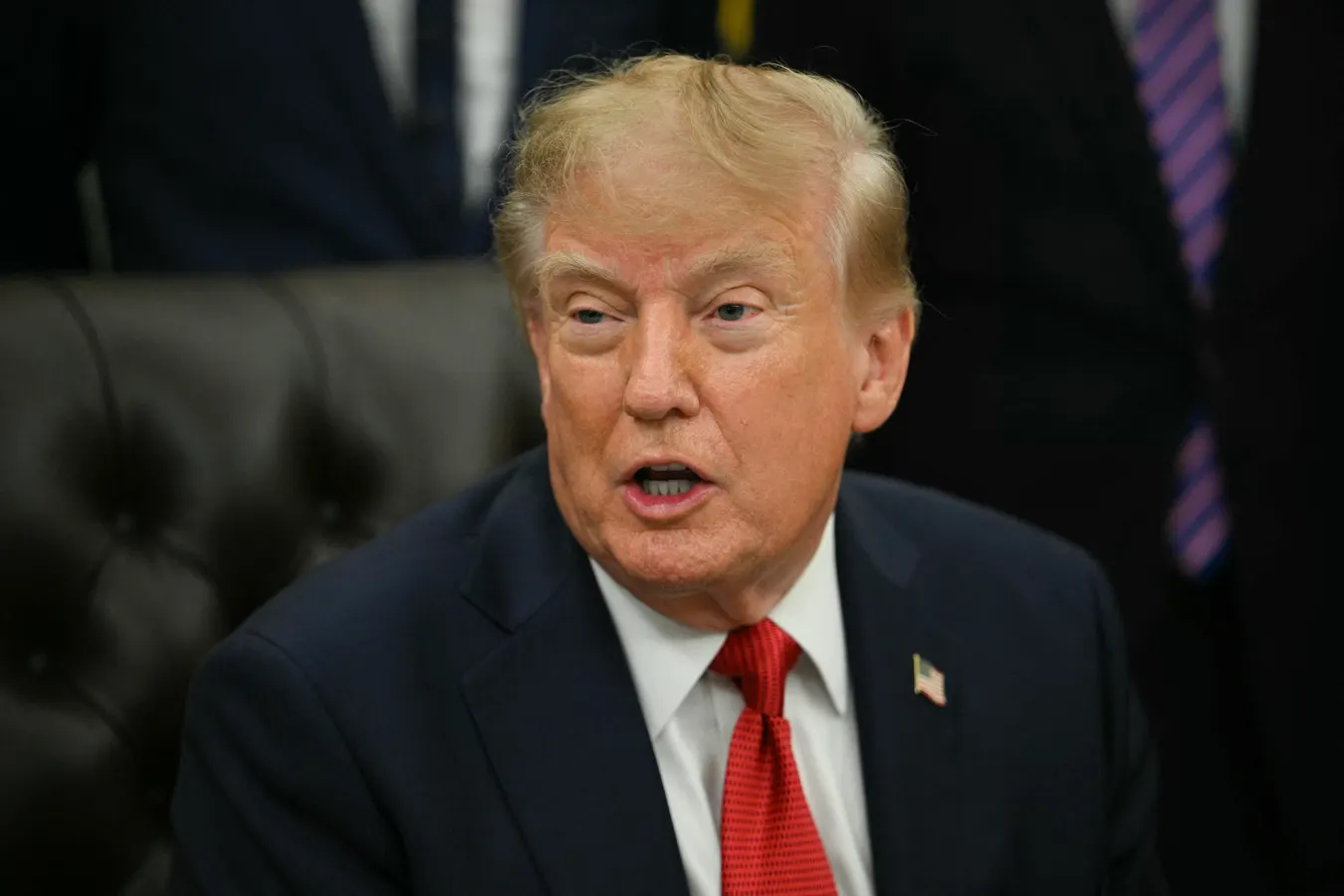
US President Donald Trump in the White House on Sept. 18, 2026.
AFP via Getty Images
Key Facts
Trump, who has brushed off concerns over rapidly evolving AI frontier models as a “hoax,” said the new agency will not “hinder or stifle the Growth” of the AI industry but “cherish it, help it, and watch over it, as it grows!”
Trump has consistently opposed federal guardrails and dismissed AI safety concerns and, short of regulating the tech, it’s unclear what actual authority or operational purpose the “AI Force” will serve.
He said the new agency will be much like Space Force, an addition to the U.S. military he established during his first term, and that the AI Force will be used to look for “BAD” in the industry through the existing criminal justice system.
Trump didn’t indicate who the nation’s new “AI Czar” may be but Silicon Valley supporters who share his anti-regulatory vision for AI include venture capitalist David Sacks and billionaires Marc Andreessen and Ben Horowitz.
The announcement comes after dire warnings from industry insiders and AI company CEOs, who’ve said the technology is outpacing their ability to understand and control it, and many leaders have called for an intentional slowdown to allow regulatory agencies to develop safeguards.
Trump and contrarian industry leaders have said slowing down would be akin to giving up America’s competitive advantage and allowing China to pull ahead in the AI race.
CRUCIAL QUOTE
“We are leading China, and the rest of the World, and I intend to keep it that way!” Trump wrote on Truth Social.
WHAT WE DON’T KNOW
How the AI Force will operate, or how it will be funded. The White House has not yet clarified whether it is an independent branch of government, an interagency task force or an advisory commission. There have also been no details revealed regarding congressional funding, legislative authorization or leadership.
Key background
Former and current employees of AI companies have, for weeks, warned of a dire turning point with the technology. Jacob Coxon, a former Anthropic & OpenAI researcher, said developers “earnestly believe that it could kill us all by the end of the decade” and Evan Hubinger, an Anthropic employee, said he estimates a greater than 10% chance of human extinction from unaligned AI within the next 10 years. After those warnings, Anthropic CEO Dario Amodei penned an essay titled “We Must Pace the Frontier” and said safety guardrails and regulations aren’t keeping pace with the rapid development of AI—and joined others in issuing a warning of “catastrophic damage.” He called on competitors to build AI at a “balanced rate” to make time for the establishment of common safety standards. Sam Altman and Elon Musk, who lead two of the world’s biggest AI companies, echoed his call but others, including Trump, have rebelled against it. Trump has firmly rejected calls to slow down development and has said while he isn’t worried about AI causing human extinction, he does have concerns “that if we don’t win AI, we’re going to be put in a very bad position.” Nvidia CEO Jensen Huang and PCAST co-chair David Sacks have also said they don’t agree with a deliberate slowdown of development.
TANGENT
The government already has a handful of task forces and advisory boards focused on AI. There’s a task force within the Department of Justice explicitly charged with litigating against state-level AI regulations, arguing the guardrails violate the Commerce Clause or conflict with a unified federal push for “minimally burdensome” AI oversight. An AI Cybersecurity Clearinghouse, created in June, is an interagency framework meant to act as a bridge between the federal government and the private-sector to coordinate threat mitigation and defensive AI tool deployment. The NSA oversees a team called the Federal “Frontier Model” Benchmarking & Advisory Group, also created in June, and the White House runs AI coordination out of the White House Office of Science and Technology Policy, which focuses on data center permitting, AI exports and procurement deregulation. The Department of Energy and Defense Department also operate project-specific AI boards.
SURPRISING FACT
Trump on Saturday morning asked followers to pick a new name for artificial intelligence, which he said is an “inaccurate, and very ineloquent” name for the technology. He proposed three “far more elegant and accurate” names and asked his Truth Social followers to vote on which they prefer: “superior intelligence,” “extreme intelligence” or “supreme intelligence.”












Leave a comment