


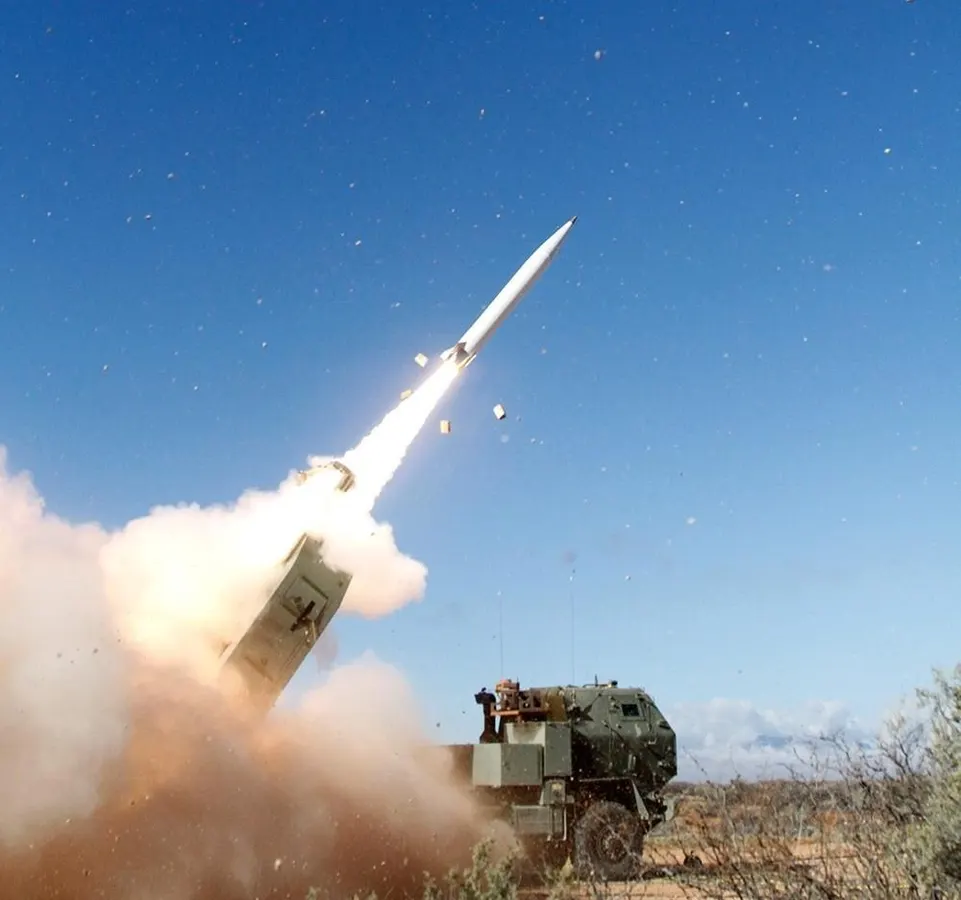

The PrSM is the next-generation, long-range precision-strike missile delivering critical capabilities to attack, neutralize, suppress, and destroy targets, supporting successful mission execution via combined Joint All-Domain Operations. (Official U.S. Army photo) (Darrell Ames)
(Official U.S. Army photo) (Darrell Ames)
The United States Army’s M142 High Mobility Artillery Rocket System, more commonly known as the HIMARS, has proved to be a game changer for Ukraine. The vehicle can “shoot and scoot” at enemy targets, meaning it launches its rockets and is already on the move before an adversary can return fire.
In Ukraine, the HIMARS has fired the legacy MGM-140 ATACMS, which offers a range of approximately 190 miles (300 km). Yet, the U.S. Army has sought to increase the firepower of the mobile launchers with the Precision Strike Missile, or PrSM. The next-generation, long-range surface-to-surface ballistic missile offers a range of more than 310 miles (500 km), but its most recent version can also strike mobile targets.
Besides being compatible with the M142 HIMARS, the PrSM can be launched from the M270 Multiple Launch System, the U.S. military’s armored, self-propelled, tracked mobile artillery system.
PrSM Increment 2 Contract
This week, the U.S. Army awarded a Precision Strike Missile Increment 2 indefinite‑delivery, indefinite‑quantity contract valued at up to $1.2 billion to Lockheed Martin Missiles and Fire Control, Grand Prairie, TX. It follows a fiscal year 2026 flight campaign that validated the PrSM Inc 2’s performance, in which the missile was fired at moving maritime and “relocatable” land targets.
The new contract award will move PrSM Inc 2 from development and flight testing into production, with work being conducted at Lockheed Martin facilities and across the aerospace and defense giant’s U.S. industrial base.
“This award marks an important step in delivering PrSM Increment 2 to the warfighter,” said Dave Griser, vice president, Precision Fires Launchers and Missile, Lockheed Martin, in a media statement. “We’re ready to move from flight testing into production and provide the Army with an expanded long-range precision fires capability.”
The company didn’t disclose how many missiles are in the current contract.
However, an indefinite-delivery/indefinite-quantity, or IDIQ, contract is a flexible ordering mechanism used when the exact times or quantities of supplies/services are not known at the time of the initial award. An IDIQ contract further allows the government to issue individual task or delivery orders over a set period.
Multiple Increments For The Multiple Launch Systems
The upgraded PrSM Inc 2 is part of the U.S. Army’s ongoing investment in long-range precision capabilities. It features advanced multi-mode seeker technologies and options for fire formations.
The Inc 2 builds on the early Increment 1 baseline variant, which was focused on stationary targets. That version of the PrSM is already in service with the U.S. military and the Australian Army, and it saw its combat debut earlier this year, when it was used in Operation Epic Fury to target positions in Iran.
“In a historic first, long-range Precision Strike Missiles (PrSMs) were used in combat during Operation Epic Fury, providing an unrivaled deep strike capability,” U.S. Central Command announced in a post on X in March.
Beyond the PrSM Inc 2, planned upgrades call for the development of modular payloads including submunitions, loitering munitions and miniature glide variants, and a further range increase up to 620 miles (1,000 km).
The PrSM offers several other advantages over the ATACMS, including that two missiles are carried in each launch pod, doubling the magazine capacity of the legacy pod. The PrSM further employs an advanced GPS-aided inertial navigation system that allows it to effectively reach a target even in heavily jammed environments.














Leave a comment